
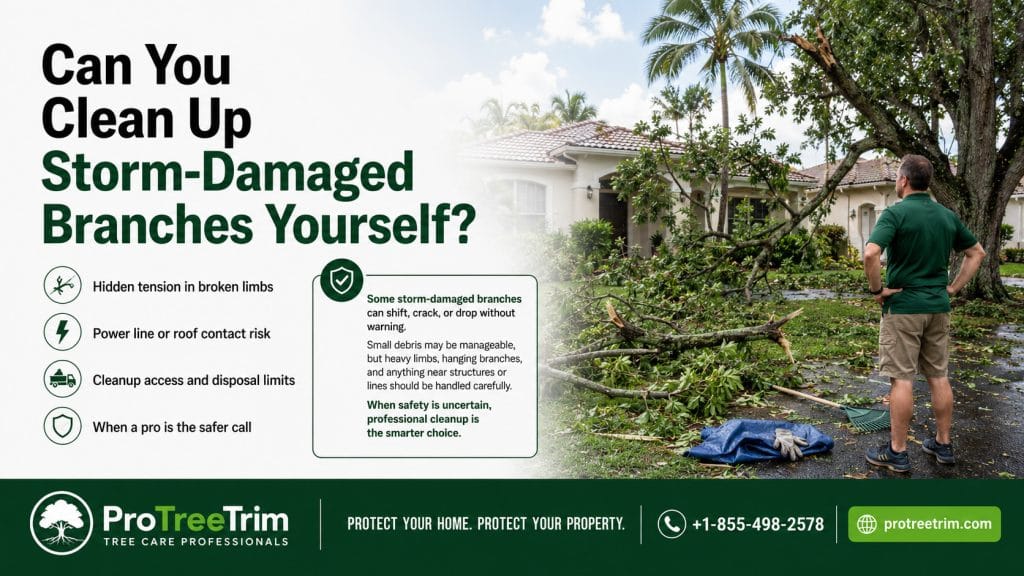
Some storm-damaged branches can be cleaned up by a Florida homeowner, but only when they are small, loose, and already on the ground. The line changes fast when a branch is heavy, cracked, hanging, resting on a roof, tangled in another tree, or near power lines. Before grabbing a saw, look at what the branch is touching and what could move.
Start With the Branch, Not the Mess
After a storm, the yard may look worse than it is. Leaves, palm fronds, twigs, and small branches can cover the lawn, driveway, pool deck, or mulch beds. That kind of cleanup may be manageable once conditions are safe.
The risky part is storm wood that still has weight, tension, or height. A branch resting on a fence may spring or roll when cut. A limb hanging over a driveway may drop without warning. A branch pinned under another limb can shift the moment pressure is released. Wet oak limbs and palm fronds can also be heavier than they look from the patio.
Do not judge only by size. A medium branch leaning against a pool cage, gutter, vehicle, or screen enclosure can cause more damage during removal than a larger branch lying flat in open grass.
| What you see | Usually safe for DIY? | Better next step |
|---|---|---|
| Small loose twigs on lawn | Yes | Clean up when safe |
| Palm fronds lying flat on open ground | Often | Wear gloves and watch for sharp edges |
| Branch resting on fence or pool cage | No | Avoid pulling or cutting casually |
| Limb hanging overhead | No | Keep people away from the area |
| Branch touching roof or gutter | No | Document and get proper help |
| Any debris near power lines | No | Stay back and contact the utility |
| Large limb under pressure | No | Do not cut without the right equipment |
What Florida Homeowners Often Miss
The biggest mistake is trying to “just make a quick cut.” Storm-damaged branches are rarely sitting in a normal position. They may be twisted, compressed, or partly supported by another branch. Once cut, the limb can swing toward a window, roll across pavers, tear a screen panel, or drop onto irrigation heads.
Florida yards make this more complicated. Many homes have narrow side yards, pool cages, paver walkways, fences, outdoor kitchens, and sprinkler systems packed close to trees. A branch may look like yard debris, but it may also be pressing against a gate, roof edge, pool equipment, or landscape lighting wire.
Before moving anything large, take photos. Show the whole branch, where it landed, the tree it came from, and anything it touched. If there is damage to pavers, gutters, screens, fencing, irrigation, or landscaping, photograph that separately before cleanup changes the scene.
Small cleanup is fine when it is truly small. Heavy cutting, overhead work, ladder work, roofline work, and utility-adjacent debris should not become a weekend experiment.
Know When Cleanup Is Really Tree Work
If a branch fell from a tree that still has cracked limbs overhead, the cleanup is not finished when the ground debris is gone. Look back at the tree. Is there a torn limb stub? A fresh trunk wound? A split where the branch was attached? Is one side of the canopy now much heavier than the other?
A fallen limb can be a one-time storm break, or it can be a clue that the tree has a larger problem. That is especially true with older oaks, trees near driveways, palms leaning toward rooflines, or trees growing in wet, soft, or recently disturbed soil.
If you are unsure whether storm-damaged branches, hanging limbs, or cleanup around a roof, pool cage, fence, or driveway needs professional attention, ProTreeTrim can help connect Florida homeowners with local tree service support. Call +1-855-498-2578 or visit protreetrim.com.
FAQs
What storm branches can I clean up myself?
Small, loose branches already on the ground are usually the safest to clean up DIY. Avoid anything heavy, overhead, pinned, or touching a structure.
Can I use a chainsaw on a fallen limb?
Only if you are trained, and the limb is not under pressure, overhead, or resting on something valuable. Many storm limbs shift once cut.
Should I photograph branches before cleanup?
Yes, especially if they damaged a roof, pool cage, fence, driveway, pavers, irrigation, or landscaping.
ProTreeTrim™ can help you take the next step.
If you are dealing with a damaged tree, fallen branch, stump, root issue, palm concern, or storm cleanup question in Florida, call ProTreeTrim for tree service support.