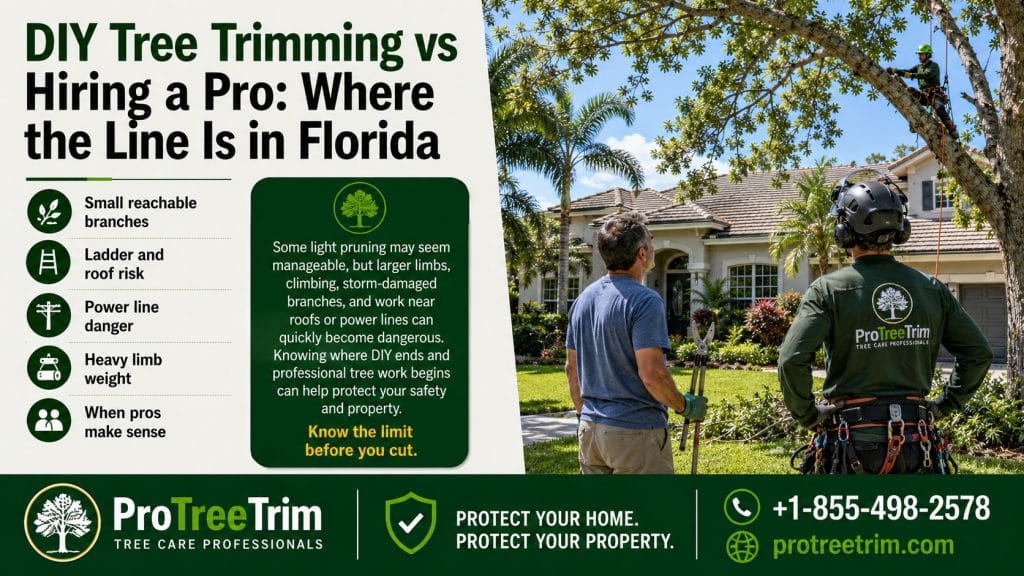
Some light tree cleanup is reasonable for Florida homeowners, but the line moves quickly once height, weight, tools, roofs, palms, or power lines are involved. Small loose branches on the ground are different from a heavy oak limb over a pool cage or a palm frond hanging near the roofline.
What Homeowners Can Usually Handle
A homeowner can often handle small, reachable cleanup: picking up fallen twigs, removing light palm debris from the lawn, or using hand pruners on small branches at shoulder height. The work should be done from the ground, with basic eye and hand protection, and without leaning a ladder into the tree.
The trouble starts when the branch has weight, tension, height, or an awkward landing zone. A limb resting on a fence, roof edge, gutter, pool screen, or another branch can move suddenly once cut. Florida yards also add tight working conditions: pavers underfoot, irrigation heads hidden in mulch, sandy soil after rain, and narrow side yards where a falling limb has nowhere clean to land.
| Situation | Usually DIY? | Better choice |
|---|---|---|
| Small fallen twigs or palm debris on open lawn | Yes | Clean up when safe |
| Small reachable branch with hand pruners | Sometimes | Cut carefully from the ground |
| Large limb over roof, driveway, pool cage, or fence | No | Call a tree crew |
| Any trimming near overhead power lines | No | Contact the utility or qualified help |
| Storm-damaged tree with cracked or hanging limbs | No | Get professional assessment |
| Palm trimming above head height | No | Use trained tree service support |
Where the Pro Line Begins
Do not climb a tree to prune it. Broward County’s tree pruning guidance says homeowners should never climb a tree to prune limbs or attempt pruning near overhead power lines. It also advises proper pruning cuts outside the branch collar and warns against leaving branch stubs.
Power lines are the clearest stop sign. UF/IFAS guidance says homeowners and others without electrical hazard training should leave utility-line pruning to line-clearance tree workers, and not prune within 10 feet of a utility conductor without appropriate training. OSHA also describes line-clearance tree trimmers as specially trained workers for work within 10 feet of energized power lines and equipment.
Large pruning is another place to slow down. ISA’s TreesAreGood homeowner guidance notes that pruning or removing trees, especially large trees, can be dangerous work and should be done by people trained and equipped to work safely in trees.
For Florida homeowners, the practical rule is simple: if the job requires a ladder, chainsaw, roof access, rope work, bucket truck, climbing, or cutting near a structure, it is probably not a casual weekend task.
If you are unsure whether a tree, palm, stump, or root issue is safe to handle yourself, ProTreeTrim can help connect Florida homeowners with local tree service support. Call +1-855-498-2578 or visit protreetrim.com.
FAQs
Can I trim small branches myself?
Often, yes, if they are small, reachable from the ground, and not near power lines, roofs, fences, or pool screens.
Is palm trimming safe for homeowners?
Light cleanup from the ground may be fine. Overhead palm fronds, tall trunks, and roof-adjacent palms are better left to trained crews.
Should I use a ladder for tree trimming?
Avoid it. Once a ladder is involved, the risk of falls, shifting branches, and bad cuts increases quickly.
ProTreeTrim™ can help you take the next step.
If you are dealing with a damaged tree, fallen branch, stump, root issue, palm concern, or storm cleanup question in Florida, call ProTreeTrim for tree service support.