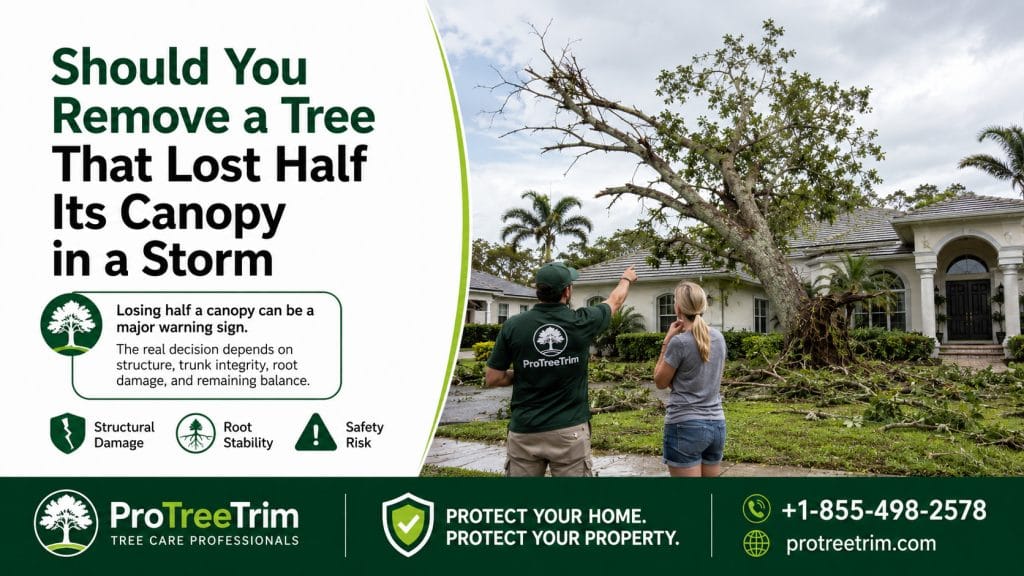
A tree that lost half its canopy in a storm does not always need to be removed, but it should be examined carefully. The missing branches may leave the tree unbalanced, expose old wounds, or reveal trunk and root problems that were not obvious before. In a Florida yard, the decision depends on structure, location, and what remains overhead.
Canopy Loss Is Not Just a Looks Problem
After a storm, many homeowners focus on how bad their trees look. A once-full oak may look lopsided. A shade tree may suddenly expose the roof, driveway, or pool cage. A palm may have lost most of its older fronds but still has a living crown.
Appearance matters, but structure matters more.
A tree can sometimes recover from losing smaller outer branches. It becomes more concerning when the lost canopy includes major limbs, large torn wounds, or one entire side of the tree. If the remaining canopy is heavily weighted toward the house, fence, street, or pool enclosure, the tree may now experience stress differently than before the storm.
| What you notice | Why it matters |
|---|---|
| Small outer branches lost | May be manageable with cleanup |
| One large limb tore from trunk | Could leave a serious wound |
| Canopy now heavy on one side | Tree may be more unbalanced |
| Trunk cracked during limb failure | Structural concern increases |
| Roots lifted or soil cracked | Canopy loss may not be the only issue |
| Large limbs still hanging | Cleanup may be urgent |
Look at What the Tree Could Hit Next
The same amount of canopy loss can mean different things depending on location. A damaged tree in an open back corner has more room to fail without hitting much. A damaged tree beside a bedroom, driveway, screened pool enclosure, septic area, fence, or neighbor’s property deserves a more cautious review.
Check the break points. Are they clean, or did the limbs tear bark down the trunk? Are there dark hollow areas inside the broken wood? Did the fallen branches expose decay, old cavities, or weak unions? Do not poke into wounds or cut more limbs just to “even it out.” Poor follow-up pruning can leave the tree worse off.
Take photos before cleanup begins. Include the full tree, missing canopy section, broken limbs, trunk base, root area, and nearby structures. If branches damaged gutters, pavers, irrigation, screens, or fencing, document that separately.
A tree that lost half its canopy may need pruning, monitoring, or removal. The right answer depends on how much living structure remains and whether the tree can safely stand through the next heavy rain or wind event.
If you are unsure whether a storm-damaged tree, palm, stump, or root issue should be removed or evaluated first, ProTreeTrim can help connect Florida homeowners with local tree service support. Call +1-855-498-2578 or visit protreetrim.com.
FAQs
Can a tree survive losing half its canopy?
Sometimes. Survival depends on the tree species, health, wound size, remaining structure, root condition, and future stress.
Should I trim the other side to balance the tree?
Not without guidance. Cutting more limbs can remove a healthy canopy and may create new structural problems.
When is canopy loss more urgent?
It is more urgent if the tree has a cracked trunk, lifted roots, large hanging limbs, or is now weighted toward a roof, driveway, pool cage, or walkway.
ProTreeTrim™ can help you take the next step.
If you are dealing with a damaged tree, fallen branch, stump, root issue, palm concern, or storm cleanup question in Florida, call ProTreeTrim for tree service support.