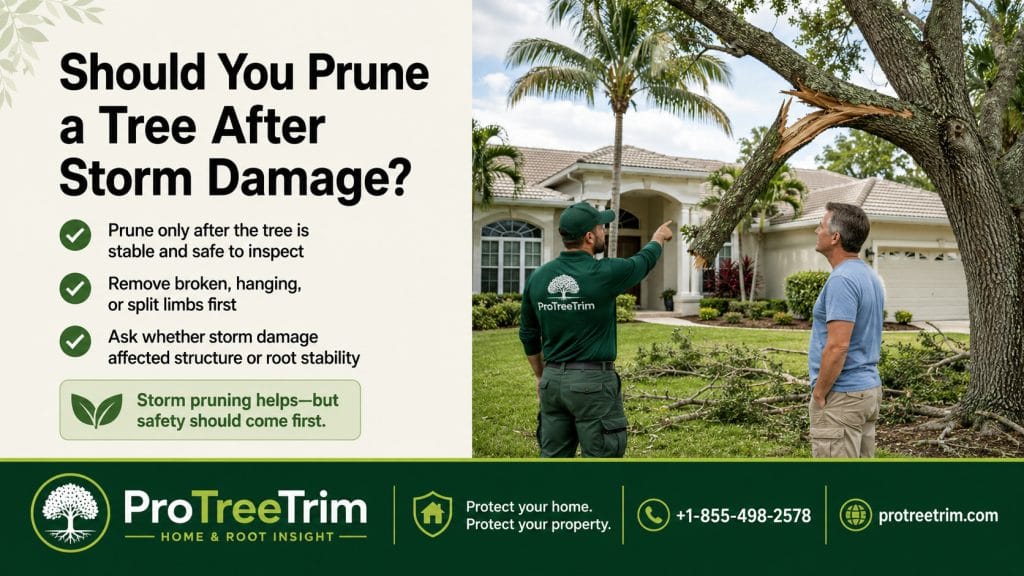
Storm damage can make a tree look worse than it really is. Broken limbs, torn bark, hanging branches, and scattered debris may tempt homeowners to cut everything back quickly. But after a storm, pruning should be done carefully and specifically. The goal is to remove danger and damaged wood without adding more stress to a tree that may already be struggling.
Safety Comes Before Cleanup
Before thinking about pruning, check the scene from a safe distance. Do not stand under hanging limbs. Do not pull branches that are caught in the canopy. Do not touch branches near power lines. Do not climb onto a roof to cut limbs loose.
Storm-damaged branches can be under tension. They may twist, drop, or swing when cut. A limb that looks stuck can release suddenly. That is why many post-storm pruning jobs are more dangerous than routine trimming.
| What you see after a storm | What it may mean |
|---|---|
| Small broken twigs on lawn | Usually routine cleanup |
| Large limb hanging in canopy | Professional removal is safer |
| Branch resting on roof | Check both tree and roof damage |
| Split trunk | More serious than simple pruning |
| Bark torn down the trunk | Needs careful cleanup, not random cutting |
| Tree leaning after storm | Root or soil movement may be involved |
| Branch near utility line | Contact the utility first |
If the tree is touching or close to wires, stop there. That is not a pruning job for a homeowner.
Do Not Cut the Tree Back Hard Just Because It Looks Damaged
A common mistake after storms is over-pruning. The tree looks messy, so homeowners ask for it to be “cleaned up hard.” That can make the tree’s recovery harder.
A storm-damaged tree still needs a live canopy to produce energy. Removing too many healthy branches after the storm can reduce the tree’s ability to recover. The better approach is to remove broken, dead, hanging, or clearly unsafe branches first. Healthy limbs should be kept unless there is a clear reason to remove or reduce them.
Good post-storm pruning is not about making the tree look perfect right away. It is about stabilizing the situation.
What Should Usually Be Removed
Storm pruning often focuses on damaged material that is already broken or likely to fall.
This may include:
- hanging limbs
- cracked branches
- broken stubs
- deadwood over driveways, roofs, pool cages, fences, or walkways
- branches rubbing against the house
- limbs torn but still attached
- small broken branches caught in the canopy
The final cuts should be clean and placed properly. A broken branch should not be left as a long ragged stub. At the same time, it should not be flush-cut against the trunk. Proper cuts near the branch collar matter even after storm damage.
What Should Not Be Removed Too Quickly
Not every branch that looks awkward after a storm needs to come off immediately. Some live branches may still be important to the tree’s structure and recovery. Removing them for appearance alone can create new wounds and reduce the tree’s leaf area.
Be cautious before removing:
| Branch type | Why you may wait |
|---|---|
| Healthy live branches | They help the tree recover |
| Large lower limbs with no damage | Removing them creates big wounds |
| Interior branches | They help balance and shade the canopy |
| Branches that only look uneven | Cosmetic pruning can wait |
| New sprouts after damage | Some may be temporary recovery growth |
The first visit after a storm may be about safety. A second, lighter structural pruning can sometimes be planned later if the tree survives and begins to recover.
Torn Bark Needs Careful Handling
Storms can peel bark when branches split or tear away. Do not rip more bark off to “clean it.” Do not paint the wound. Do not carve the trunk into a smooth shape.
If loose bark is still attached, it may be better left alone unless it creates a ragged hazard or traps moisture badly. Large torn areas, especially on the trunk or major limbs, should be looked at carefully. The tree’s ability to recover depends on how much living tissue remains, where the injury happened, and whether decay or cracking is already present.
A small torn branch is one issue. A long bark tear down the trunk is much more serious.
When the Tree May Not Be Worth Saving
Some storm-damaged trees can recover well. Others are too compromised.
Removal may deserve discussion if the tree has:
- a trunk split deeply into the main stem
- a new lean with lifted soil or exposed roots
- more than one major scaffold limb broken
- a large cavity opened by the storm
- major bark loss around the trunk
- dead limbs over structures
- repeated storm failures in the same tree
- damage near power lines or high-use areas
A tree in open lawn may be given more time than a damaged tree over a bedroom, driveway, pool cage, fence, or walkway. The location changes the decision.
Do Not Forget the Root Zone
Storm damage is not always above ground. Heavy rain and wind can loosen soil, expose roots, or shift the root plate. A tree may lose stability even if the canopy damage looks minor.
After a storm, check the ground around the tree:
- Is soil lifted on one side?
- Are roots newly exposed?
- Is the tree leaning more than before?
- Is the soil soft or cracked?
- Did water sit around the trunk?
- Are pavers, driveway edges, or walkways lifted?
A tree with root movement should not be treated as a simple pruning job.
Document Before Cleanup
Before work begins, take photos if it is safe. Photograph the full tree, broken limbs, trunk base, roofline, driveway, fence, pool cage, walkway, and any damaged property. These photos can help with insurance conversations, contractor estimates, buyer questions, or future comparison.
After work is complete, save the invoice and take after photos. A clear record is especially useful if the tree damaged a roof, gutter, fence, screen enclosure, vehicle, or neighbor-facing area.
A Good Storm-Pruning Scope Is Specific
A responsible post-storm pruning plan should not sound like “cut everything back.” It should name the problem areas.
A better scope might say:
- remove hanging limb over driveway
- clean broken branch back to proper collar cut
- remove deadwood above pool cage
- clear storm-damaged branch from roofline
- inspect split trunk before additional pruning
- leave healthy canopy where possible
That kind of plan protects the property without punishing the tree.
If you are unsure whether a storm-damaged tree needs pruning, removal, or a closer safety review, ProTreeTrim can help connect homeowners with local tree service support. Call +1-855-498-2578 or visit protreetrim.com.
FAQs
Should I prune a tree immediately after storm damage?
Remove or address hazardous broken limbs promptly, especially over roofs, driveways, pool cages, fences, or walkways. Cosmetic pruning can often wait.
Can a storm-damaged tree recover?
Sometimes. Recovery depends on how much canopy was lost, whether the trunk split, whether roots moved, and where the tree stands on the property.
Should I cut healthy branches after a storm to balance the tree?
Not automatically. Removing healthy canopy can add stress. Only cut live branches when there is a clear structural or clearance reason.
When should a storm-damaged tree be removed?
Removal may be needed if the trunk is split, the tree is newly leaning, roots have lifted, major limbs failed, or the tree threatens a house, driveway, pool cage, utility area, or walkway.
ProTreeTrim™ can help you take the next step.
If you are dealing with a damaged tree, fallen branch, stump, root issue, palm concern, or storm cleanup question in Florida, call ProTreeTrim for tree service support.