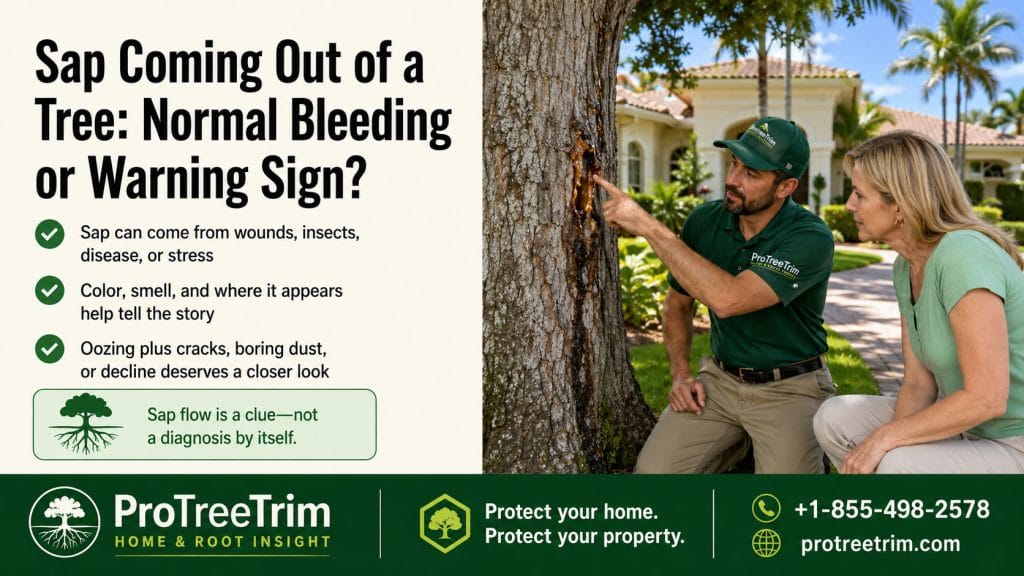
Sap coming out of a tree can be normal, minor, or a warning sign. Some trees naturally bleed sap after pruning, seasonal changes, bark injury, or insect activity. Other times, sap or dark oozing can point to stress, pests, trunk wounds, cankers, decay, root problems, or a declining section of the tree.
The key question is not just “Is sap coming out?”
It is “Where is the sap coming from, what does it look like, and what else is happening to the tree?”
Clear Sap Is Different From Dark Oozing
Not every tree fluid means the same thing. Clear, sticky sap from a small wound may be less concerning than dark, foul-smelling, wet staining from a trunk crack or soft area.
| What you see | What it may suggest |
|---|---|
| Clear sticky sap | Pruning wound, small injury, insect feeding, normal bleeding |
| White or amber resin | Common on some conifers after injury or pest stress |
| Dark staining | Possible stress, canker, wetwood, decay, or trunk injury |
| Foul-smelling ooze | More concerning; internal wood or bacterial activity possible |
| Sap mixed with sawdust | Possible boring insect activity |
| Sap around cracks | Trunk damage or canker concern |
| Sap near dead branches | Decline or old wound may be involved |
| Sap at the tree base | Root flare, decay, or lower trunk concern |
The appearance, smell, and location matter.
Some Trees Naturally Bleed Sap
Certain trees bleed more readily than others, especially after pruning or injury. Sap flow can be noticeable in maples, birches, elms, walnuts, pines, and many other species depending on season and conditions.
Sap may be less concerning when:
- it comes from a small fresh wound
- the canopy looks healthy
- leaves are normal size and color
- the exposed wood is firm
- there is no dark staining
- no sawdust or insect activity is present
- no trunk crack is visible
- the sap stops over time
A small amount of sap from a healthy tree is not always an emergency.
Sap After Pruning
Sap may appear after pruning, especially if the tree is pruned during a period of active sap flow. This can look alarming, but it does not always mean the tree was harmed.
Sap after pruning is usually less concerning when:
- cuts were made correctly
- the branch collar was not damaged
- the cut is not huge
- the tree canopy is healthy
- no bark is peeling around the wound
- no dark ooze develops
- the wound does not expand
- the branch was not torn or ripped
Poor pruning cuts are different. Flush cuts, torn limbs, topping cuts, and large wounds can create longer-term problems.
Sap From a Trunk Wound
Sap coming from a trunk wound deserves attention. The trunk is not the same as a small outer branch. Large wounds on the trunk can expose living tissue, attract insects, and create entry points for decay.
Common trunk-wound causes include:
- mower damage
- string trimmer injury
- vehicle scrape
- storm debris impact
- animal damage
- construction equipment
- bark splitting
- old pruning wounds
- branch tear-out
- sunscald or heat injury
A fresh wound may produce sap as part of the tree’s response. A wound that stays wet, dark, soft, or expanding is more concerning.
Sap With Tiny Holes
Sap around small holes may point to insect feeding, boring activity, sapsucker activity, or old bark wounds. Pattern matters.
Check whether the holes are:
- in neat rows
- scattered randomly
- surrounded by sawdust
- near dead branches
- near peeling bark
- on the lower trunk
- fresh or old
- increasing in number
Neat rows may suggest sapsucker activity. Holes with sawdust-like material or canopy decline may suggest a more serious pest or wood problem.
Sap With Sawdust or Frass
Sap mixed with sawdust-like material is more concerning. This may indicate that insects are boring into wood or that wood is breaking down around a wound.
Look for:
- fine powder on bark
- coarse shavings at the base
- small exit holes
- bark cracking
- dead branch tips
- canopy thinning
- resin or sap around holes
- loose bark
- insect galleries under bark
Do not assume spraying is the answer. The tree may be stressed for another reason, and insects may be taking advantage of that stress.
Sap on Pines and Other Conifers
Pines and other conifers often produce resin after injury. Resin can appear as sticky drops, pitch masses, or white/amber flow. Sometimes this is a normal response to a wound. Other times, it can be associated with insect activity or stress.
Be more cautious when pine sap appears with:
- browning crown
- dead top
- many small holes
- pitch tubes
- sawdust-like material
- bark flaking
- rapid needle color change
- multiple resin spots
- nearby declining pines
A pine with heavy resin flow and crown decline should not be ignored.
Sap on Oaks
Sap or dark oozing on oaks may come from wounds, insects, cankers, stress, or decay depending on the situation. Mature oaks near homes deserve careful attention because they are large, heavy trees with long-term structural importance.
With oaks, check for:
- large dead limbs
- canopy thinning
- bark loss
- trunk cracks
- mushrooms near the base
- old pruning wounds
- cavities
- dark staining
- branches over roof or driveway
Sap alone may not mean removal. Sap plus trunk defects or decline is more serious.
Sap on Maples
Maples may bleed sap from pruning cuts or wounds, especially during certain seasons. But maples can also develop trunk wounds, girdling roots, bark problems, and decay.
With maples, watch for:
- root flare buried under mulch
- trunk cracks
- bark peeling
- canopy thinning
- dead upper branches
- dark staining
- girdling roots
- wounds from mowers or construction
If sap is coming from the base or from a cracked trunk, look beyond normal seasonal bleeding.
Sap on Palms
Palms are different from branching trees. Oozing, soft trunk areas, or dark staining on a palm trunk may be more concerning than simple sap flow on a shade tree.
Check palms for:
- soft trunk tissue
- holes or wounds
- crown decline
- leaning
- fungal growth near the base
- fronds declining abnormally
- foul smell
- trunk cracking or collapse
A palm with oozing and a soft trunk should be evaluated quickly.
Dark Oozing or Slime-Like Flow
Dark, wet, or foul-smelling flow is more concerning than clear sap from a small wound. This may be associated with internal stress, bacterial activity, cankers, decay, or damaged wood.
More concerning signs include:
| Sign | Why it matters |
|---|---|
| Foul smell | Internal wood issue may be present |
| Dark streaks down trunk | Ongoing oozing or staining |
| Wet bark around a crack | Trunk defect may be active |
| Soft wood nearby | Decay concern |
| Bark peeling around ooze | Tissue may be dead or damaged |
| Insects gathering | They may be attracted to the fluid |
| Canopy decline above | Larger health issue possible |
Do not paint over or seal dark oozing areas.
Sap From a Crack in the Trunk
Sap or oozing from a trunk crack should be taken seriously, especially if the crack is large, expanding, or located on a major trunk or branch union.
Cracks may come from:
- storm stress
- included bark
- codominant stems
- freeze or heat injury
- old wounds
- decay
- rapid growth stress
- mechanical damage
- structural weakness
A crack with sap does not automatically mean the tree will fail, but it should not be dismissed.
Sap Near a Branch Union
Sap or oozing near a branch union can point to stress at the connection point. This matters if the union supports a large limb over a house, driveway, patio, or walkway.
Check for:
- included bark
- narrow V-shaped union
- cracks below the union
- bark splitting
- dead limb tips
- heavy limb over a target
- old topping cuts
- previous storm damage
A large limb with a weak union and oozing may need professional attention.
Sap Near the Base of the Tree
Sap or oozing near the lower trunk or root flare is more concerning than sap on a small branch. The base of the tree is critical for support, water movement, and stability.
Look for:
- buried root flare
- mulch piled against trunk
- mushrooms or conks
- soft wood
- trunk cracks
- cavities
- insects entering the base
- dark staining
- soil staying wet
- new lean
Sap at the base plus mushrooms, soft wood, or lean deserves faster action.
Mulch Can Make Sap Problems Worse
Mulch is useful when applied properly, but mulch piled against the trunk can trap moisture, hide wounds, encourage decay, and make sap or oozing harder to notice.
Avoid:
- mulch touching bark
- mulch volcanoes
- soil piled over the root flare
- wet mulch packed against the trunk
- raised beds around the base
- covering wounds with mulch
- hiding mushrooms or soft wood
Good mulch should be wide and shallow, with space around the trunk.
Insects Around Sap
Sap attracts insects. Ants, flies, wasps, beetles, and other insects may gather around sap because it is sugary or moist. Their presence does not always mean they caused the problem.
Ask:
- Are insects entering holes?
- Is there sawdust?
- Are there galleries under loose bark?
- Is the wood soft?
- Is the canopy declining?
- Is the sap coming from a wound?
- Is the issue near the base?
- Is the insect activity new?
Insects may be a symptom, not the original cause.
Do Not Seal Sap Wounds
It is usually not helpful to seal sap wounds with paint, tar, glue, caulk, cement, foam, or wound dressing. These materials can trap moisture, hide decay, and make it harder to monitor the tree.
Avoid trying to “stop the bleeding” by covering the wound.
A better response is to:
- keep the area visible
- prevent further damage
- correct mulch problems
- protect the trunk from mowers
- photograph changes
- monitor canopy health
- get help if structural signs appear
The tree needs to compartmentalize the wound naturally if it can.
Do Not Scrape or Cut the Bark Aggressively
It can be tempting to scrape around sap to see what is underneath. Be careful. Cutting or scraping living bark can enlarge the injury.
Avoid:
- peeling bark around sap
- cutting into the trunk
- drilling holes
- pressure washing the wound
- scraping soft areas deeply
- removing attached bark
- applying random chemicals
If the area is large, dark, soft, or near the base, get it evaluated instead of experimenting.
Sap After Storm Damage
Storms can tear bark, split branches, crack trunks, and expose wood. Sap may appear from new wounds after wind or heavy rain.
After a storm, check for:
- hanging limbs
- torn bark
- split branch unions
- trunk cracks
- new lean
- soil lifting
- broken roots
- canopy imbalance
- large dead or cracked branches
The sap may be one clue in a larger storm-damage picture.
Sap After Construction or Root Damage
Trees may ooze or decline after root-zone damage. If a driveway, patio, trench, irrigation line, fence, sidewalk, or utility project recently disturbed roots, sap or canopy stress may follow.
Construction-related stress can come from:
- root cutting
- soil compaction
- trenching
- grade changes
- equipment traffic
- irrigation damage
- drainage changes
- bark scrapes from machinery
When sap appears after construction, look at both the trunk and the root zone.
When Sap Is Less Urgent
Sap may be less urgent when:
- the tree species commonly bleeds sap
- the sap comes from a small clean wound
- canopy looks healthy
- no sawdust is present
- no bark peeling is spreading
- no trunk crack is visible
- no mushrooms are present
- wood around the wound is firm
- sap decreases over time
Even then, take photos and monitor the area.
When Sap Is Serious
Act sooner when sap appears with:
| Warning sign | Why it matters |
|---|---|
| Sawdust or frass | Possible borer activity |
| Bark peeling | Tissue damage may be spreading |
| Dark oozing | Internal stress or decay concern |
| Foul smell | More concerning wood issue possible |
| Trunk crack | Structural issue may exist |
| Mushrooms near base | Decay concern |
| Canopy thinning | Tree health may be declining |
| Dead limbs | Risk may increase |
| New lean | Stability concern |
| Soft or hollow wood | Structural strength may be reduced |
The more symptoms present, the more important evaluation becomes.
What Homeowners Should Photograph
Take photos of:
- close-up sap or ooze
- full trunk
- full tree canopy
- bark around the sap
- any holes or sawdust
- trunk cracks
- root flare and base
- mushrooms or soft areas
- dead branches
- nearby roof, driveway, patio, or walkway
Photos help compare whether the problem is spreading or improving.
What to Do First
A practical first response:
- Note the color and smell of the sap.
- Identify where it is coming from.
- Check for holes, sawdust, bark peeling, or cracks.
- Look at the canopy for thinning or dieback.
- Inspect the base for mushrooms, soft wood, or buried root flare.
- Pull mulch away from the trunk if needed.
- Do not seal the wound.
- Do not scrape aggressively.
- Get help if sap appears with decline, decay, or structural warning signs.
The goal is to understand the cause before deciding whether the tree needs monitoring, pruning, treatment, or removal.
Final Homeowner Takeaway
Sap coming out of a tree can be normal, especially after small wounds or pruning on certain species. But sap can also point to pests, bark injury, cankers, decay, trunk cracks, root stress, storm damage, or a declining section of the tree.
Clear sap from a small wound on a healthy tree may only need monitoring. Dark oozing, foul smell, sawdust, bark peeling, mushrooms, trunk cracks, canopy thinning, dead limbs, or new lean should be taken more seriously.
If you are unsure whether sap coming from your tree is normal bleeding or a warning sign, ProTreeTrim can help connect homeowners with local tree service support. Call +1-855-498-2578 or visit protreetrim.com.
FAQs
Is sap coming out of a tree bad?
Not always. Some trees naturally bleed sap after pruning or small wounds. It becomes more concerning with sawdust, bark peeling, dark oozing, cracks, or canopy decline.
Why is my tree leaking dark liquid?
Dark or foul-smelling ooze may point to internal stress, wounds, bacterial activity, decay, or trunk damage. It should be checked if it persists or spreads.
Should I seal a tree that is leaking sap?
Usually no. Sealers can trap moisture and hide decay. It is better to identify the cause and monitor the wound.
What does sap with sawdust mean?
Sap mixed with sawdust-like material may suggest boring insect activity or wood breakdown, especially if the canopy is also declining.
ProTreeTrim™ can help you take the next step.
If you are dealing with a damaged tree, fallen branch, stump, root issue, palm concern, or storm cleanup question in Florida, call ProTreeTrim for tree service support.