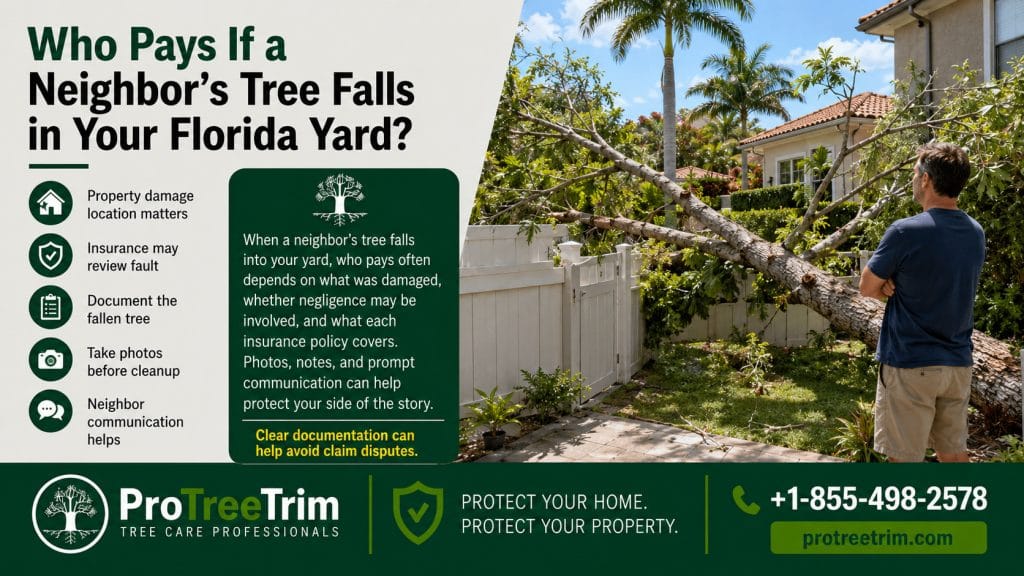
If a neighbor’s tree falls into your Florida yard, the answer is not always “the neighbor pays.” Responsibility can depend on why the tree fell, whether it damaged insured property, whether the tree was healthy or visibly hazardous, and what your insurance policy says. Start with safety, photos, and written records before cleanup changes the scene.
First, Document What Happened
Do not argue at the fence line before you document the damage. Take photos from a safe distance showing the full tree, where it came from, where it landed, and what it affected. Photograph roof damage, fences, pavers, pool cages, driveways, irrigation, sheds, landscaping, and any blocked access.
Florida’s Department of Financial Services says most insurance policies cover debris and tree removal if the downed tree damaged insured property, regardless of who owns the tree, though policy limits usually apply. It also notes there is usually no debris removal coverage if trees fall on the ground without damaging covered property, unless a policy provides coverage for a blocked main entrance. Always check your own contract.
| Situation | What to do next |
|---|---|
| Tree hit your roof, fence, shed, or pool cage | Photograph damage and contact your insurer |
| Tree fell only on open lawn | Check cleanup responsibility and policy limits |
| Tree blocks the main entrance | Ask your insurer if coverage applies |
| Tree touched power lines | Stay away and contact the utility |
| Tree looked dead or hazardous before falling | Save old photos, messages, and notes |
| Neighbor dispute starts | Keep communication calm and written |
Tree Condition Can Matter
Florida property-line tree issues are not always simple. UF/IFAS’s Handbook of Florida Fence and Property Law explains that an adjoining landowner may trim branches or roots back to the property line at their own expense, but if branches are dead, the owner of the property where the tree is located may be responsible and could be liable for damage caused by those branches.
The Florida Bar Journal has also discussed Florida’s approach to healthy trees, noting that a landowner is generally not liable to an adjoining property owner for damage caused by a healthy tree.
For homeowners, the practical takeaway is documentation. If you previously warned your neighbor about a dead limb, leaning tree, decay, or visible risk, save messages, photos, arborist notes, and dates. If the tree looked healthy and fell during a storm, the insurance path may look different.
Do not cut or remove evidence too quickly if there is damage, a claim, or a dispute. Take photos first, then make reasonable safety decisions.
If you are unsure whether a fallen neighbor tree, limb, stump, or root issue needs professional cleanup or documentation, ProTreeTrim can help connect Florida homeowners with local tree service support. Call +1-855-498-2578 or visit protreetrim.com.
FAQs
Does my neighbor automatically pay if their tree falls in my yard?
Not automatically. It may depend on tree condition, damage, insurance coverage, and whether negligence or prior notice is involved.
Should I call my insurance company first?
If insured property was damaged, yes. Take photos, protect the property from further damage if safe, and ask what records they need.
Can I cut branches from my neighbor’s tree before it falls?
In general, Florida adjoining owners may trim branches or roots back to the property line at their own expense, but avoid damaging the tree or entering the neighbor’s property without permission.
ProTreeTrim™ can help you take the next step.
If you are dealing with a damaged tree, fallen branch, stump, root issue, palm concern, or storm cleanup question in Florida, call ProTreeTrim for tree service support.