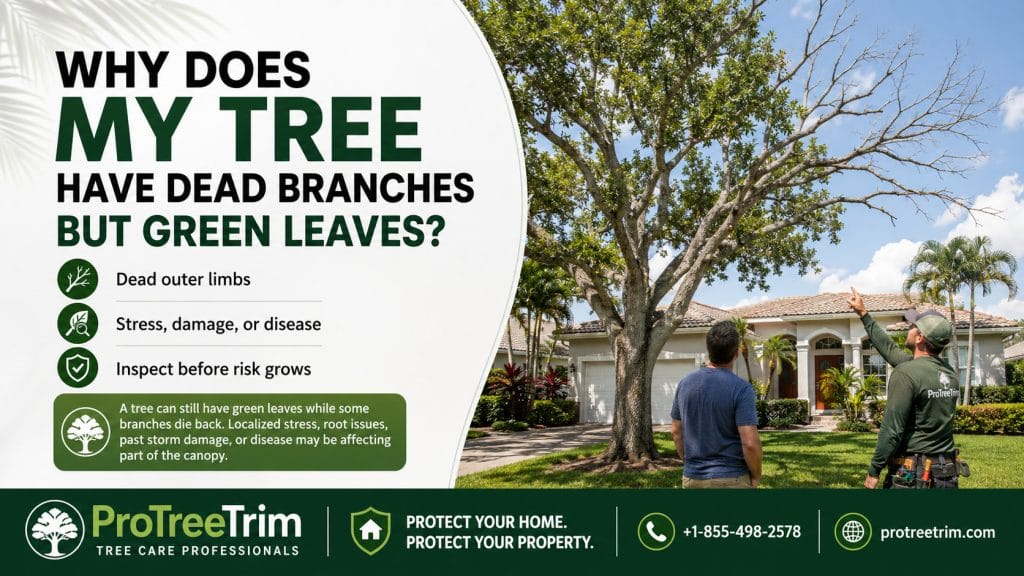
A tree can look alive and still have dead branches. Green leaves show that parts of the tree are functioning, but they do not prove every limb is sound. Dead branches may come from old storm damage, shading, root stress, drought, pests, disease, pruning wounds, or a branch that simply lost its connection to the tree’s energy flow.
Green Leaves Do Not Clear the Whole Tree
Homeowners often relax once they see green leaves. That is understandable. A full canopy feels reassuring from the driveway.
But deadwood inside or above that canopy can still matter, especially if the branch is large or hanging over a roof, driveway, sidewalk, pool cage, fence, or parked vehicle area. ISA’s tree-risk guidance notes that dead branches are among the more obvious potential hazards, and that risk depends on the size of the branch and what it could hit.
A few small dead twigs inside the canopy may be routine. A large dead limb over a walkway is a different decision. The branch size, location, and condition matter more than whether the rest of the tree still looks green.
| What you notice | What it may suggest |
|---|---|
| Small dead twigs inside canopy | May be normal shading or minor dieback |
| One large dead limb | Old injury, branch failure, decay, or localized stress |
| Dead branches on one side | Root damage, construction, drainage, or sun/heat exposure |
| Dead top branches | Root stress, drought, disease, or old damage may be involved |
| Dead limb over roof or driveway | Higher property and safety concern |
| Deadwood plus mushrooms or cracks | More than a cosmetic issue |
Check the Pattern Before Cutting
Do not start by removing every branch that looks bare. First, look at the pattern.
Is the deadwood scattered throughout the tree, or concentrated on one side? Did it appear after a storm, heavy pruning, drought, flooding, or nearby construction? Is the tree close to pavers, a driveway, a patio, or a compacted area where roots may have been disturbed?
ISA’s plant health guidance lists discolored leaves, dead branches, and early leaf drop as symptoms that may call for arborist attention because the cause can be simple or may involve several underlying problems. That is the key: dead branches are a symptom, not a complete diagnosis.
A branch may die because it was shaded out. It may also die because the tree is under root stress, the limb was damaged by wind, insects moved into weakened wood, or decay is present near the branch connection. One dead branch does not tell the whole story.
When Dead Branches Should Move Up the Priority List
Dead branches deserve faster attention when they are large, cracked, hanging, or positioned over something people use. A dead limb above a quiet back corner can often be handled differently from one above a front entry, pool deck, driveway, or neighbor’s fence.
UF/IFAS says removal of dying, diseased, broken, or dead limbs can generally be done at any time with little negative effect on the tree. It also cautions that stressed trees should not be subjected to unnecessary live-branch pruning during sensitive growth periods. In homeowner terms: removing deadwood is different from aggressively cutting healthy canopy.
Before pruning, photograph the full tree, the dead branch, the trunk base, nearby roots, and anything the branch could hit. If the branch is high, heavy, over a structure, or near wires, do not turn it into a ladder-and-chainsaw project.
If you are unsure whether dead branches are routine cleanup or a sign of a larger tree problem, ProTreeTrim can help connect homeowners with local tree service support. Call +1-855-498-2578 or visit protreetrim.com.
FAQs
Does one dead branch mean the whole tree is dying?
No. A single dead branch may come from shading, old injury, storm damage, or localized stress. Look for spreading dieback, trunk issues, root problems, or repeated limb loss.
Should dead branches be removed?
Often, yes—especially if they are large or over areas people use. UF/IFAS notes that dead, broken, dying, or diseased limbs can generally be removed at any time.
Can a tree have green leaves and still be unsafe?
Yes. Green leaves show life in parts of the canopy, but large dead limbs, cracks, decay, root movement, or hanging branches can still create risk.
Should I prune healthy branches at the same time?
Not automatically. Deadwood removal and live-canopy reduction are different decisions. Avoid extra live pruning unless there is a clear reason.
ProTreeTrim™ can help you take the next step.
If you are dealing with a damaged tree, fallen branch, stump, root issue, palm concern, or storm cleanup question in Florida, call ProTreeTrim for tree service support.