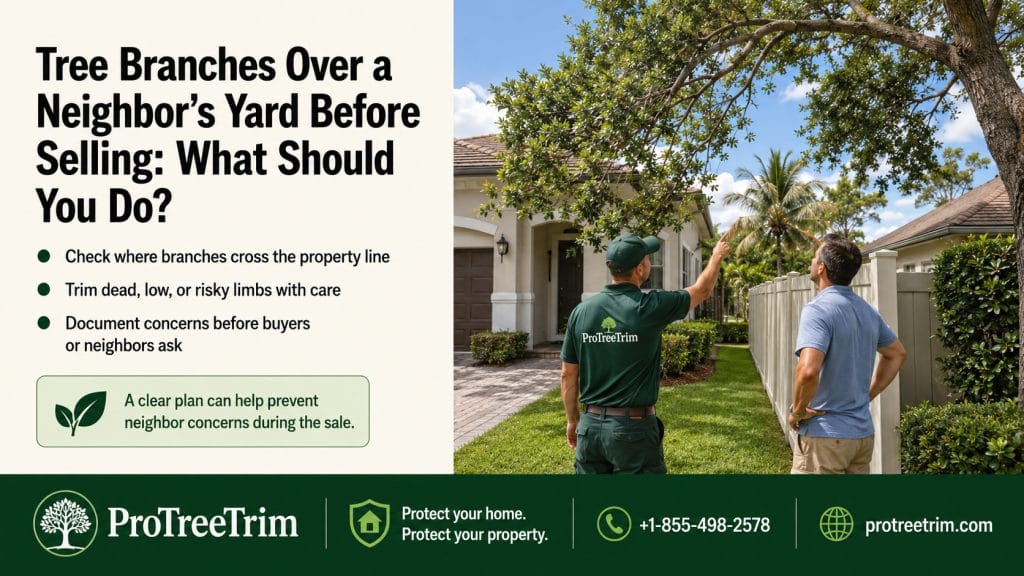
Tree branches hanging over a neighbor’s yard can become a quiet complication before selling a home. They may not be a problem at all, or they may raise questions about fences, rooflines, pool cages, storm cleanup, dead limbs, property boundaries, or future disputes. Before listing, the smart move is to look at the condition of the branches, not just where they hang.
Start With Branch Condition, Not the Property Line
A healthy branch crossing the fence line is not the same as a dead limb hanging over a neighbor’s shed, driveway, pool screen, or fence. Buyers may not know the legal details, but they will notice anything that looks like a future conversation with the neighbor.
In Florida, UF/IFAS guidance explains that an adjoining landowner may generally trim healthy branches or roots back to the property line at their own expense, while dead branches can create different responsibility concerns for the landowner where the tree is located. Because property and liability questions can be fact-specific, sellers should avoid giving legal conclusions and keep records instead.
| What you see | What to consider before listing |
|---|---|
| Healthy branches over neighbor’s lawn | May be manageable, but still worth noting |
| Dead limb over neighbor’s fence or roof | Should be checked before listing |
| Branches rubbing a shared fence | Clearance pruning may prevent a repeat issue |
| Tree leaning toward neighbor’s property | Lean history and root condition matter |
| Storm-damaged limb over boundary | Document and address before photos/showings |
| Roots lifting fence posts or pavers | Tree and hardscape should be considered together |
| Branches near utility lines | Utility safety comes before tree work |
Handle Visible Risk Before It Becomes a Buyer Question
A buyer may not ask, “What does Florida tree law say?” They are more likely to ask: “Is the neighbor going to complain about that branch?” or “Will I need to pay for tree work right after closing?”
That makes visible deadwood the first priority. If a dead or cracked limb hangs over the neighbor’s side, the fence line, or a shared access area, it is better to deal with it before listing. UF/IFAS Extension also notes that if a tree or branch issue is not easily determined, homeowners should contact the appropriate legal or insurance professional for direction rather than guessing.
Pre-listing work may include:
- removing dead limbs over the property line
- trimming branches rubbing a fence or roof edge
- clearing storm-damaged branches before photos
- documenting tree work near the boundary
- saving messages with the neighbor if relevant
- keeping invoices and before-and-after photos
Avoid entering a neighbor’s property or making cuts from their side without permission. Keep the work factual, limited, and documented.
Talk Early If the Tree Is Obvious From Their Side
Not every branch needs a neighbor conversation. But if the tree is leaning, dropping limbs, pressing into a fence, or visibly hanging over a neighbor’s roof, pool cage, driveway, or shed, silence can make the issue feel worse.
A simple, calm message is often enough: you noticed the branch, you are having it looked at or trimmed, and you will keep the work on your side unless permission is needed. Do not promise legal responsibility or future outcomes. Just communicate the practical step you are taking.
This is especially useful before listing because buyers may speak with neighbors, inspectors may notice the boundary area, and a neighbor concern can surface at the worst possible time.
Keep the Records Clean
If you trim, remove, or clean up anything near a property line, keep a simple file.
Useful records include:
| Record | Why it helps |
|---|---|
| Before photos | Shows the branch, fence line, and target area |
| Tree service invoice | Documents the work performed |
| After photos | Shows clearance or cleanup |
| Neighbor messages, if any | Shows practical communication |
| Fence or roof repair receipts | Connects tree work to related repairs |
| Debris hauling notes | Confirms cleanup was completed |
Avoid saying, “The neighbor has no claim,” or “This will never be an issue.” A safer seller response is factual: “The dead limb over the fence line was removed, debris was hauled away, and the invoice is available.”
When Removal May Be Worth Discussing
Removal may deserve discussion if the tree is dead, newly leaning, split, repeatedly dropping large limbs, damaging the fence, or growing in a place where pruning will not realistically solve the conflict.
But removal is not always the best answer. A healthy tree may add shade, privacy, and curb appeal. If the issue is only a few small branches crossing the boundary, selective pruning and documentation may be enough.
If removal happens before listing, finish the area properly. A stump, loose chips, exposed roots, damaged fence panel, or bare soil near the property line can still look like unfinished work to a buyer.
If you are unsure whether boundary branches, dead limbs, fence-line roots, or a neighbor-facing tree issue should be handled before listing your home, ProTreeTrim can help connect homeowners with local tree service support. Call +1-855-498-2578 or visit protreetrim.com.
FAQs
Should I trim branches hanging over my neighbor’s yard before selling?
If the branches are dead, cracked, storm-damaged, or visibly affecting a fence, roof, pool cage, driveway, or shed, it is worth addressing before listing.
Can I cut branches on the neighbor’s side?
Do not enter a neighbor’s property or cut from their side without permission. Property-line tree work can be fact-specific, so keep the work limited and documented.
Will buyers care about branches over a fence?
They might, especially if the branches look dead, heavy, storm-damaged, or likely to create a future neighbor dispute.
What should I save after tree work near a property line?
Keep before-and-after photos, invoices, debris hauling notes, repair receipts, and any relevant communication with the neighbor.
ProTreeTrim™ can help you take the next step.
If you are dealing with a damaged tree, fallen branch, stump, root issue, palm concern, or storm cleanup question in Florida, call ProTreeTrim for tree service support.