Tree topping is one of the most damaging pruning mistakes homeowners can make. It means cutting the top or major limbs of a tree back to large stubs, usually to make the tree shorter or smaller quickly.
It may look like a simple fix when a tree feels too tall, too close to the house, or too risky before storm season. But topping often creates bigger long-term problems: weak regrowth, large wounds, decay, poor structure, sun exposure, and repeated future pruning.
The short version is simple: topping does not make a tree safer or healthier. It usually makes the tree weaker.
What Tree Topping Looks Like
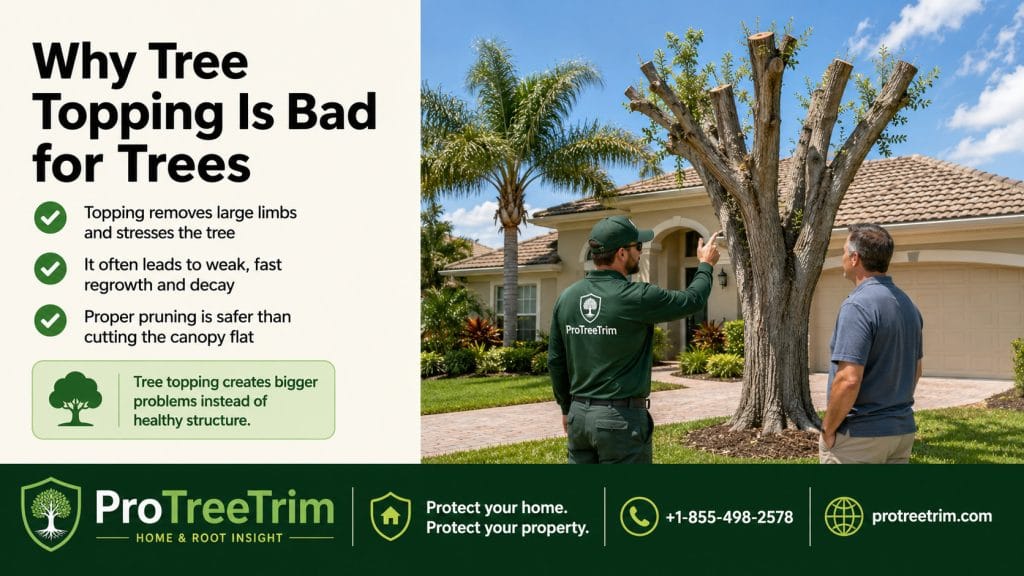
Topping is not normal pruning. It usually leaves a tree with large cut stubs instead of natural branch ends.
A topped tree may look like:
- the top was cut flat
- large limbs were cut back to stubs
- the natural canopy shape is gone
- only thick poles remain
- the tree looks suddenly much shorter
- many branch ends have large open wounds
- new shoots later grow in crowded clusters
Homeowners may call it “cutting back,” “lowering,” “taking the top off,” or “making it smaller.” But if major limbs are cut to stubs, it is topping.
Why Homeowners Ask for Tree Topping
Most homeowners do not ask for topping because they want to hurt the tree. They ask because they are trying to solve a real concern.
Common reasons include:
| Homeowner concern | Better question to ask |
|---|---|
| Tree is too tall | Is the tree actually unsafe or just large? |
| Branches are near roof | Can selective clearance solve it? |
| Storm season is coming | Are there dead, cracked, or weak limbs? |
| Tree drops leaves or acorns | Is pruning the right fix for normal debris? |
| Tree blocks light | Would limited thinning help without stripping? |
| Tree is near wires | Should utility-safe help handle it? |
| Tree feels too big for yard | Is removal/replacement more honest than topping? |
The concern may be valid. Topping is usually the wrong solution.
Topping Creates Large Wounds
A proper pruning cut removes a branch at a natural branch union or just outside the branch collar. Topping cuts through large limbs at random points. That creates big wounds the tree may struggle to close.
Large topping wounds can:
- expose inner wood
- dry out and crack
- invite decay
- create long-term cavities
- weaken limb structure
- remain visible for years
- become entry points for pests and fungi
A tree may survive topping, but survival does not mean the cut was good.
Fast Regrowth After Topping Is Not Good Recovery
After topping, many trees respond by sending out fast-growing shoots near the cuts. Homeowners may think, “It grew back, so it worked.”
That regrowth is often a stress response.
New topping sprouts may be:
- weakly attached
- crowded
- fast-growing
- upright and unstable
- connected to decaying wood
- more likely to break later
- difficult to manage
The tree may become bushier at the cut points, but not stronger.
Topping Can Increase Future Risk
One of the biggest myths is that topping makes a tree safer in storms. It may reduce height temporarily, but it can create weak regrowth and decay-prone wounds.
Over time, topping can make the tree more risky because:
- new shoots may attach poorly
- decay can develop below large cuts
- branch structure becomes unnatural
- the tree may produce dense weak regrowth
- future pruning becomes more frequent
- large wounds weaken major limbs
- the canopy may become unbalanced
A topped tree may look shorter today and become more problematic later.
Topping Does Not Fix a Tree That Is Too Large for the Space
Sometimes the real issue is placement. A large tree may have been planted too close to the house, driveway, pool cage, fence, sidewalk, or utility line. Topping does not change the fact that the tree wants to become large.
If a tree is fundamentally too big for the site, repeated topping becomes a cycle:
- tree is topped
- weak sprouts grow quickly
- canopy becomes dense and awkward
- homeowner cuts it back again
- wounds and decay increase
- tree becomes harder to maintain
At some point, removal and replacement with a better-sized tree may be more honest.
Topping Can Lead to Decay
When large limbs are cut back to stubs, the tree may not close the wounds properly. The exposed wood can begin to decay. Over time, decay may move into the limb or trunk.
Decay risk is worse when:
- cuts are large
- cuts are made on mature limbs
- the tree is already stressed
- water collects around wounds
- the cut stubs die back
- fungi or insects enter the exposed wood
- the tree is repeatedly topped
Decay may not be obvious right away. The tree can look leafy while internal strength is declining.
Topping Can Sunburn Bark and Branches
A full canopy shades the tree’s own limbs and trunk. When topping suddenly removes large parts of the canopy, bark that used to be shaded may become exposed to harsh sunlight.
This can cause sunscald or bark stress, especially on thin-barked trees or trees in hot, open yards.
This matters near:
- driveways
- streets
- patios
- pool decks
- front yards with reflected heat
- young trees
- trees already stressed by drought or root damage
The canopy is not just decoration. It protects the tree.
Topping Can Make a Tree Ugly for Years
A topped tree often loses its natural form. Even if it grows back, the regrowth may look crowded, unnatural, or broom-like.
The tree may develop:
- awkward sprouts
- thick knobs at old cut points
- uneven canopy shape
- bare large limbs
- repeated stub growth
- poor branch spacing
- a permanently damaged silhouette
For front-yard trees, this can hurt curb appeal instead of improving it.
Topping Is Not Proper Height Reduction
There are cases where tree size or spread needs to be reduced. But proper reduction pruning is different from topping. Reduction pruning uses selective cuts back to appropriate lateral branches. It preserves structure better and avoids leaving large random stubs.
Even then, reduction pruning has limits. Not every tree can be safely reduced enough to satisfy the homeowner.
A good height or spread discussion should ask:
- Why does the tree need reduction?
- How much reduction is realistic?
- Are cuts being made to proper laterals?
- Will large wounds be avoided?
- Is the tree healthy enough?
- Is removal a better long-term option?
- Will the tree still look natural?
If the answer is “cut it in half,” that is not proper reduction.
Topping Is Different From Crown Reduction
Crown reduction is a careful pruning method used to reduce height or spread in a limited, structured way. Topping is crude cutting to stubs.
| Crown reduction | Topping |
|---|---|
| Uses selective cuts | Uses large stub cuts |
| Preserves natural shape | Destroys canopy form |
| Cuts back to suitable laterals | Cuts at random points |
| Limited and careful | Usually aggressive |
| May be appropriate in some cases | Generally harmful |
| Requires skill | Often used as a shortcut |
A homeowner asking for a smaller tree should ask whether true crown reduction is possible, not topping.
Topping Is Different From Crown Raising
Crown raising removes selected lower branches to create clearance under the tree. It may help with driveways, sidewalks, mowing, patios, or roof edges.
Topping removes the upper canopy or major limbs.
Crown raising can be appropriate when done carefully. Topping should be avoided.
Topping Is Different From Crown Cleaning
Crown cleaning removes dead, broken, diseased, or damaged branches. It is often one of the safest and most useful pruning goals.
If the concern is falling branches, crown cleaning may be more appropriate than topping.
A good crown cleaning scope may include:
- deadwood over driveway
- broken storm limbs
- cracked branches
- dead palm fronds
- branches rubbing the roof
- hazardous hanging material
This addresses actual risk instead of cutting the whole tree down to stubs.
Topping Before Storm Season Can Backfire
Some homeowners think topping before hurricane or storm season will reduce wind resistance. This can be a costly mistake.
Better storm preparation focuses on:
- removing dead branches
- removing broken limbs
- checking weak unions
- clearing roof contact
- removing dead palm fronds
- inspecting trunk cracks
- checking root stability
- addressing hanging storm-damaged limbs
Storm prep should target weak or dead material. It should not strip or top healthy canopy.
Topping Palms Is Not the Same Issue, but Over-Cutting Is Still Harmful
Palms are not topped like branching shade trees. But palms are often over-trimmed into hurricane cuts, leaving only a small tuft of green fronds.
This is also harmful.
For palms, avoid:
- removing healthy green fronds
- cutting into the crown
- shaving the trunk aggressively
- hurricane-cutting before storms
- removing too much canopy for appearance
Good palm care removes fully dead fronds, broken fronds, seed pods when needed, and fronds touching structures.
Topping Pines and Evergreens Can Be Especially Bad
Pines, spruce, fir, arborvitae, and many other evergreens do not respond well to hard cutting. If they are topped or cut into old bare wood, they may not regrow naturally.
Topping evergreens can leave:
- permanent bare spots
- dead tops
- ugly regrowth
- weak leaders
- poor screening
- decay at cut points
- loss of natural form
If an evergreen is too tall or too wide for the space, topping is rarely a good fix.
What to Do Instead of Topping
A better approach depends on the real problem.
| Problem | Better option |
|---|---|
| Dead branches | Deadwood pruning |
| Branches touching roof | Selective clearance pruning |
| Low branches over driveway | Crown raising |
| Dense canopy | Careful limited thinning |
| Tree too large for site | Evaluate reduction or removal |
| Storm concern | Risk-focused pruning and inspection |
| Weak branch unions | Structural pruning |
| Palm debris | Dead frond and seed pod removal |
| Utility conflict | Utility-safe professional help |
The right cut depends on the problem.
When Removal May Be Better Than Topping
Sometimes a tree is too large, too damaged, too decayed, or too poorly placed to maintain safely. In those cases, removal may be better than topping.
Removal may be more realistic when the tree:
- is too close to the house
- grows into utility lines
- has major trunk decay
- has a severe lean
- has repeated large limb failure
- is mostly dead
- has deep trunk splits
- is damaging hardscape
- has outgrown a narrow space
- would need topping repeatedly to fit
It is better to remove and replace a poor-fit tree than keep injuring it every few years.
How to Talk to a Tree Crew About Avoiding Topping
Before hiring tree work, be specific.
Say:
- “Do not top the tree.”
- “I want selective roof clearance.”
- “Please remove deadwood only.”
- “Can this be reduced without stub cuts?”
- “Will the tree keep its natural shape?”
- “How much live canopy will be removed?”
- “Are large cuts necessary?”
- “Is removal a better option than topping?”
A good tree-care plan should explain which branches are being removed and why.
Warning Signs a Proposal Is Actually Topping
Be cautious if someone says:
- “We’ll cut it in half.”
- “We’ll take the whole top off.”
- “It will grow back.”
- “We’ll leave stubs so it sprouts.”
- “We’ll make it much shorter fast.”
- “We’ll flat-top it.”
- “This is the best way before storms.”
- “The tree is too big, so we just cut it back hard.”
Those phrases often point to topping or severe over-pruning.
Final Homeowner Takeaway
Tree topping is bad because it creates large wounds, weak regrowth, decay risk, poor structure, and long-term maintenance problems. It may make a tree shorter temporarily, but it does not make the tree healthier or safer.
Better options include deadwood pruning, roof clearance, crown raising, structural pruning, limited crown reduction, or removal and replacement when the tree no longer fits the site.
If you are unsure whether your tree needs pruning, reduction, clearance, or removal instead of topping, ProTreeTrim can help connect homeowners with local tree service support. Call +1-855-498-2578 or visit protreetrim.com.
FAQs
What is tree topping?
Tree topping means cutting the top or major limbs back to large stubs, usually to make a tree shorter quickly.
Why is topping bad for trees?
Topping creates large wounds, weak regrowth, decay risk, poor structure, and repeated future pruning problems.
Will a topped tree grow back?
It may produce fast shoots near the cuts, but that regrowth is often weak, crowded, and poorly attached.
What should I do instead of topping a tree?
Use selective pruning, crown cleaning, roof clearance, crown raising, limited reduction, or removal if the tree is too large or unsafe for the site.
ProTreeTrim™ can help you take the next step.
If you are dealing with a damaged tree, fallen branch, stump, root issue, palm concern, or storm cleanup question in Florida, call ProTreeTrim for tree service support.