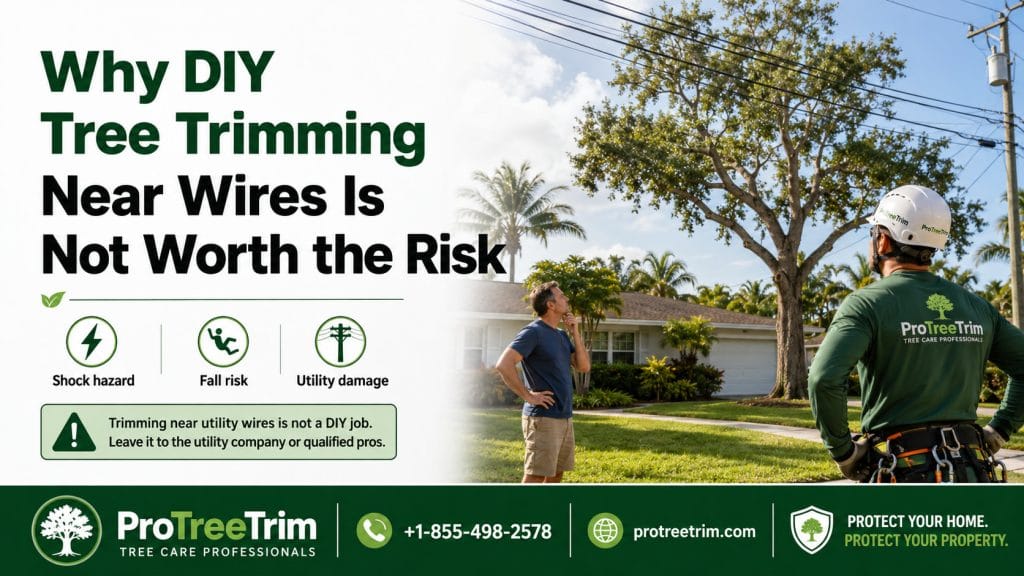
A branch near wires may look like a small Saturday project. It is not. Tree trimming near electrical lines can turn dangerous before the first cut is finished. Homeowners should not use ladders, pole saws, ropes, pruning tools, or rented equipment near overhead wires. The safer first move is to step back and call the utility.
The Branch Is Only Part of the Hazard
Most DIY mistakes start with a simple thought: “I can reach that.” The branch may be small. The wire may not be sparking. The tree may only be touching the service line lightly. None of that makes the work safe.
FPL tells customers to keep at least 10 feet away from any power line, including the end of anything they are holding or carrying. FPL also warns that even nonmetallic ladders and equipment can conduct electricity. OSHA describes line-clearance tree trimmers as workers with specialized training who may work within 10 feet of energized power lines and equipment under specific requirements.
That gap between “homeowner trimming” and “line-clearance work” matters. A pole saw can move farther than expected. A cut limb can swing into a wire. A palm frond can slide, twist, or fall across the line. Wet branches, metal fences, gutters, ladders, and puddles can make the scene even more dangerous.
| DIY move | Why it is risky near wires |
|---|---|
| Standing on a ladder | The ladder, tool, or branch can enter the unsafe zone |
| Using a pole saw | Extended reach may contact or approach the line |
| Pulling a branch with rope | The branch can spring or drag the line |
| Cutting a small limb first | The remaining limb may swing into wires |
| Working after rain | Wet surfaces can increase danger |
| Assuming the line is dead | You cannot rely on appearance alone |
Downed or Tangled Lines Are a Stop Sign
After storms, the temptation to “clear just enough” can be strong. A limb may be blocking the driveway. A palm frond may be hanging from the line. A branch may be resting against the roof and wire at the same time.
Do not move it.
The Electrical Safety Foundation International advises people to assume downed power lines are live and avoid going near the line or anything in contact with it. ESFI also warns that downed lines can energize the ground around them, especially in wet conditions.
For a homeowner, the rule is practical: if a tree, branch, fence, vehicle, puddle, pool equipment, or metal object is touching or near a downed or sagging line, keep people and pets away. Call the utility or emergency services. Tree cleanup comes later.
What to Do Instead
Take wide photos only from a safe distance. You do not need a close-up of the wire to explain the problem. A photo from across the driveway or yard is enough.
When you call, describe the situation clearly:
- Is the branch touching the wire or just close to it?
- Did a storm move the branch?
- Is the line down, sagging, or still attached?
- Is the tree near the roof, driveway, pool cage, fence, or main entrance?
- Is access blocked?
Once the utility has addressed the electrical concern, a tree crew may still be needed for pruning, debris removal, stump work, or cleanup. But the order matters. Electrical safety first. Tree work second.
If you are unsure whether a tree, palm, limb, stump, or root issue needs professional cleanup after the utility concern is handled, ProTreeTrim can help connect homeowners with local tree service support. Call +1-855-498-2578 or visit protreetrim.com.
FAQs
Can I trim branches near wires if I stay on the ground?
No. Ground work can still be dangerous if your tool, branch, rope, or cut limb enters the unsafe area near an electrical line.
What if the branch is small?
Size does not make it safe. Small limbs and palm fronds can move unpredictably and contact wires.
Should I call a tree service or the utility first?
If electrical lines are involved, call the utility first. Tree service should come after the electrical hazard is handled.
Can a regular tree crew trim near power lines?
Only properly trained line-clearance workers should work near energized lines. Ordinary pruning and utility-line clearance are not the same job.
ProTreeTrim™ can help you take the next step.
If you are dealing with a damaged tree, fallen branch, stump, root issue, palm concern, or storm cleanup question in Florida, call ProTreeTrim for tree service support.