
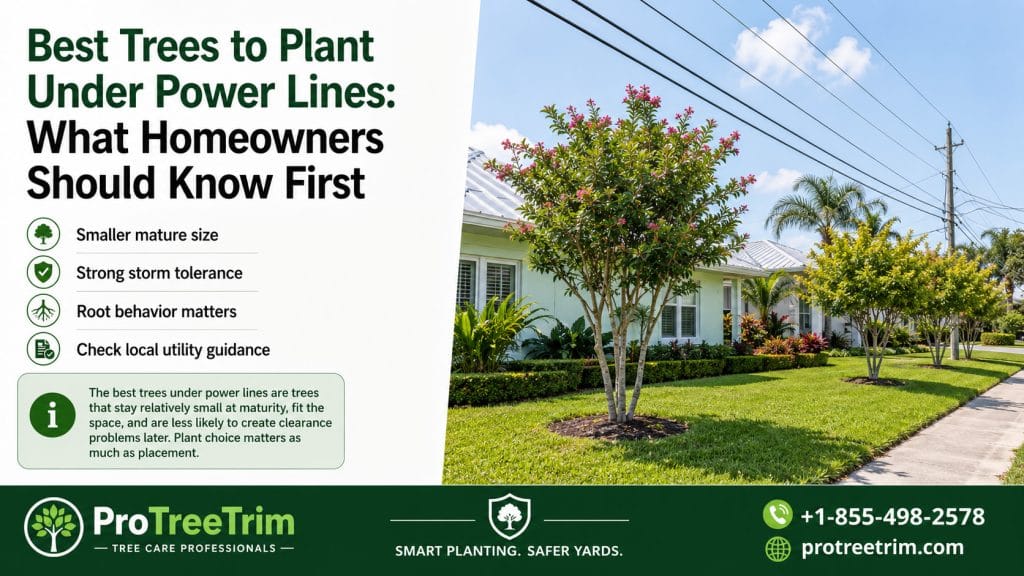
The best tree to plant under power lines is usually not the prettiest one at the nursery. It is the one that will stay small enough at maturity, avoid repeated utility conflicts, and fit the actual space. Before planting, homeowners should look up, look down, check mature height, and call 811 before digging.
Start With Mature Size, Not the Nursery Tag
A young tree can look harmless in a five-gallon or fifteen-gallon container. Ten years later, that same tree may be tangled near service lines, rubbing a roof edge, or needing repeated pruning just to stay out of trouble.
FPL’s “Right Tree, Right Place” guidance says planting the right tree in the right place can help prevent future power-line conflicts and reduce outages. FPL also reminds homeowners to understand how tall, wide, and deep a tree will grow at maturity before choosing a planting spot.
Arbor Day gives a practical spacing rule: plant a tree at least as far from the pole-to-pole center line as the tree’s expected mature height. It also advises that trees expected to grow taller than 25 feet should not be planted directly under lines or within 20 feet of that line corridor.
| Planting zone | Better tree choice |
|---|---|
| Directly under overhead lines | Small trees only, usually 25 feet mature height or less |
| Within roughly 20 feet of line corridor | Avoid medium and tall trees |
| 20–50 feet from lines | Small or medium trees may fit, depending on mature size |
| 50+ feet from lines | Larger trees may be possible if space, roots, and structures allow |
| Near driveways, roofs, or sidewalks | Also check canopy width and roots, not just height |
“Small Tree” Does Not Mean “No Planning Needed”
A small ornamental tree can still be wrong for the site if it spreads too wide, drops messy fruit onto a driveway, blocks visibility, crowds a sidewalk, or needs more irrigation than the yard can support.
For Florida homeowners, this is where yard details matter. A tree under or near utility lines may also sit near pavers, irrigation heads, a front walkway, a mailbox, a fence corner, or a driveway edge. Even a low-growing tree can become a maintenance problem if it is planted too close to hardscape or the house.
Before planting, ask:
- How tall will this tree get at maturity?
- How wide will the canopy become?
- Will roots conflict with pavers, sidewalks, irrigation, or driveway edges?
- Will the tree need frequent pruning to stay clear of wires?
- Will falling branches, flowers, seed pods, or fruit create cleanup issues?
- Is the soil dry, wet, compacted, sandy, or irrigated?
Arbor Day also warns homeowners to look above and below before planting, because tall trees under power lines may require constant pruning to keep branches away from wires. That repeated pruning can leave the tree less attractive and less vigorous over time.
Do Not Forget Underground Utilities
Power lines are not only overhead. Irrigation lines, communication cables, gas lines, electric service, landscape lighting, and other buried utilities may also be present.
FPL’s tree FAQ tells homeowners to consider both overhead and underground power lines before planting and to call 811 or visit Call811 before digging. FPL says this free service identifies buried wires in the area where planting is planned.
FPL’s safety quiz also states that homeowners should call 811 before digging to plant a tree, and it repeats that only qualified line-clearing professionals should trim trees near power lines.
That is an important distinction. Planting is the homeowner’s planning decision. Line clearance is not a DIY pruning project later.
What to Avoid Planting Under Lines
Avoid any tree that will naturally grow into the utility space and require repeated hard pruning. A large shade tree may be excellent in the right yard, but not under overhead wires. The same goes for fast-growing trees that are likely to outgrow the space quickly.
In storm-prone areas, also think about branch structure and future cleanup. A tree planted under lines today may become tomorrow’s service-call problem after wind, heavy rain, or a bad pruning job. If the tree will eventually need harsh trimming to stay away from wires, it was probably the wrong tree for that spot.
Better choices usually stay compact, have a predictable mature height, and fit the soil and light conditions. Local extension offices, utility planting guides, and nursery professionals can help narrow species choices for your area. Do not choose from appearance alone.
If you are unsure whether an existing tree is too close to utility lines, do not trim it yourself. Contact the utility first. If planting, pruning, stump, or root questions remain after the utility safety issue is clear, ProTreeTrim can help connect homeowners with local tree service support. Call +1-855-498-2578 or visit protreetrim.com.
FAQs
Can I plant any small tree under power lines?
Not automatically. Mature height matters, but so do canopy width, root behavior, cleanup needs, soil, irrigation, and nearby sidewalks or driveways.
What height should a tree stay under power lines?
Arbor Day advises that only small-statured trees, generally 25 feet mature height or less, belong directly under or within about 20 feet of the line corridor.
Should I call 811 before planting a tree?
Yes. Call 811 before digging so underground utilities can be marked. This matters even for small trees.
What if I already have a tree growing into power lines?
Do not trim it yourself. Contact the utility first. Tree work near energized lines requires qualified line-clearance professionals, not routine homeowner pruning.
ProTreeTrim™ can help you take the next step.
If you are dealing with a damaged tree, fallen branch, stump, root issue, palm concern, or storm cleanup question in Florida, call ProTreeTrim for tree service support.