
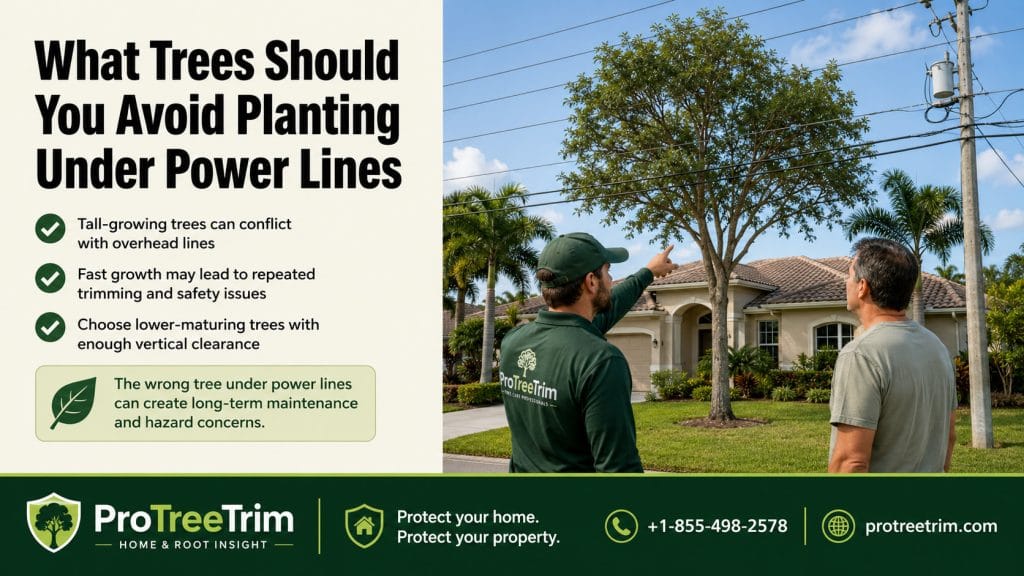
The trees to avoid under power lines are the ones that will eventually grow into the lines: tall shade trees, fast-growing trees, broad canopy trees, brittle trees, and any species that needs repeated hard pruning to stay below utility clearance. The best tree for that space is usually a small, low-growing tree or shrub that stays in scale at maturity.
Look Up Before You Plant
A young tree under a power line may look harmless. The real question is not how tall it is today. The real question is how tall and wide it will become when mature.
Many “right tree, right place” utility guides divide planting space into zones. Arbor Day Foundation guidance describes a low zone under or near overhead lines for small-statured trees, a medium zone farther out for medium trees, and a tall zone beyond that for larger trees. Safe Electricity’s planting guidance is even more conservative near lines, recommending small mature heights close to power lines and placing tall-growing trees farther away to avoid future pruning conflicts.
| Tree type | Why it is a poor choice under power lines |
|---|---|
| Large shade trees | Will likely grow into utility clearance zones |
| Fast-growing trees | May create line conflicts sooner |
| Broad spreading trees | Can reach lines from the side as well as below |
| Brittle-limbed trees | May drop branches during storms |
| Trees needing repeated topping | Poor long-term structure and maintenance cycle |
| Tall palms | Fronds and crowns can conflict with overhead lines |
| Trees planted for quick privacy | Often outgrow the space quickly |
Avoid Any Tree That Must Be Topped to Fit
If the only way a tree can live under power lines is by cutting the top off every few years, it is the wrong tree for that spot.
Topping may make a tree shorter temporarily, but it often creates weak regrowth, poor structure, and a cycle of repeated pruning. Utility pruning may also be done for clearance, not beauty. A tree planted too close to overhead lines may eventually be cut in a way that looks uneven because the utility’s priority is safety and service reliability.
A better planting decision avoids that conflict from the beginning.
Ask before planting:
- Will this tree stay below the line at maturity?
- Will the canopy spread sideways into the line?
- Will the tree need repeated pruning to stay clear?
- Will it grow fast enough to become a problem quickly?
- Will storm movement push branches toward the wires?
- Is there a better small tree, shrub, or planting bed option?
Small Trees Are Usually the Better Fit
Under power lines, the safest landscape choice is usually a tree that naturally stays small. That does not mean the yard has to look empty. Small flowering trees, small ornamentals, shrubs, and layered planting beds can still add curb appeal, shade, and privacy without fighting the utility corridor.
The best choices usually have:
| Better trait | Why it helps |
|---|---|
| Low mature height | Reduces future wire conflict |
| Moderate canopy spread | Keeps branches out of the line path |
| Strong branch structure | Reduces storm limb-drop concern |
| Manageable debris | Keeps the area easier to maintain |
| Slow to moderate growth | Avoids fast clearance problems |
| Easy access for pruning | Allows routine care without risky work |
| Right fit for local soil and climate | Reduces stress and decline |
The goal is not to find a “tiny” tree. The goal is to choose one whose mature size fits the overhead space.
Do Not Forget Side Clearance
Power-line conflicts do not only happen from directly underneath. A tree planted beside the line can still grow into it from the side.
This matters near fences, sidewalks, driveways, and property lines. A homeowner may plant a tree “next to” the utility corridor and think it is far enough away. Years later, the canopy spreads sideways and branches enter the clearance zone.
Before planting, look at mature canopy width, not only mature height. A tree with a wide crown can become a line problem even if the trunk is not directly below the wire.
Utility Safety Comes Before Tree Work
If a tree is already touching or growing close to power lines, do not treat it as ordinary pruning. Florida Power & Light tells customers not to perform work near power lines and to hire a qualified professional when trees or plants are growing near lines.
That point matters for planting too. A poor planting choice today can become a future safety issue that a homeowner cannot safely correct alone.
Do not use ladders, pole saws, ropes, fruit pickers, or trimming tools near power lines. If electrical lines are involved, contact the utility first.
Palms Need Careful Placement Too
Homeowners sometimes assume palms are safer near overhead lines because they do not spread like shade trees. That can be misleading.
A tall palm can still grow into a line corridor. Fronds can hang, whip, or drop near service areas. Seed clusters may create maintenance issues. A palm planted under or too close to power lines may eventually require specialized trimming or removal.
Small palms or low-growing landscape plants may work in some utility areas, but tall palms should be treated with the same mature-height caution as other trees.
Avoid Fast Privacy Fixes Under Lines
Power-line areas are tempting places for privacy planting. A homeowner wants to block a road, neighbor view, or bare fence line, so they plant fast-growing trees under the lines.
That is usually where future trouble begins.
Fast privacy trees may quickly become too tall, too wide, or too difficult to maintain. If they are cut repeatedly for clearance, they may lose their natural shape and become a long-term maintenance burden.
For privacy near utilities, think in layers:
- shrubs that stay below the lines
- small ornamental trees planted outside the main conflict zone
- fence-friendly plantings
- lower hedging
- groundcovers or mulch beds
- trees placed farther away where they can grow naturally
Privacy should not depend on a tree that is destined to be cut back hard.
Check Underground Utilities Too
Overhead lines are the obvious concern, but underground utilities matter as well. Before digging, homeowners should make sure underground lines are marked according to local requirements. Irrigation, gas, electric, cable, water, and sewer lines can all complicate planting.
A tree may fit under the wires but still be wrong if the planting hole or future roots conflict with underground service areas.
Look down as well as up.
When Not to Plant a Tree There
Sometimes the best power-line planting decision is not planting a tree at all.
Avoid planting a tree under or near lines if:
- the tree will exceed the safe mature height for that zone
- it will need repeated topping
- it has brittle branches
- it grows fast and large
- it spreads wide toward the wires
- it drops heavy limbs or fronds
- it blocks utility access
- it sits near both overhead and underground utilities
- the only available tree choices are too large
A well-designed shrub bed can be better than the wrong tree.
Final Homeowner Takeaway
Power lines are not a place to gamble with tree size. The tree that looks small today can become tomorrow’s clearance problem, outage risk, or expensive removal.
Plant the tree where it can grow naturally without being cut into the lines. Under power lines, choose small, utility-friendly trees or lower plantings. Save large shade trees for places where they have room to mature safely.
If you are unsure whether a tree is too close to power lines, a driveway, roofline, fence, or utility area, ProTreeTrim can help connect homeowners with local tree service support. Call +1-855-498-2578 or visit protreetrim.com.
FAQs
Can you plant a tree under power lines?
Sometimes, but only if the tree stays small enough at maturity and does not grow into utility clearance zones. Small trees or shrubs are usually better choices.
What trees should not be planted under power lines?
Avoid large shade trees, fast-growing trees, tall palms, broad canopy trees, brittle trees, and any tree that would need repeated topping to stay below the wires.
Is it safe to trim a tree near power lines yourself?
No. If electrical lines may be involved, contact the utility or a qualified professional. Do not use ladders, pole saws, or tools near power lines.
What is the best planting rule near power lines?
Choose based on mature size, not nursery size. If the full-grown tree will reach or spread into the lines, it belongs somewhere else.
ProTreeTrim™ can help you take the next step.
If you are dealing with a damaged tree, fallen branch, stump, root issue, palm concern, or storm cleanup question in Florida, call ProTreeTrim for tree service support.