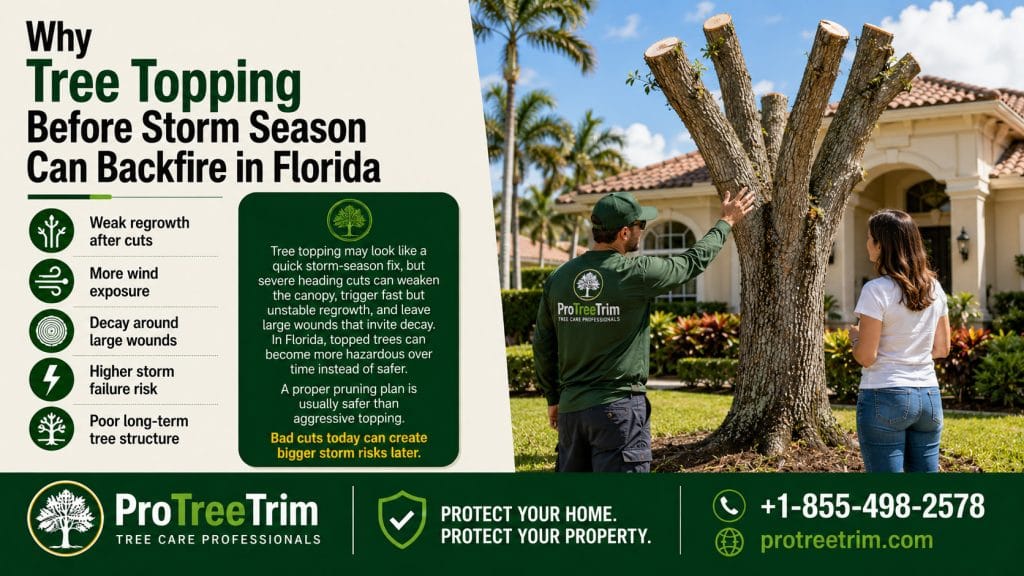
Tree topping may look like a quick way to make a Florida tree “storm ready,” but it can create bigger problems later. Cutting the top or major limbs back harshly can leave weak regrowth, decay-prone cuts, and an unbalanced canopy. Proper pruning is usually about structure and risk reduction, not simply making the tree shorter.
Shorter Does Not Always Mean Safer
Many homeowners ask for topping because a tree feels too tall near the house, driveway, pool cage, or power service line. The concern is understandable. A large oak, maple, or other shade tree can feel intimidating before hurricane season.
The problem is that topping often removes too much live canopy and leaves large cut ends. UF/IFAS notes that topped stems and branches can decay, and the sprouts that grow back from those cuts may be poorly attached for several years.
That matters in Florida because the tree does not stop growing after topping. It often responds with fast, upright shoots around the cut area. Those shoots may look like healthy new growth from the ground, but they are not the same as well-spaced, naturally developed limbs. UF/IFAS also notes that tipping and topping can encourage weak codominant stems.
| What topping may seem to solve | What it can create instead |
|---|---|
| Tree feels too tall | Weak, fast regrowth |
| Canopy looks heavy | Poorly attached sprouts |
| Branches are near roof | Large wounds and decay risk |
| Homeowner wants quick storm prep | Long-term structure problems |
| Tree blocks light | Unbalanced, stressed canopy |
What to Ask for Instead
A better conversation is not “Can you cut the top off?” It is “What parts of this tree are actually risky?”
A careful crew or arborist may look at dead branches, overextended limbs, weak unions, cracks, decay signs, and branches growing toward structures. UF/IFAS guidance on hurricane-damaged trees notes that decay can weaken wood and may be associated with signs such as cracks, seams, abnormal swelling, cankers, dead branch stubs, or large older wounds.
For a Florida homeowner, the practical goal is targeted risk reduction. That may mean removing deadwood, reducing the length of a heavy limb, improving clearance from the roof, or addressing a specific branch over a driveway or pool enclosure. It may also mean removal if the tree has serious structural problems that pruning cannot fix.
Do not let anyone sell topping as a clean shortcut before storm season. If the tree is too close to the house, already cracked, leaning, or root-damaged, topping may only hide the real issue.
If you are unsure whether a tree, palm, stump, or root issue needs proper pruning or removal, ProTreeTrim can help connect Florida homeowners with local tree service support. Call +1-855-498-2578 or visit protreetrim.com.
FAQs
Is topping a tree the same as pruning?
No. Pruning should make selective cuts for structure, clearance, or risk reduction. Topping is a harsh height reduction that can damage tree structure.
Can topping make a tree safer before hurricane season?
Not necessarily. It may create weak regrowth and larger wounds, which can become future problems.
What should I ask a tree crew instead of topping?
Ask which limbs are risky, whether the tree has structural defects, and whether pruning or removal is the safer long-term option.
ProTreeTrim™ can help you take the next step.
If you are dealing with a damaged tree, fallen branch, stump, root issue, palm concern, or storm cleanup question in Florida, call ProTreeTrim for tree service support.