
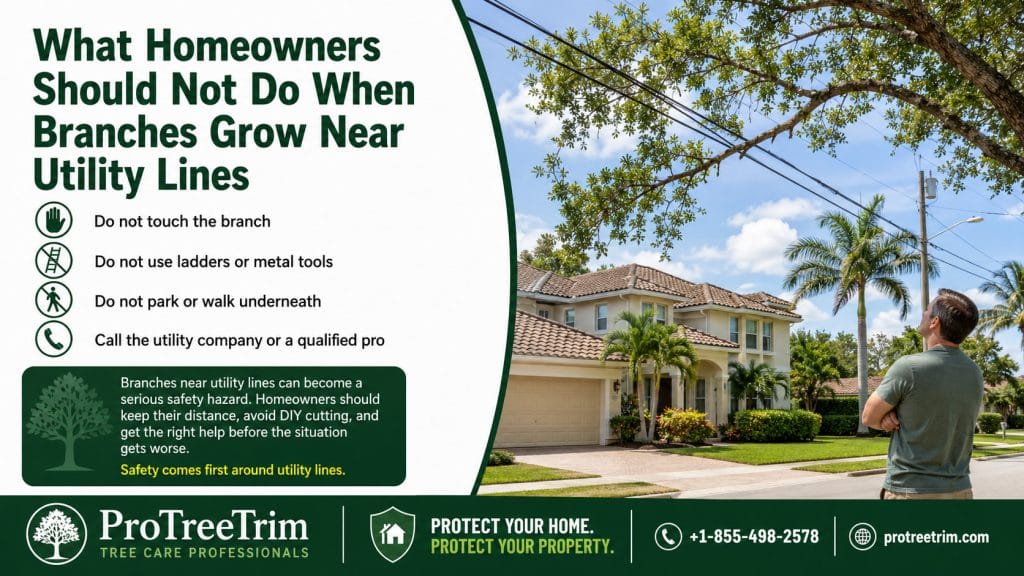
Branches near utility lines can turn a routine-looking trimming job into a serious safety problem. The safest move is usually not to cut, pull, climb, or guess. Homeowners should step back, identify whether electrical lines may be involved, contact the utility when needed, and save tree service work for after the electrical risk is addressed.
Do Not Assume the Line Is Safe
The first mistake is assuming a line is harmless because it is quiet, not sparking, or looks like a cable line. From the ground, it can be hard to tell the difference between electrical service lines, communication lines, and other overhead wires. Treat uncertainty as a reason to stop, not a reason to take a closer look with a ladder.
FPL tells customers to keep at least 10 feet away from any power line, including the end of anything they are holding or carrying, and warns that even non-metallic ladders and equipment can conduct electricity. OSHA describes line-clearance tree trimmers as specially trained workers who may work within 10 feet of energized power lines and equipment under specific safety requirements.
That means a homeowner should not use a pole saw, ladder, rope, pruning tool, or rented lift near a line. The risk is not only direct contact. A branch can move, a tool can extend farther than expected, or a cut limb can fall into a wire.
| What not to do | Why it matters |
|---|---|
| Climb a tree near wires | The tree or your body may contact a line |
| Use a pole saw near overhead lines | The tool can enter the unsafe zone |
| Pull branches off wires | The branch or line can shift suddenly |
| Cut a limb that may fall into a line | The limb can become part of the hazard |
| Assume a quiet line is dead | Power lines can be dangerous without sparking |
| Work after rain or in wet ground | Moisture can make the scene more dangerous |
Do Not Try to “Clear Just One Branch”
This is the moment many homeowners get in trouble. A branch looks close to the service line. It seems small enough to cut. It is bothering the roofline or scraping near the house. The job feels manageable.
But near utility lines, the size of the branch is not the only issue. Direction, weight, wind, moisture, and contact points all matter. A light palm frond can move in the wrong direction. A small oak limb can spring, twist, or hang after the first cut. A branch tangled in a wire may not fall where you expect.
The Electrical Safety Foundation International advises people to assume downed power lines are live and dangerous, and notes that power lines can energize the ground around them, especially when conditions are wet. That same cautious mindset belongs around trees and overhead lines before anything is down, too.
For Florida homeowners, the risk often shows up after storms: palms shedding fronds, oaks dropping limbs, wet fences, puddles near service areas, and branches moving closer to lines after wind. Do not turn storm cleanup into electrical work.
Call the Right Party First
If a branch is touching or very close to a power line, call the utility before calling a normal tree crew. If a line is down, sagging, sparking, or tangled with a tree after a storm, keep people and pets away and contact emergency services or the utility.
A tree service may still be needed later for cleanup, pruning, removal, or stump grinding. But the electrical question comes first. Once the utility has addressed the line or explained the safe next step, the tree work can be planned more clearly.
Before making calls, take photos only from a safe distance. A wide photo from across the driveway or yard is enough. Do not stand under the branch, walk near a downed line, or try to move debris for a better picture.
Useful details to share:
- Whether the branch is touching the line or just near it
- Whether the line connects to your home
- Whether the tree is also near the roof, driveway, pool cage, fence, or street
- Whether storm damage caused the branch to move
- Whether access is blocked or people are at risk
Do Not Forget the Rest of the Tree
After the utility issue is handled, look at the tree itself. A branch near a wire may be one symptom of a larger problem: poor placement, overgrown canopy, storm damage, repeated limb drop, a leaning trunk, or a palm planted too close to the service area.
If the tree has grown into a utility conflict, ask whether selective pruning is enough or whether removal should be discussed. A tree that keeps growing into lines may become a recurring maintenance and safety issue. Around homes, that may also involve roof clearance, driveway access, pool screen protection, irrigation, pavers, and neighboring property.
Do not approve harsh topping simply because wires are nearby. Topping can create weak regrowth and future problems. The better plan is specific: address the utility clearance safely, then decide whether the remaining tree structure makes sense for the site.
If you are unsure whether a tree, palm, limb, stump, or root issue near utility lines needs professional attention after the electrical safety concern is addressed, ProTreeTrim can help connect homeowners with local tree service support. Call +1-855-498-2578 or visit protreetrim.com.
FAQs
Can I trim branches near a utility line if they are not touching it?
Do not guess. If the branch is close to an electrical line, contact the utility or qualified help before trimming.
What if the line looks like a cable or internet line?
Still avoid cutting until you know what it is. Overhead lines can be hard to identify from the ground.
Should I call a tree service or the utility first?
If electrical lines may be involved, call the utility first. Tree cleanup or pruning can be planned after the line hazard is addressed.
Can a branch near a power line wait?
Sometimes, but not if it is touching the line, hanging after storm damage, blocking access, or likely to fall into the wire.
ProTreeTrim™ can help you take the next step.
If you are dealing with a damaged tree, fallen branch, stump, root issue, palm concern, or storm cleanup question in Florida, call ProTreeTrim for tree service support.