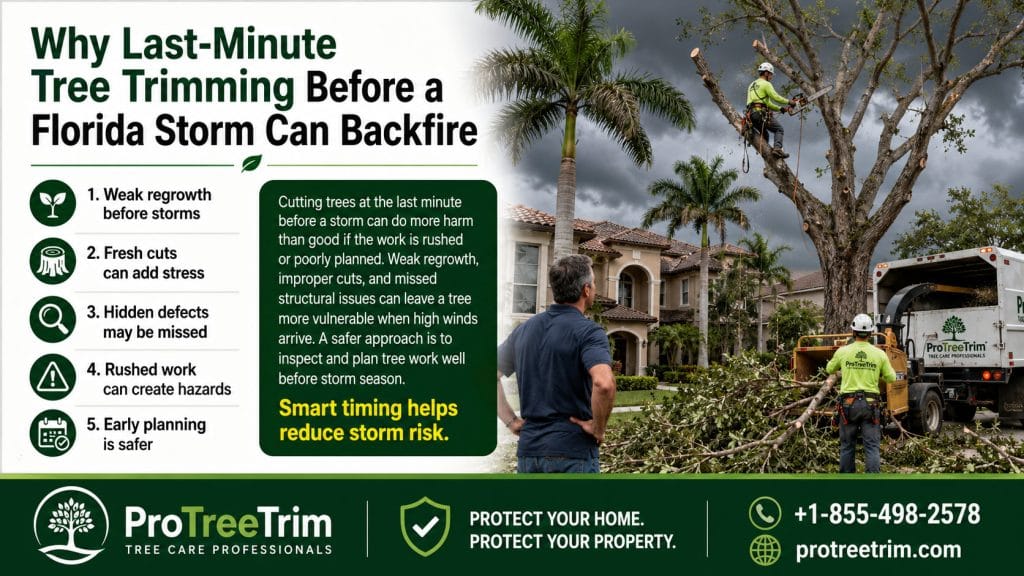
Last-minute tree trimming before a Florida storm may feel responsible, but it can create new hazards if the work is rushed. Large cuts, half-removed limbs, unstable debris, and poor pruning can make a tree less predictable just as wind and rain arrive. Focus on safety, loose items, documentation, and urgent hazards instead of panic trimming.
Rushed Cuts Can Make a Yard More Dangerous
A homeowner may look at a heavy limb over the roof or palm fronds near the pool cage and think, “Let me handle this before the storm.” That instinct makes sense. The problem is timing.
Tree work needs safe conditions, clear access, and a plan for where branches will land. If rain has already started, the ground may be slick or soft. Ladders become more dangerous. Branches may be heavier when wet. A limb that looks easy to cut can swing, split, or drop toward a fence, gutter, driveway, screen enclosure, or parked vehicle.
Poor cuts can also leave the tree in worse shape. Removing too much canopy, cutting large limbs without knowing how the weight is distributed, or leaving broken stubs can create stress points. For palms, pulling or cutting overhead fronds near a roofline can send debris exactly where you do not want it.
| Last-minute action | Why it can backfire |
|---|---|
| Cutting large limbs yourself | Weight can shift suddenly |
| Using a ladder near branches | Wet ground and wind increase fall risk |
| Pulling palm fronds down | Fronds can tear, swing, or hit screens |
| Trimming near power lines | Electrical risk should not be handled by homeowners |
| Leaving cut debris outside | Branches can become wind-blown debris |
| Over-pruning before wind | Tree structure may be weakened |
What to Do Instead Before Conditions Get Worse
Start with what you can safely control. Move cars away from large trees if possible. Clear patio furniture, planters, grills, umbrellas, pool toys, hoses, and loose décor. Take photos of trees, limbs, rooflines, pool cages, fences, pavers, and any existing damage before the storm arrives.
If a limb is already cracked, hanging, touching the roof, blocking the driveway, or near a power line, do not turn it into a DIY project. Keep people and pets away from the area and ask for qualified help if there is still safe time before conditions deteriorate.
After the storm, document the damage before cleanup begins. A calm, organized response is better than rushed cutting in unsafe weather.
If you are unsure whether a tree, palm, stump, or root issue should be handled before or after a storm, ProTreeTrim can help connect Florida homeowners with local tree service support. Call +1-855-498-2578 or visit protreetrim.com.
FAQs
Should I trim trees right before a hurricane?
Avoid rushed trimming. Large, overhead, or roof-adjacent work should be handled earlier, not when storm conditions are close.
What can I safely do before a storm?
Move loose yard items, clear access paths, photograph risky trees, and keep people away from hanging limbs or utility-line hazards.
Is it okay to leave cut branches outside before a storm?
No. Loose branches can become debris. If trimming is done, debris should be cleaned up before wind arrives.
ProTreeTrim™ can help you take the next step.
If you are dealing with a damaged tree, fallen branch, stump, root issue, palm concern, or storm cleanup question in Florida, call ProTreeTrim for tree service support.