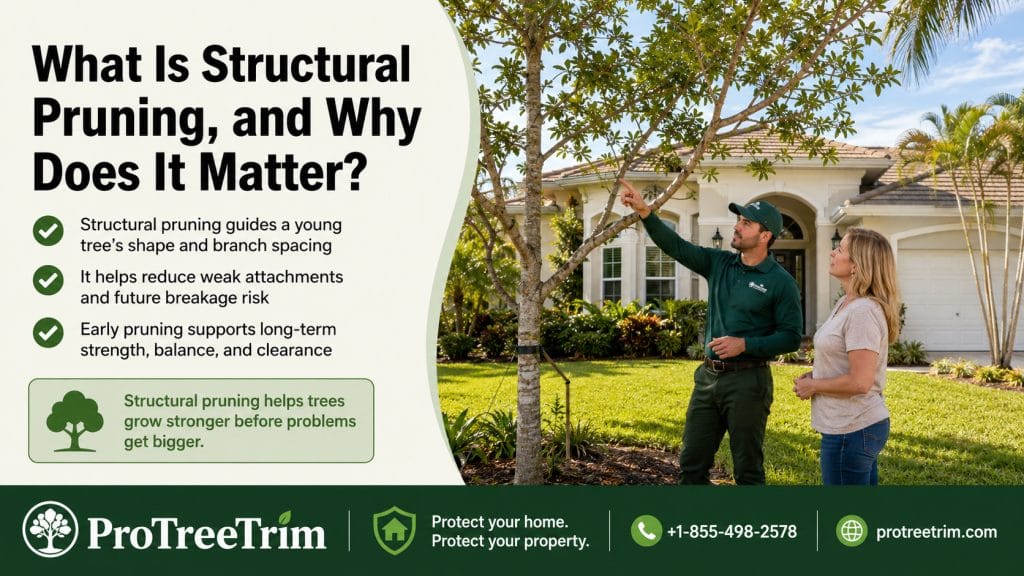
Structural pruning is pruning done to guide a tree’s future shape, branch spacing, and strength. It is especially useful on young and developing trees because small cuts made early can prevent larger, more expensive problems later.
The goal is not to make the tree smaller. The goal is to help the tree grow with better branch structure, fewer weak attachments, and less future conflict with roofs, driveways, sidewalks, fences, and storm-prone areas.
Structural Pruning Is Preventive Tree Care
Many homeowners wait until a tree is large, crowded, leaning, or dropping branches before calling for pruning. By that time, the cuts may be bigger and the choices may be harder.
Structural pruning works earlier.
It can help reduce future problems such as:
- competing main stems
- weak branch unions
- crossing branches
- rubbing branches
- low limbs over driveways
- branches growing toward the roof
- crowded branch spacing
- storm-vulnerable limb patterns
- large corrective cuts later
A young tree can often be improved with small, careful cuts. A mature tree with poor structure may need much more cautious work.
Structural Pruning Is Not the Same as Shaping
Shaping often focuses on appearance. Structural pruning focuses on how the tree is built.
A tree may look attractive when young but still have poor structure developing inside the canopy. Two stems may be competing. Branches may be crossing. A limb may be growing toward the house. A narrow V-shaped union may become a future split point.
| Goal | What it focuses on |
|---|---|
| Shaping | Appearance and outline |
| Trimming | Clearance and general cutting |
| Crown cleaning | Dead, broken, or damaged branches |
| Structural pruning | Long-term branch strength and spacing |
| Topping | Harmful cutting to stubs; should be avoided |
Good structural pruning may not look dramatic immediately. Its value shows over time.
Young Trees Benefit Most
Structural pruning is usually most valuable when the tree is young. Smaller branches are easier to remove, wounds are smaller, and the tree has time to grow into better form.
Young-tree structural pruning may address:
- one strong central leader where appropriate
- branch spacing along the trunk
- branches with weak angles
- early crossing limbs
- broken or damaged branches
- low limbs that will later block access
- competing stems
- branches growing back toward the trunk
The work should be light. Young trees still need leaves to build energy and roots.
Competing Leaders Are a Common Problem
A leader is a main upright stem. Some trees naturally develop one main leader. Others may form two or more competing leaders. When two stems grow side by side, they may create a weak structure as the tree matures.
This can become more serious when the stems form a tight V shape or have included bark trapped between them.
Competing leaders may lead to:
- weak attachment
- future splitting
- uneven canopy growth
- storm vulnerability
- large corrective cuts later
- one side becoming dominant
- poor long-term form
Structural pruning can sometimes guide one leader to become dominant while the tree is still young.
Weak Branch Unions Matter
A branch union is where a branch attaches to the trunk or another limb. Strong unions usually have enough space and good attachment. Weak unions may be narrow, crowded, cracked, or trapped with included bark.
Weak unions deserve attention because they can become failure points later.
Warning signs include:
| Branch union sign | Why it matters |
|---|---|
| Tight V-shaped connection | May be weaker than a wider attachment |
| Bark trapped between stems | Included bark may prevent strong wood connection |
| Crack forming at union | Split risk may be increasing |
| Two large stems equal in size | Competing structure may develop |
| Heavy limb growing from weak union | Weight may worsen the defect |
| Branch over roof or driveway | Consequences are higher if it fails |
Not every narrow union is an emergency, but it is easier to manage early.
Crossing and Rubbing Branches Should Be Corrected Early
Crossing branches may rub against each other as they grow. Over time, rubbing can create wounds, bark damage, decay entry points, and weak branch structure.
On a young tree, removing one small crossing branch may be simple. On a mature tree, the same issue may involve large limbs and bigger wounds.
Structural pruning can remove or redirect branches that:
- cross through the canopy
- rub against other limbs
- grow back toward the trunk
- crowd stronger branches
- block future clearance
- create poor branch spacing
The goal is to prevent conflict before branches become large.
Low Limbs Need a Long-Term Plan
Lower branches are not always bad. On young trees, some temporary lower branches can help trunk development and protect bark. But if the tree is planted near a sidewalk, driveway, street, patio, or entry, some low branches may eventually need to be removed.
The mistake is removing too many low limbs too soon or waiting until they are too large.
A better approach is gradual:
- identify future clearance needs
- keep useful temporary branches when possible
- remove problem branches while they are small
- avoid stripping the trunk
- stage clearance pruning over time
- preserve enough canopy for healthy growth
A young tree should be trained into clearance, not forced into it all at once.
Structural Pruning Helps With Future Storm Resilience
No pruning can storm-proof a tree. But structural pruning can reduce some obvious weak points before they become large.
It may help address:
- weak unions
- competing stems
- overextended branches
- crowded branching
- broken or damaged limbs
- poor branch spacing
- branches growing into structures
Storm risk also depends on roots, trunk condition, soil, decay, species, past pruning, and exposure. Structural pruning is one part of a broader tree-care picture.
Structural Pruning Is Not Heavy Thinning
Some homeowners hear “structure” and assume the tree should be opened up dramatically. That is not the point. Structural pruning is selective. It removes or shortens specific branches that affect future form.
It should not create:
- a hollow canopy
- lion-tailed limbs
- a stripped trunk
- large unnecessary wounds
- a tree that looks shocked
- a thin top-heavy shape
The best structural pruning may look subtle to the homeowner but meaningful to the tree’s future.
Mature Trees Can Still Need Structural Decisions
Structural pruning is easiest on young trees, but mature trees may still need structural assessment. The difference is that mature-tree cuts must be more conservative because branches are larger and wounds are harder to close.
On mature trees, structural pruning may involve:
- removing dead or cracked limbs
- reducing a specific overextended branch
- correcting rubbing branches
- addressing storm-damaged structure
- improving roof or driveway clearance
- evaluating weak unions
- deciding whether support, pruning, or removal is more realistic
A mature tree with major structural defects should not be casually “cut back.” It needs a careful plan.
Oaks Need Special Care
Large oaks often develop broad limbs and complex structure. Structural pruning on oaks should be conservative and purposeful.
For young oaks, early structural pruning can help guide branch spacing and reduce competing leaders. For mature oaks, removing large healthy limbs should not be casual.
Oak structural concerns may include:
- co-dominant stems
- heavy lateral limbs
- weak branch unions
- limbs over roofs
- deadwood over driveways
- storm cracks
- branches rubbing structures
- large wounds from past pruning
A good oak pruning plan preserves the tree’s character while addressing specific risk points.
Palms Do Not Get Structural Pruning the Same Way
Palms are different. They do not have branching canopies like oaks, maples, or pines. Palm care focuses more on dead fronds, broken fronds, seed pods, crown health, trunk condition, and placement.
Do not apply structural pruning logic to palms by removing green fronds aggressively.
For palms, good care usually means:
- remove fully dead fronds
- remove broken hanging fronds
- remove seed pods when needed
- avoid cutting into the trunk
- avoid hurricane cuts
- preserve healthy green crown
A palm’s structure is managed differently from a shade tree’s structure.
Structural Pruning Near Houses
A tree near a house needs future planning. A branch that looks small today may grow into the roofline later. A young tree planted near a corner of the house may eventually need clearance over gutters, siding, windows, or walkways.
Structural pruning near homes may help guide branches away from:
- rooflines
- gutters
- siding
- windows
- chimneys
- pool cages
- fences
- driveways
- front entries
The goal is to avoid large cuts later by making smaller decisions earlier.
Structural Pruning Near Driveways and Sidewalks
Trees near driveways and sidewalks often develop clearance issues. If handled early, pruning can guide the canopy upward gradually while preserving healthy form.
Structural pruning may help prevent:
- branches hitting vehicles
- limbs blocking sidewalks
- low branches over walkways
- poor visibility near driveways
- branches growing into fences
- future large lower-limb removal
This is especially useful for young front-yard trees.
Do Not Remove Too Much at Once
Structural pruning should be staged when needed. Removing too many branches in one visit can stress the tree and distort its form.
Be cautious if the plan would remove:
- many live branches
- large healthy limbs
- most lower branches
- a major leader without reason
- much of the canopy in one visit
- branches only for cosmetic symmetry
Tree structure is built over time. One aggressive visit can create more problems than it solves.
What Homeowners Should Ask Before Structural Pruning
Before approving structural pruning, ask:
- What future problem are we preventing?
- Are competing leaders present?
- Are there weak branch unions?
- Are branches crossing or rubbing?
- Are low limbs being removed gradually?
- How much live canopy will be removed?
- Are cuts small or large?
- Will the tree keep a natural shape?
- Can some work be staged over time?
A good structural pruning plan should sound like training, not cutting back.
What a Good Structural Pruning Scope Sounds Like
A good scope:
- “Reduce one competing leader on the young tree.”
- “Remove small crossing branches before they become larger.”
- “Correct rubbing limbs while cuts are still small.”
- “Preserve the main structure and natural canopy.”
- “Stage future driveway clearance over time.”
- “Remove broken branch and guide future leader growth.”
A poor scope:
- “Cut it way back.”
- “Make it smaller.”
- “Remove all lower limbs.”
- “Thin the whole inside.”
- “Top it before it gets too tall.”
- “Shape it into a ball.”
Structural pruning is precise. It is not random size control.
When Structural Pruning Should Wait
Waiting may be better when:
- the tree is newly planted and stressed
- the tree is drought-stressed
- roots were recently damaged
- the canopy is already thin
- the pruning would remove too much live growth
- the purpose is only cosmetic
- the tree was recently over-pruned
- the tree needs recovery before more cuts
If no structural issue is urgent, staging the work may be better.
When Structural Pruning Should Not Wait
Structural pruning should be considered sooner when defects are small but likely to become larger.
Act earlier when:
| Situation | Why earlier work helps |
|---|---|
| Competing leaders are forming | Easier to correct while small |
| Branches are rubbing | Prevents larger wounds later |
| Weak union is developing | May reduce future split risk |
| Low branch will block driveway | Smaller cut now may avoid larger cut later |
| Young tree is storm-damaged | Structure can be guided during recovery |
| Branch is growing toward roof | Early correction may prevent roof conflict |
The best structural pruning is often early and modest.
Final Homeowner Takeaway
Structural pruning helps trees develop stronger, better-spaced, more practical branch patterns. It is especially valuable for young trees because small cuts now can prevent large problems later.
It is not topping, heavy thinning, or cosmetic shaping. It is careful pruning with a long-term purpose: better structure, fewer weak unions, less rubbing, improved clearance, and reduced future risk.
If you are unsure whether your tree needs structural pruning, deadwood pruning, crown raising, or simple clearance work, ProTreeTrim can help connect homeowners with local tree service support. Call +1-855-498-2578 or visit protreetrim.com.
FAQs
What is structural pruning?
Structural pruning is pruning that guides a tree’s future branch pattern, spacing, leader development, and long-term strength.
When should structural pruning start?
It is usually most useful when trees are young because smaller cuts can prevent larger structural problems later.
Is structural pruning the same as trimming?
No. Trimming often focuses on clearance or appearance. Structural pruning focuses on long-term tree form and branch strength.
Can mature trees get structural pruning?
Sometimes, but mature-tree structural work must be more conservative because large cuts create larger wounds and bigger risks.
ProTreeTrim™ can help you take the next step.
If you are dealing with a damaged tree, fallen branch, stump, root issue, palm concern, or storm cleanup question in Florida, call ProTreeTrim for tree service support.