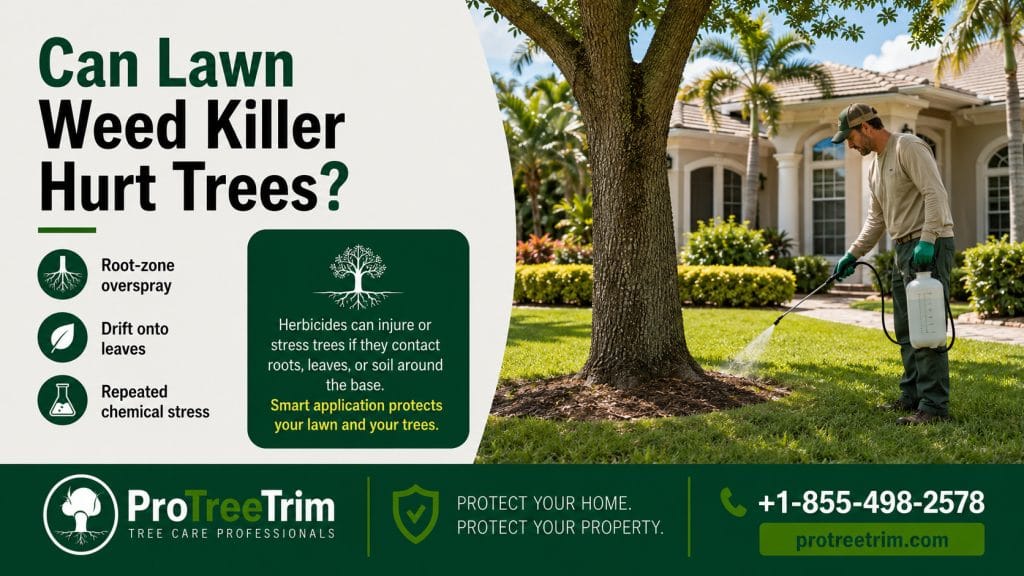
Yes, lawn weed killer can hurt trees, especially if spray drifts onto leaves, contacts young bark, reaches exposed roots, or is applied too close to the root zone. The damage may look like disease, drought stress, or pest trouble at first. Before treating the tree, check the timing: did symptoms appear after lawn spraying?
The Damage May Not Look Like “Chemical Burn”
Herbicide injury does not always show up as one obvious brown patch. Leaves may curl, cup, twist, yellow, brown at the edges, or grow in a narrow, distorted shape. New growth can look strange while older leaves appear less affected. Minnesota Extension notes that herbicide drift can cause leaf distortion and stunting, especially with products such as dicamba and 2,4-D.
UF/IFAS lawn weed guidance also warns that drift from 2,4-D, dicamba, and similar herbicides may damage sensitive plants, including ornamentals, trees, vegetables, or fruit plants. That matters in normal yards where turf, tree beds, shrubs, and irrigation zones sit close together.
| What you notice after lawn treatment | What it may suggest |
|---|---|
| Curled or cupped new leaves | Possible herbicide drift |
| Twisted or narrow new growth | Growth-regulator herbicide injury may be involved |
| Yellowing or browning after spraying | Stress, drift, or root exposure should be checked |
| One side of tree affected | Spray drift or application pattern may matter |
| Symptoms near lawn edge only | Root zone or trunk exposure may be involved |
| Bark splitting or stunted shoots later | Past misapplication may be part of the timeline |
Check the Timeline Before Treating the Tree
The most useful question is not “What disease is this?” It is: what happened in the yard before the symptoms appeared?
Was the lawn treated for broadleaf weeds? Did a neighbor spray on a windy day? Was weed killer applied around the tree bed, driveway edge, fence line, or paver cracks? Did someone spray near exposed roots or suckers at the base of the tree?
Penn State Extension cautions that glyphosate should be used carefully near trees and describes delayed symptoms such as cupping, stunted growth, chlorosis, bark splitting, and witches’ broom after misapplication. Some injury may not show until the following growing season.
That delay is what makes herbicide injury confusing. A homeowner may blame insects, disease, or drought because the spraying happened weeks or months earlier.
Do Not Prune or Spray Again Too Quickly
A stressed tree does not need guesswork piled on top of guesswork. If herbicide injury is possible, avoid heavy pruning unless there are dead, cracked, hanging, or unsafe limbs. Removing live canopy may make recovery harder.
Also avoid applying another product to “fix” the first one. Leaf distortion, yellowing, and browning can come from herbicide exposure, pests, heat, drought, waterlogged roots, nutrient issues, or disease. Treating without identifying the cause can waste time and create more stress.
Take photos instead:
- the full tree
- affected leaves and new growth
- the side facing the lawn or spray area
- trunk base and exposed roots
- lawn edge, pavers, driveway, or fence line
- product label or service record, if available
- date of spraying and date symptoms appeared
If the tree stands near a roof, driveway, pool cage, walkway, fence, or service line, also check for dead limbs or structural concerns. Herbicide injury may be a plant-health issue, but a declining tree near property can become a risk decision later.
If you are unsure whether distorted leaves, browning, root stress, or possible herbicide injury points to a larger tree issue, ProTreeTrim can help connect homeowners with local tree service support. Call +1-855-498-2578 or visit protreetrim.com.
FAQs
Can weed killer damage tree roots?
It can, depending on the product, application method, exposure, and root location. Be especially careful around exposed roots, young trees, tree wells, and lawn edges near the trunk.
How long after spraying would tree damage appear?
Some symptoms appear within days or weeks. Other injury, especially from certain misapplications, may show later as distorted growth, stunting, chlorosis, or bark symptoms.
Should I prune off herbicide-damaged leaves?
Not automatically. Damaged leaves may look bad, but heavy pruning can further stress the tree. Remove hazardous dead limbs when needed, but avoid cosmetic cutting until the tree’s response is clearer.
Can herbicide damage look like disease?
Yes. Curling, yellowing, browning, stunted growth, and distorted leaves can resemble pests, disease, drought, or root stress. The spray timeline helps narrow the cause.
ProTreeTrim™ can help you take the next step.
If you are dealing with a damaged tree, fallen branch, stump, root issue, palm concern, or storm cleanup question in Florida, call ProTreeTrim for tree service support.