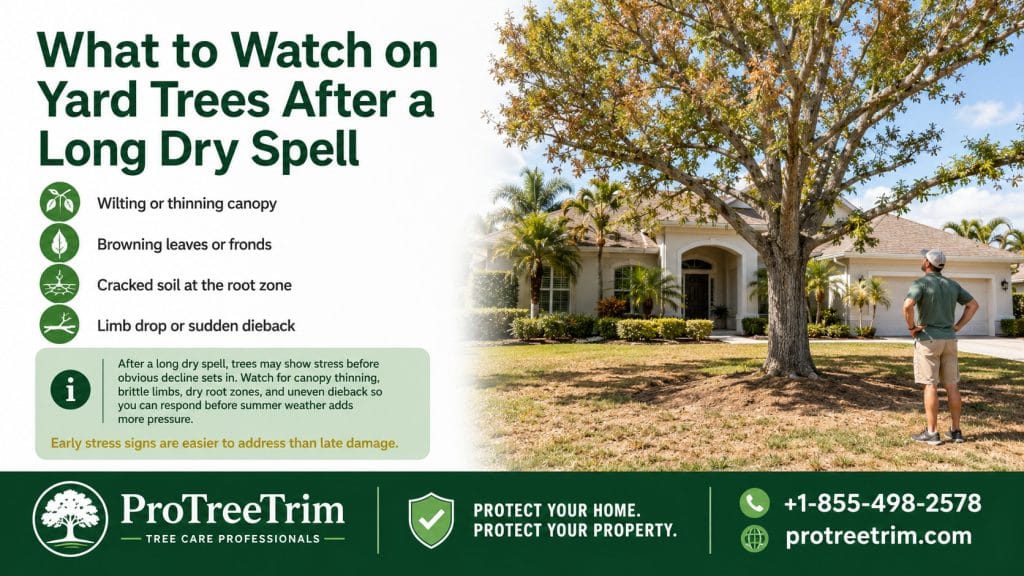
A long dry spell can leave a tree looking only slightly tired at first. The real signs may show up later: thinning leaves, dead branch tips, early leaf drop, cracked soil, exposed roots, or limbs that become more brittle before the next round of rain and wind. Homeowners should look at both the canopy and the ground before assuming the tree will bounce back on its own.
Dry Stress Does Not Always Look Dramatic
Some trees show stress quietly. Leaves may look dull, smaller, curled, or thinner than usual. A shade tree may drop leaves early. A palm may hold older fronds longer or look sparse around the crown. Young trees and recently planted palms often show stress faster than mature trees because their root systems are still limited.
A dry spell can also make older problems easier to see. Soil may pull away from the trunk base. Mulch beds may crack. Surface roots may become more exposed. A tree near a driveway, wall, patio, or paver walkway may deal with extra reflected heat that dries the root zone faster than the rest of the yard.
Do not judge only by whether the tree is still green. A stressed tree can keep leaves while branches, roots, or soil conditions are already weakened.
| What you notice | What it may suggest |
|---|---|
| Leaves curling or wilting | Water stress or root stress |
| Early leaf drop | Tree may be reducing water loss |
| Dead tips in upper canopy | Drought stress, root issues, or prior damage |
| Soil pulling away near trunk | Drying, shrinkage, or poor root-zone moisture |
| Exposed roots | Erosion, shallow soil, or repeated dry/wet cycles |
| Branches dropping after dry weather | Deadwood or weakened limbs may be present |
| One side thinning more than the other | Root damage, reflected heat, or localized stress |
Check the Soil Before You Start Cutting
A common mistake is to respond to dry-looking trees with pruning. That is not always the right first move.
Leaves help a tree produce energy. Removing live canopy from a stressed tree can make recovery harder unless there is a clear safety reason for the cut. Dead, cracked, or hanging limbs over a roof, driveway, pool cage, walkway, or fence are different; those may need attention because they create a property risk.
Before pruning, check the soil and water pattern. Is irrigation reaching the root zone, or only spraying the lawn nearby? Is mulch piled against the trunk but dry underneath? Does water run off a compacted bed instead of soaking in? Is the tree competing with turf, pavers, or other landscape plants?
For Florida yards, the dry-to-wet swing matters. A tree may struggle through dry weeks, then face heavy rain and wind soon after. That shift can expose dead limbs, weakened branch connections, or root problems that were not obvious during the dry period.
What Not to Do After a Dry Spell
Do not drown the tree suddenly because it looks stressed. A root zone that has been dry for a while may not benefit from constant shallow watering. Repeated surface watering can encourage shallow roots and keep mulch wet against the trunk without helping deeper roots much.
Do not pile extra mulch against the base to “protect” it. Mulch can help conserve moisture, but it should not be mounded against bark or buried over the root flare. A thick mound may hide decay, insects, soft soil, or root problems.
Do not remove large limbs just because the tree looks thin. If the tree is already under stress, heavy pruning may create more problems unless the limb is dead, cracked, rubbing, or threatening something below.
A better approach is slower and more useful:
- Photograph the tree from the same spot every week or two.
- Check whether thinning is spreading or staying stable.
- Pull mulch back from the trunk if it is piled too high.
- Look for dead limbs over structures or high-use areas.
- Watch how the tree responds after rain returns.
- Note any recent digging, driveway work, irrigation repair, or grading near the roots.
When Dry Stress Becomes a Safety Question
Most dry-stressed trees are not emergencies. The concern rises when stress overlaps with structure.
Pay closer attention if you see dead limbs over a roof, large branches shedding bark, cracks near a branch union, mushrooms at the base after watering resumes, or a new lean after the soil shifts. A tree that looked only “dry” may actually have root damage, decay, or old storm injury showing up late.
Location matters. A thinning tree in an open corner of the yard is one concern. A thinning oak over a driveway, a palm near a pool cage, or a tree beside a bedroom window deserves a more cautious look.
If you are unsure whether a dry-stressed tree, palm, root issue, or dead limb needs professional attention before the next storm pattern, ProTreeTrim can help connect homeowners with local tree service support. Call +1-855-498-2578 or visit protreetrim.com.
FAQs
Will a tree recover after a long dry spell?
Some trees recover once soil moisture improves, but recovery depends on root condition, species, age, prior damage, and how long the stress lasted.
Should I prune a tree that looks dry or thin?
Not automatically. Remove hazardous dead or broken limbs when needed, but avoid heavy live pruning while the tree is already stressed.
Is leaf drop after dry weather always bad?
No. Some trees drop leaves to reduce stress. The concern grows if leaf loss is severe, one-sided, paired with dead limbs, or followed by branch failure.
What should I check before storms return?
Look for dead limbs, cracked branches, exposed roots, soil movement, canopy thinning, and trees leaning toward roofs, driveways, fences, or pool cages.
ProTreeTrim™ can help you take the next step.
If you are dealing with a damaged tree, fallen branch, stump, root issue, palm concern, or storm cleanup question in Florida, call ProTreeTrim for tree service support.