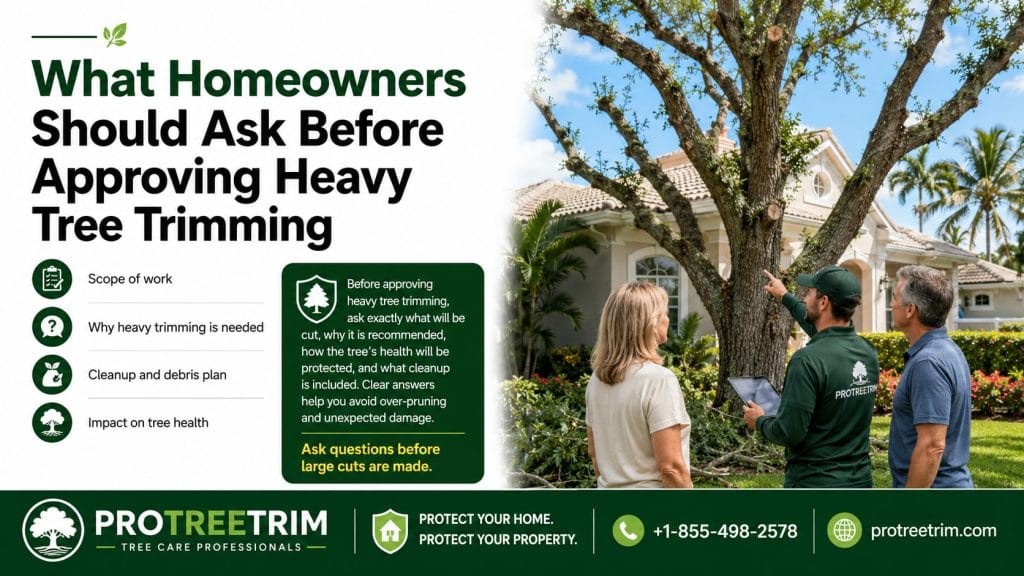
Heavy tree trimming should never be approved with a vague “cut it back” instruction. Before work starts, homeowners should understand which limbs are being removed, why those cuts are needed, how much live canopy will come off, and whether the crew has a plan for roofs, driveways, fences, pavers, pool cages, and irrigation.
Ask What Problem the Trimming Is Solving
A large tree can feel intimidating, especially if limbs hang over the house or driveway. Still, size alone is not a pruning plan. The first question should be simple: What specific risk or conflict are we trying to fix?
A good answer may mention dead limbs, roof clearance, a cracked branch, branches rubbing a structure, weight reduction on an overextended limb, or clearance over a walkway. A weak answer sounds like: “We’ll just thin it out,” or “We’ll take a lot off so you don’t have to worry.”
ISA’s TreesAreGood guidance says each cut can change tree growth, so no branch should be removed without a reason. Common reasons include removing dead branches, improving form, increasing safety, and corrective or preventive work.
| Ask this before approving | Why it matters |
|---|---|
| Which limbs are being removed? | Prevents vague, excessive cutting |
| Why are those limbs being cut? | Separates risk reduction from guesswork |
| How much live canopy will be removed? | Too much can stress mature trees |
| Will the tree still look balanced? | Reduces lopsided structure and future risk |
| How will large limbs be lowered? | Protects roofs, fences, pool cages, and pavers |
| What cleanup is included? | Avoids surprise debris or hauling issues |
Be Cautious With “A Lot Needs to Come Off”
Heavy trimming can be appropriate in some situations, but it should have a clear reason. UF/IFAS notes that on mature trees, there should be a very good reason, such as reducing the likelihood of branch failure, before removing more than 10 percent of live foliage.
That does not mean every tree has the same limit or that homeowners should calculate percentages from the yard. It means a mature tree should not be stripped simply because it looks dense. Leaves are how the tree produces energy. Removing too much live canopy can stress the tree, trigger weak sprouting, or leave limbs exposed.
For large trees, UF/IFAS also cautions that removing more than about 15 to 20 percent of live foliage at one time can lead to sprouting, and that mature trees often need less than that.
Ask How the Property Will Be Protected
A pruning plan is not only about the tree. It is also about what sits under the tree.
If heavy limbs are over a roof, driveway, pool enclosure, fence, patio, or vehicle area, ask how they will be controlled as they come down. Will limbs be lowered in sections? Will pavers or lawn areas be protected? Does the crew know where irrigation heads, septic areas, lighting wires, or pool equipment are located?
This is especially important in Florida yards where live oaks, palms, sandy soil, pool cages, and tight side yards often overlap. A branch cut correctly can still cause damage if it is dropped carelessly.
Before work begins, take photos of the tree and the surrounding property. Photograph the roofline, pavers, fences, screens, irrigation areas, and access route. It is not about expecting something to go wrong. It is about starting the job with clear records.
Know the Difference Between Pruning and Hiding a Bigger Problem
Sometimes heavy trimming is being used to avoid a harder decision. A tree with a split trunk, lifted roots, severe lean, hollow base, or repeated large limb failures may not be fixed by cutting more branches.
In that case, the right question is not “How much can we trim?” It is “Is pruning enough to reduce the risk, or does this tree need a different plan?”
If you are unsure whether a tree, palm, roofline limb, or overgrown canopy needs pruning, risk reduction, or removal planning, ProTreeTrim can help connect homeowners with local tree service support. Call +1-855-498-2578 or visit protreetrim.com.
FAQs
Is heavy tree trimming bad for a tree?
It can be if too much live canopy is removed without a clear reason. Mature trees usually need careful, selective cuts rather than aggressive cutbacks.
What is a red flag before tree trimming starts?
Be cautious if the crew cannot explain which limbs will be removed, why they are being removed, or how nearby property will be protected.
Should I approve trimming just to make the tree shorter?
Not without a better reason. Height reduction by harsh cutting can create weak regrowth and does not always reduce risk.
What should be included in a trimming estimate?
The estimate should describe the scope: limbs to be removed or reduced, cleanup, hauling, stump or debris work if relevant, and any access concerns.
ProTreeTrim™ can help you take the next step.
If you are dealing with a damaged tree, fallen branch, stump, root issue, palm concern, or storm cleanup question in Florida, call ProTreeTrim for tree service support.