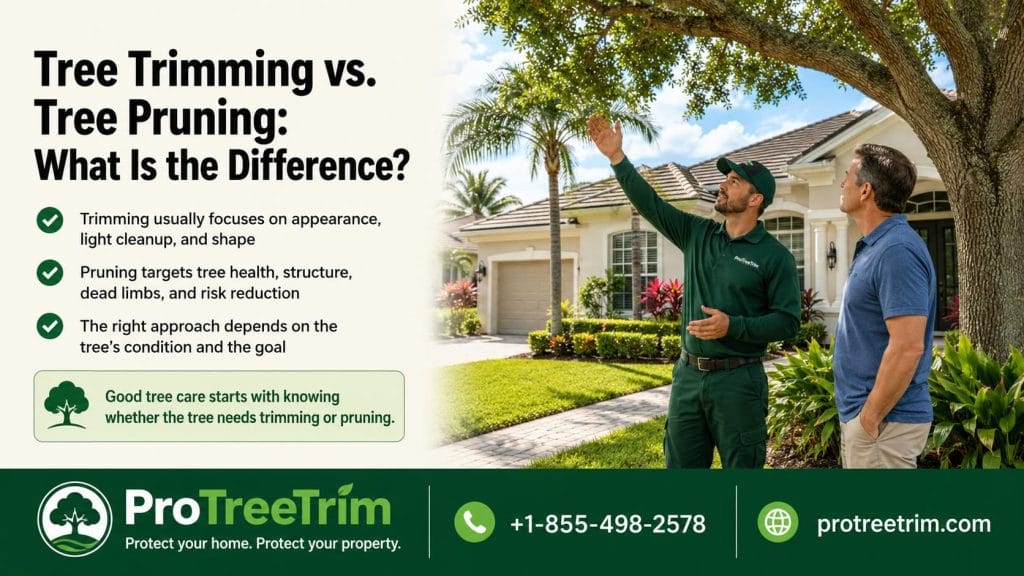
Tree trimming and tree pruning are often used like they mean the same thing. In everyday conversation, many homeowners say “trim the tree” when they want branches cut back. But in practice, trimming and pruning can have different goals.
Tree trimming is often about appearance, clearance, and keeping branches away from homes, fences, driveways, walkways, or pool areas. Tree pruning is usually more focused on tree structure, health, deadwood, storm risk, branch defects, and long-term growth.
The best question is not “Do I need trimming or pruning?”
It is “What problem am I trying to solve?”
Tree Trimming Is Often About Clearance and Appearance
Homeowners usually ask for trimming when branches are getting in the way or making the yard look overgrown.
Tree trimming may involve:
- cutting branches away from the roof
- clearing limbs over a driveway
- improving walkway clearance
- shaping small ornamental trees
- cutting back branches from a fence
- clearing branches from a pool cage
- reducing branches touching siding or gutters
- cleaning up low growth near the yard
This type of work can be useful when done carefully. The risk is that “trimming” can become too vague. If the instruction is only “cut it back,” too much healthy growth may be removed.
Tree Pruning Is Usually More Purposeful
Tree pruning should have a clearer reason. It is often about improving structure, reducing risk, removing dead or damaged branches, and helping the tree grow in a better direction over time.
Pruning may focus on:
| Pruning goal | Why it matters |
|---|---|
| Deadwood removal | Reduces falling-branch concerns |
| Broken branch removal | Cleans up storm or mechanical damage |
| Structural correction | Helps young trees develop better form |
| Rubbing branch removal | Prevents wounds and weak points |
| Clearance pruning | Keeps branches off roofs, driveways, and walkways |
| Crown cleaning | Removes dead, diseased, or damaged material |
| Risk reduction | Addresses branches over important targets |
| Corrective pruning | Improves poor past cuts or weak growth |
Good pruning is not simply cutting more. It is cutting the right branches for the right reason.
The Words Matter Less Than the Scope
A homeowner may call it trimming. A tree professional may call it pruning. The name matters less than the work being described.
A good job scope should answer:
- Which branches are being removed?
- Why are they being removed?
- Are they dead, broken, rubbing, or hazardous?
- Are they touching a roof, driveway, pool cage, or walkway?
- How much live canopy will be removed?
- Will the tree keep a natural shape?
- Are any large cuts involved?
- Is the tree already stressed?
If the scope is specific, the word choice is less important. If the scope is vague, the tree may be at risk of over-cutting.
“Trim It Back” Can Be Risky
The phrase “trim it back” sounds simple, but it can lead to poor work if no one defines how much and why.
A crew may interpret that as:
- cutting branches back from the house
- reducing the canopy broadly
- removing lower limbs
- thinning the inside
- cutting branch ends randomly
- topping the tree
- shaping the tree like a hedge
Those are very different outcomes.
A better request is more specific:
- “Clear branches touching the roofline.”
- “Remove dead limbs over the driveway.”
- “Lift low branches enough for walkway clearance.”
- “Remove broken storm-damaged branches.”
- “Preserve the natural canopy.”
- “Do not top the tree.”
- “Do not remove healthy green palm fronds.”
Specific instructions protect the tree and the homeowner.
Tree Trimming for Roof Clearance
Roof clearance is one of the most common reasons homeowners request tree trimming. Branches touching shingles, gutters, fascia, or siding can create repeated contact, debris buildup, and maintenance issues.
Good roofline trimming should focus on:
- branches physically touching the roof
- limbs rubbing gutters
- deadwood over the roof
- branches dropping debris into roof valleys
- small clearance cuts where possible
- preserving the tree’s structure
Poor roofline trimming cuts the entire side of the tree flat. That can create ugly regrowth, imbalance, and unnecessary stress.
Tree Pruning for Deadwood
Deadwood removal is one of the clearest pruning goals. Dead branches no longer help the tree and may fall, especially during wind, rain, or storms.
Deadwood matters more when branches are over:
- driveways
- sidewalks
- patios
- pool cages
- fences
- parked vehicles
- rooflines
- outdoor seating areas
- neighbor property
A dead limb over open lawn may be less urgent. A dead limb over a driveway or roof deserves faster attention.
Pruning Young Trees Is Different From Trimming Mature Trees
Young trees often need light structural pruning. The goal is to guide the tree before problems become large.
Young-tree pruning may address:
- competing leaders
- crossing branches
- weak branch angles
- broken branches
- low limbs that will become future clearance issues
- poor spacing between main branches
This is not the same as trimming a mature tree for roof clearance. Small cuts on a young tree can prevent large cuts later.
Mature Trees Need More Conservative Decisions
Mature trees should not be cut heavily without a clear reason. Large branches store energy, support structure, and create shade. Removing too much live canopy can stress the tree.
Mature tree pruning should usually focus on:
- dead branches
- broken limbs
- storm damage
- roof or driveway conflicts
- rubbing or cracked branches
- weak branch unions
- safety concerns
- clearance where necessary
A mature tree should not be made smaller just because it is large. If the tree is truly too large for the site, repeated trimming may not be the best long-term answer.
Palm Trimming Is a Special Case
Palm trimming is often requested for appearance, but palms need careful handling. Removing fully dead fronds, broken fronds, or seed pods can be appropriate. Removing too many green fronds can stress the palm.
Good palm trimming may include:
- fully dead fronds
- broken fronds
- fronds touching roofs
- fronds resting on pool cages
- seed pods over driveways or patios
- hanging storm-damaged fronds
Poor palm trimming removes healthy green fronds just to create a tight, stripped look.
A palm should look maintained, not scalped.
Trimming for Shape Can Become Over-Pruning
Some ornamental trees need light shaping. But shaping becomes harmful when the tree is cut into an unnatural form or repeatedly forced smaller than it wants to be.
Be careful with:
- crape myrtles cut back hard every year
- hedged trees that are not true hedges
- large shade trees trimmed like shrubs
- palms stripped for appearance
- branches cut only at the ends
- repeated cuts at the same points
- “rounding over” mature trees
A tree should be guided, not repeatedly punished for growing.
Crown Cleaning vs. Crown Thinning
These terms are often confused.
Crown cleaning usually means removing dead, diseased, broken, or damaged branches. It is often a practical and conservative pruning goal.
Crown thinning means selectively removing live branches to reduce density. This must be done carefully. Too much thinning can remove useful leaf area, expose interior branches, and weaken the tree’s natural structure.
For many homeowners, crown cleaning is more appropriate than heavy thinning.
Do Not Confuse Pruning With Topping
Topping is not proper trimming or pruning. Topping means cutting back large limbs or the top of a tree to stubs. It creates large wounds, weak sprouts, poor structure, and long-term problems.
Avoid any tree-care plan that sounds like:
- “Cut the top off.”
- “Take it down by half.”
- “Make it much smaller.”
- “Cut all the limbs back hard.”
- “Leave only the main trunk and stubs.”
- “Flat-top it.”
A tree that needs height reduction may need a more thoughtful plan, and sometimes removal and replacement is more realistic than topping.
What Homeowners Should Ask Before Hiring
Before hiring tree work, ask practical questions.
| Question | Why it matters |
|---|---|
| What branches will be removed? | Prevents vague over-cutting |
| Why are they being removed? | Confirms the pruning goal |
| How much live canopy will be removed? | Helps avoid over-pruning |
| Will the tree be topped? | Topping should be avoided |
| Are branches near utilities? | Safety issue |
| Will roof clearance be selective? | Avoids flat-sided cutting |
| Will deadwood be removed? | Addresses risk |
| Will debris be hauled away? | Prevents unfinished cleanup |
A good tree-care scope should sound specific and measured.
When Trimming Makes Sense
Tree trimming may make sense when branches are interfering with daily property use.
Trimming may be appropriate for:
- roofline clearance
- driveway clearance
- walkway clearance
- pool cage clearance
- fence-line branches
- small ornamental shaping
- entryway visibility
- branches blocking service access
The work should still protect the tree’s natural structure.
When Pruning Makes Sense
Tree pruning may make sense when the tree has health, structure, or risk concerns.
Pruning may be appropriate for:
- deadwood
- broken limbs
- cracked branches
- storm damage
- rubbing branches
- young-tree structure
- weak unions
- branches over targets
- corrective work after bad cuts
The best pruning has a purpose beyond appearance.
When Cutting Should Wait
Sometimes the best decision is to wait.
Cutting may be better delayed when:
- the tree is drought-stressed
- the tree was recently transplanted
- roots were recently damaged
- the canopy is already thin
- pruning is only cosmetic
- cuts would be large
- the tree was recently over-pruned
- the cause of decline is unclear
If no branch is hazardous or conflicting with property use, waiting can be better than unnecessary cutting.
When Cutting Should Not Wait
Cutting should not wait when there is a clear risk.
Act sooner when:
- a broken branch is hanging
- a dead limb is over a driveway
- a branch is touching the roof
- a limb is blocking a walkway
- storm damage created cracked branches
- a palm frond rests on a pool cage
- a branch is near service lines
- a limb is resting on a fence or structure
The work should solve the urgent problem without turning into excessive pruning.
What a Good Scope Sounds Like
A good scope:
- “Remove deadwood over the driveway.”
- “Clear branches touching the gutter line.”
- “Remove broken storm-damaged limb over the patio.”
- “Lightly prune crossing branches on the young tree.”
- “Remove dead palm fronds and seed pods over the pool deck.”
- “Preserve the tree’s natural canopy.”
A poor scope:
- “Cut it way back.”
- “Thin it out a lot.”
- “Make it smaller.”
- “Top it.”
- “Remove all the lower limbs.”
- “Hurricane-cut the palm.”
- “Shape it however.”
Specific work leads to better results.
Final Homeowner Takeaway
Tree trimming and tree pruning are closely related, but they often focus on different goals. Trimming is usually about clearance and appearance. Pruning is usually about structure, health, deadwood, and risk reduction.
The words matter less than the scope. Before any branches are cut, know what problem the work is solving. Avoid topping, over-thinning, and vague “cut it back” requests. A healthy tree should look safer, cleaner, and more natural after work—not stripped or stressed.
If you are unsure whether your tree needs trimming, pruning, deadwood removal, roof clearance, or a more careful risk review, ProTreeTrim can help connect homeowners with local tree service support. Call +1-855-498-2578 or visit protreetrim.com.
FAQs
Is tree trimming the same as tree pruning?
They are often used interchangeably, but trimming usually focuses on clearance and appearance, while pruning is more focused on structure, health, and risk reduction.
Which is better, trimming or pruning?
Neither word is automatically better. What matters is whether the work has a clear purpose and protects the tree’s long-term health.
Is cutting branches away from a roof trimming or pruning?
It may be called either, but the goal is roof clearance. The work should be selective and avoid cutting the tree flat on one side.
Is topping a tree the same as pruning?
No. Topping is harmful and should not be considered proper pruning.
ProTreeTrim™ can help you take the next step.
If you are dealing with a damaged tree, fallen branch, stump, root issue, palm concern, or storm cleanup question in Florida, call ProTreeTrim for tree service support.