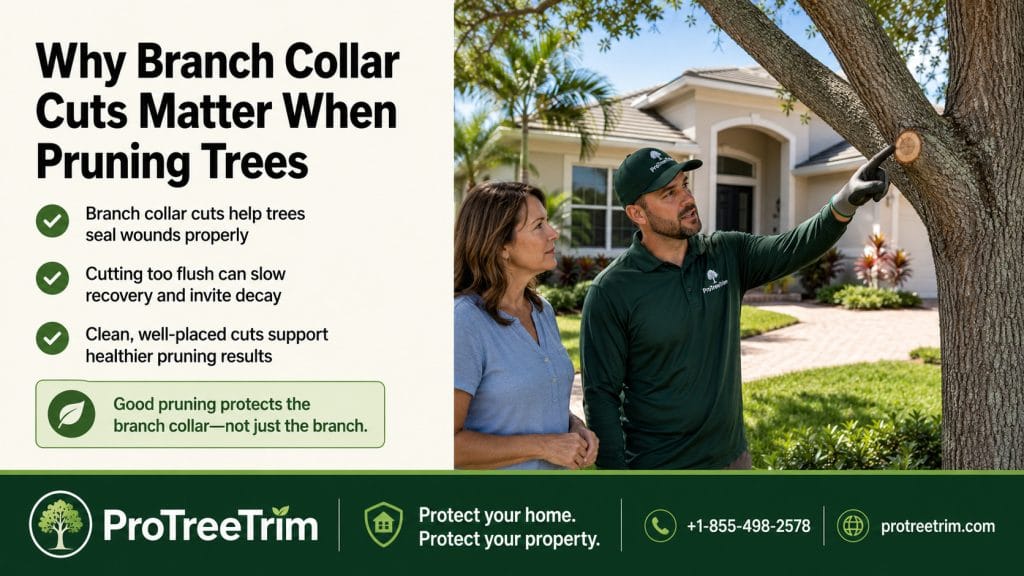
A pruning cut is not just about removing a branch. Where the cut is made can affect how the tree responds for years. Cutting too close to the trunk, leaving a long stub, or tearing bark can turn a simple pruning job into a future wound, decay pocket, or structural concern. That is why the branch collar matters.
What Is the Branch Collar?
The branch collar is the slightly swollen area where a branch connects to the trunk or a larger limb. It may look like a raised ring, shoulder, or thicker transition zone at the base of the branch.
That area is important because it contains tissue the tree uses to close around the wound after the branch is removed. A proper cut removes the branch without cutting into the collar.
| Cut type | Why it matters |
|---|---|
| Proper collar cut | Gives the tree a better chance to close over the wound |
| Flush cut against trunk | Removes protective tissue and creates a larger wound |
| Long stub | Leaves dead wood that may decay before closure |
| Torn branch | Rips bark and enlarges the injury |
| Random heading cut | Can trigger weak regrowth or poor structure |
| Large unnecessary cut | Creates a wound the tree may struggle to close |
A good cut may not look dramatic. It simply respects the natural connection point between branch and tree.
Flush Cuts Are a Common Mistake
A flush cut is made flat against the trunk or main limb. It may look “clean” to a homeowner because no bump or collar remains. But that smooth look is misleading.
When the branch collar is removed, the tree loses part of the tissue that helps close the wound. The cut surface may be larger than necessary, and the trunk tissue may be injured. Over time, that can increase the chance of poor closure, decay, or a wound that stays open longer than it should.
This is especially important on large branches. A small bad cut may be minor. A large flush cut on a mature tree near a roof, driveway, pool cage, or walkway can become part of a larger tree-health and risk conversation later.
Stubs Are Not Better
Some homeowners avoid cutting too close by leaving a long stub. That creates a different problem.
A stub is no longer supported by living branch growth. It can die back, dry out, decay, and prevent the wound from closing properly. The tree may eventually grow around the base, but the dead stub can remain as a weak, decaying section.
A proper cut is not flush and not a stub. It is made just outside the branch collar.
Large Branches Need a Different Cutting Method
Large limbs should not be cut in one heavy pass. The branch can split, tear bark, or peel down the trunk before the cut is finished.
A safer method usually involves removing weight first, then making the final cut near the branch collar. This is often called a three-cut method: one small undercut, one outer cut to remove the weight, and one final collar cut.
For homeowners, the practical lesson is simple: if the branch is large enough to tear bark, swing, or fall unpredictably, it is probably not a casual DIY cut.
Why Bad Cuts Show Up Later
Poor pruning does not always look terrible the next day. The tree may still be green. The branch may be gone. The yard may look cleaner.
The problem can show later:
- bark starts peeling around the old cut
- decay develops behind a large wound
- water sprouts grow around the cut
- the tree produces weak regrowth
- a cavity forms at an old pruning site
- deadwood appears above or near the wound
- insects or fungi take advantage of damaged tissue
This is why a cheap pruning job can become expensive later. The cut may be quick; the tree lives with the wound.
Do Not Use Wound Paint to Fix a Bad Cut
Painting or sealing a bad pruning cut does not turn it into a good cut. A sealer may hide the wound, but it does not replace the branch collar, remove a stub properly, or undo torn bark.
The better approach is to make the right cut in the first place. If a bad cut has already been made, the next step depends on the situation. A long stub may be correctable. A flush cut cannot be “put back.” A torn limb may need careful cleanup. A large old wound may simply need monitoring.
When Branch Collar Cuts Matter Most
They matter on every pruning cut, but they matter most when the branch is large, attached to the trunk, near a structure, or part of a mature tree’s main canopy.
Pay extra attention when pruning:
| Situation | Why the cut matters more |
|---|---|
| Large lower limb | Big wound close to trunk |
| Branch over roof or driveway | Poor cut may create future risk |
| Storm-broken limb | Bark tearing may already be present |
| Mature oak or shade tree | Large wounds close slowly |
| Tree already stressed | Recovery may be weaker |
| Branch near old decay or cavity | Bad cuts can worsen the problem |
| Recently topped tree | More poor cuts can add stress |
What to Ask a Tree Crew
Before approving pruning, ask how the branches will be removed. A good crew should understand collar cuts, avoid flush cuts, and avoid leaving long stubs.
Ask:
- Will branches be cut outside the branch collar?
- Are any large limbs being removed?
- Will heavy limbs be lowered or cut in sections?
- Are there existing bad cuts or old stubs?
- Are we removing deadwood only, or live branches too?
- Will the tree keep its natural structure?
- Will debris be hauled away?
- Are roof, driveway, pool cage, fence, or utility conflicts involved?
If someone says, “We’ll just cut everything close to the trunk,” that is a warning sign.
When to Leave the Branch Alone
Sometimes the best cut is no cut. If a healthy large branch is not touching anything, not cracked, not dead, and not causing a real clearance issue, removing it may create a bigger wound than the branch is worth.
This is especially true on mature trees. Large live-limb removal should have a clear reason: roof contact, driveway clearance, structural defect, storm damage, disease, or a specific risk issue. Pruning for appearance alone can be costly to the tree.
If you are unsure whether a branch should be removed, shortened, or left alone, ProTreeTrim can help connect homeowners with local tree service support. Call +1-855-498-2578 or visit protreetrim.com.
FAQs
What is a branch collar?
The branch collar is the slightly swollen area where a branch joins the trunk or a larger limb. Proper pruning cuts usually stay just outside this area.
Is a flush cut bad for a tree?
Yes, it can be. A flush cut removes important collar tissue and creates a larger wound than necessary.
Is it okay to leave a branch stub?
No. A long stub can die back, decay, and prevent proper wound closure.
Can pruning paint fix a bad cut?
No. Wound paint does not replace a proper cut. The best protection is a clean cut in the right location.
ProTreeTrim™ can help you take the next step.
If you are dealing with a damaged tree, fallen branch, stump, root issue, palm concern, or storm cleanup question in Florida, call ProTreeTrim for tree service support.