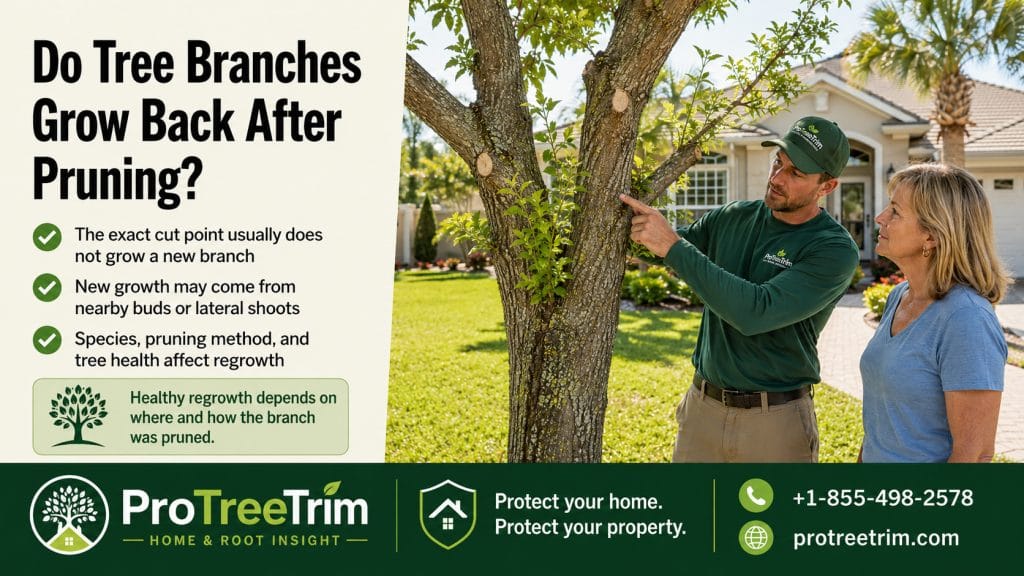
Tree branches do not always grow back after pruning. A cut branch usually does not regrow from the exact same spot in the same way. Instead, the tree may seal around the wound, redirect growth to nearby buds, or send out new shoots depending on the species, branch size, cut location, tree health, and pruning method.
This is why pruning should never be treated as a simple “it will grow back” decision. Some cuts are temporary. Some cuts are permanent. Some create weak regrowth that becomes a bigger problem later.
A Cut Branch Usually Does Not Rebuild Itself
When a branch is removed correctly, the tree does not replace that branch like a lizard growing a new tail. The tree grows around the wound and may produce new growth nearby, but the original branch is gone.
| What was cut | What may happen |
|---|---|
| Small young branch | Tree may close over the wound well |
| Large mature limb | Wound may remain visible for years |
| Branch cut to a stub | Stub may die and decay |
| Branch cut flush to trunk | Wound may close poorly |
| Topped limb | Weak shoots may grow near the cut |
| Palm frond | It will not grow back from that cut point |
| Evergreen branch cut into bare wood | It may stay bare |
The result depends heavily on how the cut was made.
New Shoots Are Not the Same as the Old Branch
After pruning, some trees produce new shoots near the cut. Homeowners may think this means the branch “grew back.” But those shoots are not always strong replacements.
Fast regrowth after a bad cut can be weak, crowded, and poorly attached.
This often happens after:
- topping
- cutting branches to stubs
- removing large limbs suddenly
- over-thinning
- heavy size reduction
- repeated harsh pruning
- cutting into stressed trees
The tree is reacting to injury. That reaction is not always healthy structure.
Proper Pruning Helps the Tree Seal the Wound
A good pruning cut is made just outside the branch collar. The branch collar is the natural raised area where the branch joins the trunk or a larger limb. When the cut respects this area, the tree has a better chance of sealing around the wound.
A proper cut should:
- preserve the branch collar
- avoid cutting flush against the trunk
- avoid leaving a long stub
- avoid tearing bark
- avoid unnecessary large wounds
- remove only branches with a clear reason
The goal is not to make the branch grow back. The goal is to help the tree respond well to the cut.
Stubs Often Create Bad Regrowth
When a branch is cut back to a long stub, the remaining stub usually dies. It may crack, decay, or send out weak sprouts. Those sprouts can grow quickly but may not be well attached.
A stub can create:
| Problem | Why it matters |
|---|---|
| Dead wood | Stub may decay over time |
| Weak sprouts | New growth may attach poorly |
| Ugly regrowth | Tree may look crowded or unnatural |
| Repeated pruning need | Sprouts often need future correction |
| Slow wound closure | Tree may not close around the stub well |
| Insect or decay activity | Dead wood can attract problems |
This is why “leave a little extra” is not always safer. A long stub is usually not good pruning.
Flush Cuts Are Also a Problem
A flush cut removes the branch too close to the trunk. It may look clean at first, but it damages the branch collar and creates a larger wound than necessary.
Flush cuts can slow the tree’s wound response and increase the chance of decay around the cut.
A branch should not be cut:
- flat against the trunk
- into the trunk wood
- through the branch collar
- so close that the natural swelling is removed
- for appearance only
A clean-looking cut can still be biologically wrong.
Topped Trees Often Grow Back Weakly
Topping is one of the main reasons homeowners see fast regrowth after pruning. When the top or major limbs are cut back to stubs, the tree may push many new shoots near the cuts.
This can look like recovery, but it is often a stress response.
Topping can lead to:
- weakly attached shoots
- crowded regrowth
- large decay-prone wounds
- repeated future cutting
- poor structure
- increased long-term risk
- unnatural tree shape
A topped tree may grow back quickly, but not necessarily safely or strongly.
Small Cuts Usually Close Better Than Large Cuts
Small branch cuts on healthy trees usually close more easily than large limb removals. This is why early structural pruning matters. Removing a small crossing branch on a young tree is very different from removing a large mature limb years later.
Large cuts are more likely to:
- remain visible for years
- close slowly
- expose more wood
- invite decay concerns
- affect tree balance
- trigger weak sprouts
- change canopy shape permanently
Before removing a large limb, the reason should be clear.
Dead Branches Will Not Come Back
A dead branch will not become alive again. If a branch is truly dead, removing it does not stop future growth from that branch because it was already gone biologically.
Deadwood pruning can still be very useful because it removes branches that may fall, decay, or create property concerns.
Dead branches should be prioritized when they are over:
- driveways
- sidewalks
- roofs
- patios
- pool cages
- parked vehicles
- fences
- outdoor seating
- neighbor property
A dead branch over open lawn may be less urgent. A dead branch over a roof or driveway deserves more attention.
Evergreen Branches May Not Fill Back In
Evergreens can be less forgiving than some leafy trees. If a pine, spruce, fir, arborvitae, or similar evergreen is cut back into old bare wood, it may not produce new growth from that spot.
This matters for privacy trees and screening plants.
Be careful when pruning:
- arborvitae
- junipers
- spruce
- fir
- pine
- cedar-like evergreens
- privacy rows
- foundation evergreens
Cutting too deeply can leave permanent bare spots.
Pine Branches Usually Do Not Regrow From Bare Wood
Pines need special caution. If a pine branch is cut back too far, it may not fill in. If a pine branch is removed completely, that exact branch is gone.
Interior needle drop on pine is not the same as branch death, but once a pine branch is fully dead or cut back into bare wood, recovery is limited.
Avoid:
- topping pines
- cutting into bare older wood
- removing large live limbs without reason
- shearing mature pines like hedges
- assuming brown branches will refill
Pine pruning should be selective.
Palms Do Not Grow Back Cut Fronds
Palm fronds do not grow back from the cut point. Once a frond is removed, that frond is gone. The palm produces new fronds from the crown, not from where old fronds were cut.
This is why removing too many green palm fronds can stress the palm.
Good palm pruning removes:
- fully dead fronds
- broken fronds
- hazardous hanging fronds
- seed pods when needed
- fronds touching roofs or pool cages
Bad palm pruning removes healthy green fronds just to make the palm look cleaner.
Lower Branches Removed for Clearance Are Usually Gone Permanently
When lower branches are removed for driveway, sidewalk, or lawn clearance, those exact branches usually do not return. The tree may produce small sprouts, but the original lower limb is gone.
This is why crown raising should be gradual and thoughtful.
Lower branches should not be removed too aggressively because they help:
- support natural form
- protect trunk bark
- contribute energy
- balance canopy structure
- develop young tree strength
Clearance is important, but over-lifting can permanently change the tree.
Young Trees Can Be Guided More Easily
Young trees often respond better to pruning because cuts are smaller and the tree is still developing. If a young tree has crossing branches, competing leaders, or low limbs that will cause future clearance problems, early pruning can help.
Young tree pruning should focus on:
- broken branches
- crossing limbs
- rubbing branches
- competing leaders
- weak branch angles
- future driveway clearance
- future roofline clearance
- natural structure
The goal is not regrowth from every cut. The goal is better future structure.
Mature Trees Need More Conservative Cuts
Mature trees do not recover from large cuts as easily as young trees. A mature oak, maple, pine, sycamore, or other large tree may carry pruning wounds for years.
Before pruning mature trees, ask:
- Is the branch dead or broken?
- Is it touching a structure?
- Is it cracked or hazardous?
- Is it over a driveway or roof?
- Is there decay or weakness?
- Is there a smaller cut that solves the problem?
- Will removal unbalance the tree?
- Is the tree already stressed?
Do not remove large mature limbs just because “they will grow back.” They may not.
Sprouts After Pruning Need Monitoring
Sometimes new shoots appear around a pruning cut. These may be called sprouts, water sprouts, or epicormic shoots depending on where and how they grow. They may develop after stress, topping, sun exposure, or heavy pruning.
Not all sprouts are bad, but many are weak or crowded.
Watch for sprouts that are:
- growing from old stubs
- crowded around a large cut
- very vertical and fast-growing
- attached weakly
- growing toward a roof or structure
- forming after topping
- creating dense regrowth in one spot
These may need future corrective pruning.
Do Not Prune Just to Force New Growth
Pruning can stimulate growth in some situations, but that does not mean cutting is always good. Forcing new growth with heavy pruning can create weak, fast, poorly attached shoots.
Avoid pruning just to:
- make the tree bushier
- force branches to grow lower
- create quick shade
- make a topped tree fill in
- hide bare evergreen spots
- make a palm replace fronds faster
- repair a tree that was cut too hard
Good pruning works with the tree’s structure, not against it.
Branches Near Roofs and Driveways Need Careful Decisions
Branches near homes often need pruning, but homeowners should understand that removed limbs may not return. If a large shade limb is cut from the house side, the tree may look uneven for years.
Roof and driveway pruning should focus on:
- branches touching shingles
- limbs rubbing gutters
- deadwood over the driveway
- broken storm limbs
- branches blocking access
- limbs that are cracked or weak
- selective clearance instead of flat cutting
The goal is property protection while preserving natural form.
When Regrowth Is a Warning Sign
Fast regrowth after pruning may be a warning that the tree was cut too hard. If a tree produces many shoots around large cuts, it may be trying to replace lost leaf area quickly.
This can happen after:
| Cause | Possible result |
|---|---|
| Topping | Many weak shoots near cuts |
| Over-thinning | Stress sprouts inside canopy |
| Large limb removal | Sprouts near wound |
| Root stress plus pruning | Weak, irregular growth |
| Severe storm damage | Recovery sprouts after canopy loss |
| Repeated hard cuts | Dense regrowth cycle |
Regrowth is not always proof of good pruning. Sometimes it is proof the tree is reacting to stress.
What Homeowners Should Ask Before Cutting
Before pruning, ask:
- Will this branch actually grow back?
- Is this cut permanent?
- Is the branch dead, broken, rubbing, or hazardous?
- Is the cut near a branch collar?
- Is the branch too large to remove casually?
- Will the tree become unbalanced?
- Will the cut create weak sprouts?
- Is the tree an evergreen or palm that may not refill?
- Is there a smaller cut that solves the problem?
These questions prevent regret after pruning.
What a Good Pruning Scope Sounds Like
A good scope:
- “Remove the dead branch over the driveway.”
- “Make proper collar cuts.”
- “Avoid leaving stubs.”
- “Preserve natural canopy shape.”
- “Do not top the tree.”
- “Remove only branches touching the roof.”
- “Avoid cutting evergreens into bare wood.”
- “Remove only dead palm fronds and seed pods.”
A poor scope:
- “Cut it way back.”
- “It will grow back.”
- “Leave stubs so it sprouts.”
- “Top it so it fills in.”
- “Cut the evergreen smaller.”
- “Remove all the lower branches.”
- “Strip the palm.”
Good pruning assumes cuts matter.
Final Homeowner Takeaway
Tree branches do not always grow back after pruning. A removed branch is usually gone. The tree may seal the wound, redirect growth, or produce new shoots nearby, but that is not the same as replacing the original branch.
This is why proper pruning matters. Avoid topping, flush cuts, long stubs, over-thinning, and cutting evergreens into bare wood. Be especially careful with palms because removed fronds do not regrow from the cut point.
If you are unsure whether a branch should be removed, reduced, or left alone, ProTreeTrim can help connect homeowners with local tree service support. Call +1-855-498-2578 or visit protreetrim.com.
FAQs
Do tree branches grow back after pruning?
Usually not from the exact same spot in the same way. The tree may grow new shoots nearby, but the original branch is gone.
Will a branch grow back if I leave a stub?
A stub may produce weak sprouts, but it often dies and decays. Long stubs are not good pruning.
Do palm fronds grow back after cutting?
No. Cut palm fronds do not grow back from the cut point. New fronds grow from the crown.
Will evergreen branches grow back after pruning?
Not always. Many evergreens do not regrow well from old bare wood, so deep cuts can leave permanent bare spots.
ProTreeTrim™ can help you take the next step.
If you are dealing with a damaged tree, fallen branch, stump, root issue, palm concern, or storm cleanup question in Florida, call ProTreeTrim for tree service support.