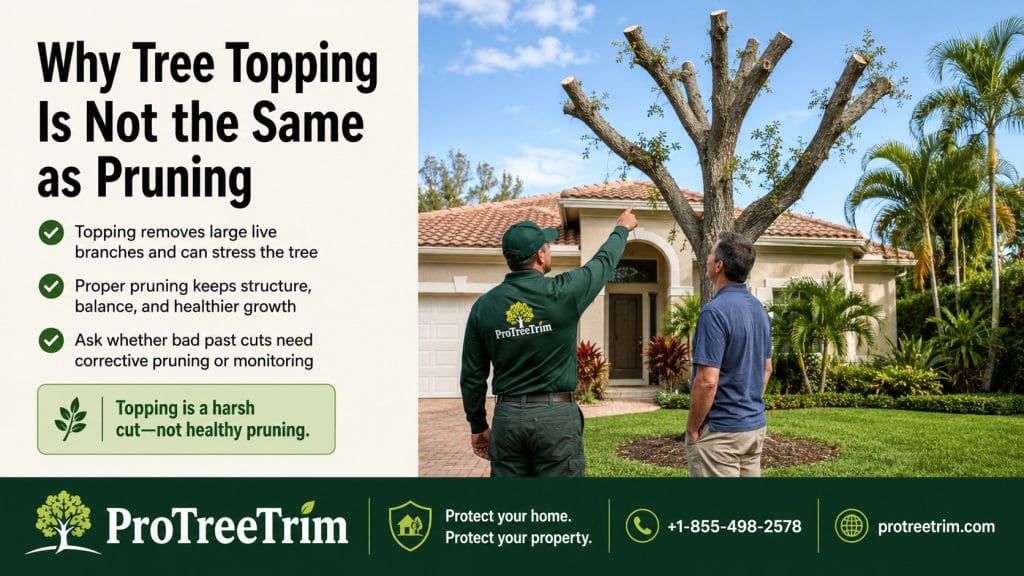
Tree topping is not careful pruning. It is the harsh cutting back of large limbs or the upper canopy, often leaving stubs and forcing the tree into survival growth. A topped tree may look smaller for a short time, but the long-term result is often more stress, weaker regrowth, more decay risk, and repeated future cutting.
What Tree Topping Really Means
Topping usually happens when someone wants a tree made shorter or “cut back hard.” Instead of selectively removing branches for structure, clearance, or safety, large limbs are cut back to stubs or to points that are not strong natural branch unions.
That may reduce the tree’s height quickly, but it does not solve the real issue. If the tree is too large for the space, growing into the roofline, interfering with wires, or overwhelming a small yard, topping only delays the bigger decision.
| What homeowners ask for | Better question to ask |
|---|---|
| “Cut the top off” | Is the tree too large for this site? |
| “Make it shorter fast” | Can selective reduction solve the issue safely? |
| “Open it way up” | Are we removing too much live canopy? |
| “Stop it from growing” | Will this create weak regrowth instead? |
| “Make it safe for storms” | Are there dead, cracked, or overextended limbs? |
| “Keep it away from the roof” | Can roofline clearance be done selectively? |
ISA’s homeowner guidance explains that topping can remove too much leaf-bearing canopy, forcing the tree to use stored energy and triggering rapid shoot growth below the cuts.
Why Topped Trees Often Become More Work Later
Topping can make a tree look controlled right after the crew leaves. Months later, the tree may push out many fast-growing shoots near the cuts. Those shoots are often not attached the same way as natural branches, and they can become the next maintenance problem.
Penn State Extension describes topped trees as sometimes producing water sprouts from cuts, while other topped trees may slowly decline in the years afterward. Older ISA material also warns that deteriorating stubs and weak sprout growth can make topped trees more vulnerable to later damage.
In homeowner terms: topping may reduce the tree today and create a more complicated tree tomorrow.
Topping Is Not Storm Preparation
One of the most common reasons homeowners ask for topping is storm fear. The thinking is understandable: a shorter tree must be safer. Unfortunately, tree risk does not work that simply.
A tree with dead limbs, cracked branches, roof contact, or poor structure may need pruning. But stripping the canopy or cutting the top off can stress the tree and encourage weak regrowth. UF/IFAS notes that reducing an entire crown can place physiological stress on a tree because many reduction cuts are required, and those cuts can contribute to discoloration or decay behind pruning wounds, especially in weaker or stressed trees.
Better storm-minded pruning is more specific:
- remove dead branches over high-use areas
- reduce or remove cracked limbs
- clear branches from rooflines and gutters
- correct rubbing or crossing branches
- reduce overextended limbs carefully
- avoid stripping the interior canopy
- avoid large unnecessary live cuts
The goal is not to make the tree look smaller. The goal is to reduce clear defects while preserving structure.
What to Do Instead of Topping
If the tree is too close to the house, too tall for the space, or repeatedly interfering with structures, ask for a real pruning plan.
A better plan may include selective reduction, roofline clearance, deadwood removal, structural pruning, or staged pruning over time. UF/IFAS says reduction pruning can control tree size to some degree, but it is not a substitute for choosing the right tree for the right site, and trees kept reduced may need ongoing pruning to stay within limits.
That is an important point for homeowners. If a large tree needs to be cut back hard every few years just to fit the yard, the problem may be placement, not pruning.
When Removal May Be More Honest Than Repeated Hard Cutting
Nobody wants to remove a good tree without reason. Mature trees provide shade, privacy, curb appeal, and character. But sometimes repeated topping or severe cutting is a sign that the tree no longer fits the space.
Removal may deserve discussion if the tree is:
- repeatedly growing into the roof
- too close to utility lines
- damaging hardscape every year
- leaning toward the home
- hollow, cracked, or declining
- dropping large limbs
- planted in a space too small for its mature size
In those cases, topping may create a cycle of stress and regrowth. A planned removal and better replacement tree may be a more responsible long-term decision.
What Homeowners Should Ask Before Approving Pruning
Before tree work begins, ask exactly what will be cut and why. A good crew should be able to explain the goal clearly.
Ask:
- Are you removing deadwood, live branches, or both?
- Will any large limbs be cut back to stubs?
- Is this topping or selective pruning?
- How much live canopy will be removed?
- Will the tree still have a natural structure afterward?
- Are we solving roof, driveway, fence, or pool cage clearance?
- Is the tree healthy enough for this work?
- Would removal be better than repeated hard cutting?
Be cautious if the answer is vague: “We will just cut it way back.” That is not enough of a plan.
If you are unsure whether a tree needs pruning, reduction, deadwood removal, roofline clearance, or a more serious long-term decision, ProTreeTrim can help connect homeowners with local tree service support. Call +1-855-498-2578 or visit protreetrim.com.
FAQs
Is tree topping the same as pruning?
No. Pruning is selective and purposeful. Topping is harsh cutting that often removes too much canopy and leaves poor branch structure behind.
Why is topping bad for trees?
Topping can remove too many leaves, stress the tree, trigger weak regrowth, and increase future maintenance or decay concerns.
Can topping make a tree safer before storms?
Not necessarily. Removing dead, cracked, or overextended limbs can help, but topping can create weak regrowth and new structural problems.
What should I ask for instead of topping?
Ask for selective pruning, deadwood removal, roofline clearance, structural pruning, or a careful reduction plan if size control is truly needed.
ProTreeTrim™ can help you take the next step.
If you are dealing with a damaged tree, fallen branch, stump, root issue, palm concern, or storm cleanup question in Florida, call ProTreeTrim for tree service support.