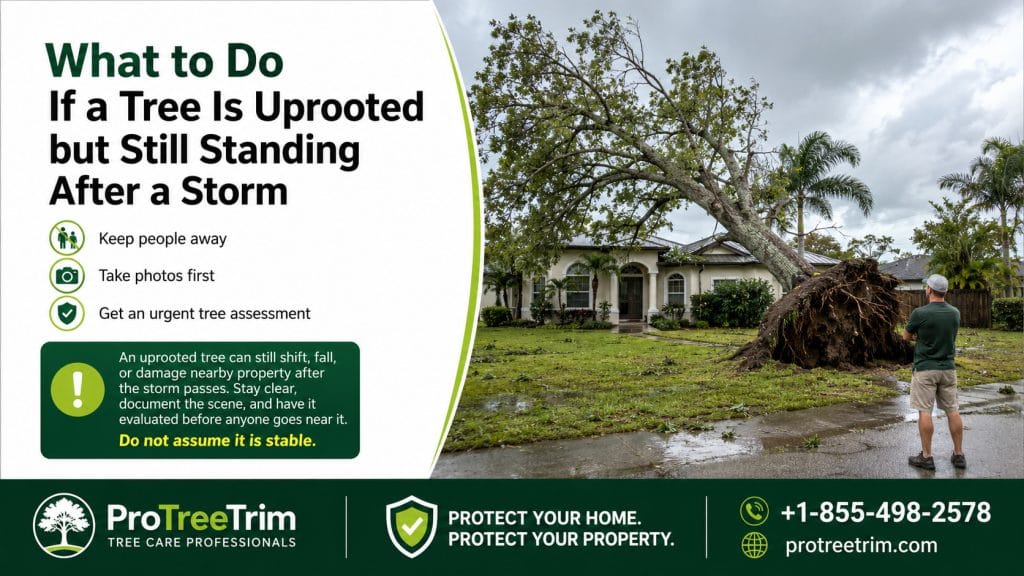
A tree that is partly uprooted but still standing should be treated as unstable until proven otherwise. In a Florida yard, heavy rain and wind can lift the root plate, crack the soil, and leave the tree balanced in a way that is hard to judge from the ground. Keep your distance, take photos, and do not try to push it back upright.
Look at the Root Plate, Not Just the Trunk
After a storm, some trees do not fall all the way. They lean, lift the soil on one side, and remain standing because roots, branches, or nearby trees are still holding part of the weight. That can make the situation look less urgent than it really is.
Start by looking at the ground from a safe distance. Is there a mound of soil lifting near the trunk? Are the roots exposed or torn? Has mulch cracked or pulled away from the base? Is the tree leaning toward a roof, driveway, pool cage, fence, septic area, or neighbor’s property?
Do not walk onto the lifted root plate. The soil may be loose, and the tree can shift. In sandy Florida soil, the area may look firm on top while the roots below have lost support.
| What you notice | Why it matters |
|---|---|
| Soil lifting on one side | Root plate may have shifted |
| Exposed or torn roots | Tree support may be compromised |
| New lean after storm | Movement likely happened recently |
| Tree resting against another tree | Weight may shift during cutting |
| Canopy aimed at a structure | Property risk is higher |
| Wet or soft ground near base | Stability may change as soil moves |
Do Not Try to Save It With Quick Fixes
A partly uprooted tree is not something to straighten with a truck, rope, or winch. Pulling on it can snap roots, shift the trunk, damage nearby pavers or fencing, and put people in the fall zone. Cutting limbs to “reduce weight” can also suddenly alter the balance.
Take photos before cleanup begins. Get the full tree, the lifted root area, the lean direction, and anything the tree could hit. If branches are already touching a roof, screen enclosure, vehicle, fence, or utility line, document that from a safe location.
Whether the tree can be saved depends on size, species, root loss, lean, soil condition, and location. A small newly planted tree may be a different conversation than a mature oak or palm that has lifted a large section of root plate. If the tree is large, leaning toward a structure, or still moving, waiting can make cleanup more dangerous.
If you are unsure whether an uprooted tree, storm-damaged root system, stump, or leaning palm needs professional attention, ProTreeTrim can help connect Florida homeowners with local tree service support. Call +1-855-498-2578 or visit protreetrim.com.
FAQs
Can an uprooted tree be saved?
Sometimes small trees can be reset, but large or mature trees with major root loss are much more complicated and may be unsafe.
Should I push the tree back upright?
No. Pulling or pushing an uprooted tree can cause it to move suddenly and pose a serious safety risk.
Is a partly uprooted tree an emergency?
It can be, especially if it is leaning toward a home, driveway, pool cage, fence, utility line, or high-use area.
ProTreeTrim™ can help you take the next step.
If you are dealing with a damaged tree, fallen branch, stump, root issue, palm concern, or storm cleanup question in Florida, call ProTreeTrim for tree service support.