A newly moved or newly planted tree can look worse before it looks better. Wilting leaves, brown edges, yellowing, early leaf drop, slow growth, or thinning can all be signs of transplant shock. The tree is trying to adjust after root disturbance, a new planting site, changed watering, and a different soil environment.
The good news: transplant shock does not always mean the tree is dying. The bad news: the wrong reaction—too much water, heavy pruning, deep mulch, or panic fertilizer—can make recovery harder.
What Transplant Shock Looks Like
Transplant shock happens when a tree’s root system cannot fully support the canopy after planting or relocation. Roots may have been cut, dried, compacted, disturbed, or placed in soil that does not drain or hold moisture the same way.
Common signs include:
| Symptom | What it may mean |
|---|---|
| Wilting leaves | Roots cannot keep up with water demand |
| Brown leaf edges | Moisture stress or root stress may be involved |
| Yellow leaves | Water, roots, planting depth, or nutrient stress may matter |
| Early leaf drop | Tree may be reducing demand |
| Slow new growth | Tree may be focusing on root recovery |
| Brown evergreen tips | Moisture or root stress may be present |
| Palm fronds yellowing | Establishment or watering issue may be involved |
| Branch-tip dieback | Stress may be more serious |
A stressed tree may still recover if the roots, soil, water, and planting depth are corrected early enough.
First, Check the Planting Depth
Planting too deep is one of the most common reasons a transplanted tree struggles. The root flare should be visible where the trunk begins to widen into the main roots. If the trunk goes straight into the ground like a pole, the tree may be buried too deeply.
A buried root flare can trap moisture against the trunk, reduce root oxygen, and hide early decay or root problems.
Check for:
- soil piled against the trunk
- mulch touching the bark
- root flare not visible
- tree settling lower after watering
- planting hole acting like a bowl
- trunk base staying wet
- roots buried under extra soil
Do not fix this by scraping randomly or cutting roots. But if the root flare is buried, the planting depth deserves attention.
Water Carefully, Not Constantly
Watering is the most important part of transplant recovery, but more water is not always better. A transplanted tree can fail from drying out or from sitting in soggy soil.
The goal is steady moisture around the root ball and surrounding soil, not constant saturation.
Ask:
- Is the original root ball dry?
- Is surrounding soil wet while the root ball is dry?
- Does water run off instead of soaking in?
- Does the planting hole stay soggy?
- Is irrigation reaching the root zone?
- Is a downspout flooding the area?
- Is mulch hiding wet soil around the trunk?
A tree can look thirsty above ground while roots are stressed by too much water below ground.
Check the Root Ball, Not Just the Soil Nearby
This is a common mistake. The soil around the tree may feel moist, but the root ball itself may be dry. This often happens with newly planted trees when water moves around the root ball instead of soaking into it.
The opposite can also happen. The root ball may stay too wet if the surrounding soil drains poorly.
A practical check is to feel moisture in more than one place:
- near the trunk but not against it
- at the edge of the root ball
- in the surrounding native soil
- after irrigation
- a day after rain
Watering should be adjusted based on what the soil is actually doing, not just a fixed schedule.
Mulch Can Help, but Only If It Is Used Correctly
Mulch can help a transplanted tree recover by moderating soil temperature, reducing competition, and helping moisture stay more stable. But mulch can also hurt the tree if it is piled too deep or pushed against the trunk.
A good mulch ring should be wide and shallow.
Better mulch habits:
- spread mulch outward, not upward
- keep mulch away from the trunk
- leave the root flare visible
- avoid volcano mulching
- do not stack new mulch over old deep mulch
- keep the area easy to inspect
Mulch should protect the root zone, not bury the tree.
Do Not Fertilize as a Panic Fix
When a transplanted tree looks weak, homeowners often think it needs fertilizer. In many cases, it does not. The tree first needs functioning roots, correct planting depth, balanced moisture, and stable soil.
Fertilizer cannot fix a dry root ball, soggy planting hole, buried root flare, or damaged roots.
Avoid fertilizing immediately if the tree is:
- wilting badly
- newly planted
- sitting in wet soil
- planted too deep
- dropping leaves from shock
- showing root damage
- affected by heat or drought stress
- declining rapidly for unknown reasons
Fertilizer may be useful later in some situations, but it should not be the first rescue step.
Do Not Over-Prune the Canopy
Another common reaction is to cut the tree back hard to “balance” root loss. Heavy pruning can remove leaf area the tree needs for energy and add more wounds while it is already stressed.
Pruning may be appropriate only when branches are dead, broken, cracked, rubbing, or damaged during the move.
Avoid:
- topping the tree
- cutting back healthy branches without a reason
- stripping the canopy
- removing too many lower branches
- pruning just because leaves are wilting
- shaping the tree while it is still establishing
A stressed tree needs stability, not cosmetic pruning.
Some Leaf Drop Can Be Normal
A transplanted tree may drop some leaves as a survival response. By shedding foliage, it reduces water demand while roots recover. That can look scary, but it does not always mean failure.
Leaf drop is less concerning when:
- branches remain flexible
- buds are still present
- trunk and root flare look healthy
- soil moisture is being managed
- the tree is not leaning
- new growth eventually appears
- the problem does not keep worsening
It is more concerning when leaf drop is paired with branch dieback, trunk cracks, mushrooms, soft bark, or a loose root ball.
Evergreens Show Shock Differently
Evergreens may show transplant shock as browning tips, thinning, dull foliage color, or branch sections turning brown. Because evergreens keep foliage year-round, they can continue losing moisture even when deciduous trees are dormant.
Watch evergreens carefully after planting, especially arborvitae, pine, spruce, fir, cedar-like trees, and junipers.
Evergreen transplant stress is more likely when:
- the root ball dried out
- the tree was planted too deep
- wind exposure is high
- watering is inconsistent
- soil drains poorly
- hot pavement reflects heat
- the tree was planted in a tight privacy row
- tips brown and do not recover
Interior browning may be normal shedding. Outer tip browning after transplanting deserves more attention.
Palms Have Their Own Recovery Pattern
Palms can yellow, brown, or drop older fronds after planting. Some stress may be expected, but the center crown matters most.
Pay close attention if a newly planted palm has:
| Palm sign | Why it matters |
|---|---|
| Lower fronds yellowing slowly | May be transplant or older frond stress |
| New center growth yellowing | More serious concern |
| Spear leaf pulling loose | Urgent palm-health issue |
| Crown soft or wet | Not routine transplant shock |
| Sudden lean | Root or support problem |
| Trunk base buried | Planting depth issue |
| Soil staying soggy | Root stress may worsen |
A palm with a healthy center and stable trunk may recover from some outer frond stress. A palm with crown decline needs closer attention.
Protect the Tree From Mowers and Trimmers
A newly planted tree is vulnerable. Mower bumps and string-trimmer cuts can damage bark and add stress while the tree is trying to establish.
Create a mulch ring or clear bed so lawn equipment stays away from the trunk. This is one of the simplest ways to protect a recovering tree.
Watch for:
- bark nicks at the base
- exposed wood
- cuts from string trimmers
- mower scrapes
- mulch hiding trunk wounds
- weeds growing against the trunk
A small trunk injury can become a larger problem when the tree is already stressed.
Watch Stakes and Ties
Some transplanted trees need temporary staking, especially if the root ball is unstable or the site is windy. But stakes and ties can also cause problems if they are too tight, left too long, or rubbing the trunk.
Check that ties are:
- not cutting into bark
- not rubbing in wind
- not pulling the tree unnaturally
- not attached too high or too tightly
- allowing some natural trunk movement
- removed when no longer needed
A tree should be supported, not strapped into stress.
Shade and Heat Matter After Transplanting
A tree moved into harsh afternoon sun, reflected heat, or a windy exposed spot may struggle more than one planted in a protected location. Heat increases water demand just when the roots are least able to keep up.
Stress is more likely near:
- driveways
- sidewalks
- patios
- pool decks
- walls
- streets
- pavers
- open windy yards
- compacted front lawns
If the new location is harsh, watering and mulch become even more important.
Do Not Keep Replanting the Same Problem
Sometimes transplant shock reveals that the new site is not suitable. A tree may be planted in a wet low spot, narrow side yard, compacted bed, or area surrounded by hardscape.
If the site is wrong, the tree may struggle no matter how carefully you water.
Look for site problems:
- poor drainage
- standing water
- compacted soil
- too little root space
- overhead utility conflict
- too close to driveway or sidewalk
- too close to house or fence
- irrigation misses the root zone
- root flare buried by landscape design
A tree cannot recover well in a site that keeps stressing it.
How Long Does Transplant Shock Last?
There is no single timeline. Small young trees may recover faster. Larger trees may take much longer because they lost or disturbed more roots. Evergreens and palms may show stress differently than deciduous trees.
Recovery depends on:
- tree size
- tree species
- root ball quality
- planting depth
- watering consistency
- drainage
- weather
- mulch
- aftercare
- whether the tree was healthy before moving
The best sign of recovery is healthy new growth over time, not instant improvement.
When Transplant Shock Is More Serious
Transplant shock deserves closer attention when symptoms get worse instead of stabilizing.
Be more cautious if you see:
| Warning sign | Why it matters |
|---|---|
| Branches becoming brittle | Dieback may be progressing |
| Trunk cracking or softening | More serious stress or injury |
| Mushrooms near base | Decay or moisture concern |
| Root ball rocking | Tree may not be stable |
| New lean | Support or root problem |
| Whole canopy browning rapidly | Severe root or water stress |
| Center palm spear failing | Serious palm-health issue |
| No buds or new growth after expected period | Tree may not be recovering |
If the tree is near a roof, driveway, walkway, pool cage, or fence, decline should be taken more seriously.
What Homeowners Should Photograph
Photos help track whether the tree is improving or worsening.
Take photos of:
- full tree from several angles
- leaves, needles, or fronds close up
- trunk base and root flare
- mulch depth
- soil moisture or standing water
- staking and ties
- any dead branches
- any trunk wounds
- nearby pavement, downspouts, or drainage issues
- changes every few weeks
Photos also help if you ask for help later.
What to Do First
A practical recovery checklist:
- Check whether the root flare is visible.
- Keep mulch away from the trunk.
- Check root ball moisture, not just surrounding soil.
- Water deeply but do not keep soil soggy.
- Avoid panic fertilizer.
- Avoid heavy pruning.
- Protect the trunk from mowers and trimmers.
- Check stakes and ties.
- Watch for new growth.
- Get help if decline is rapid or structural signs appear.
Most recovery work is simple, but it has to be consistent.
Final Homeowner Takeaway
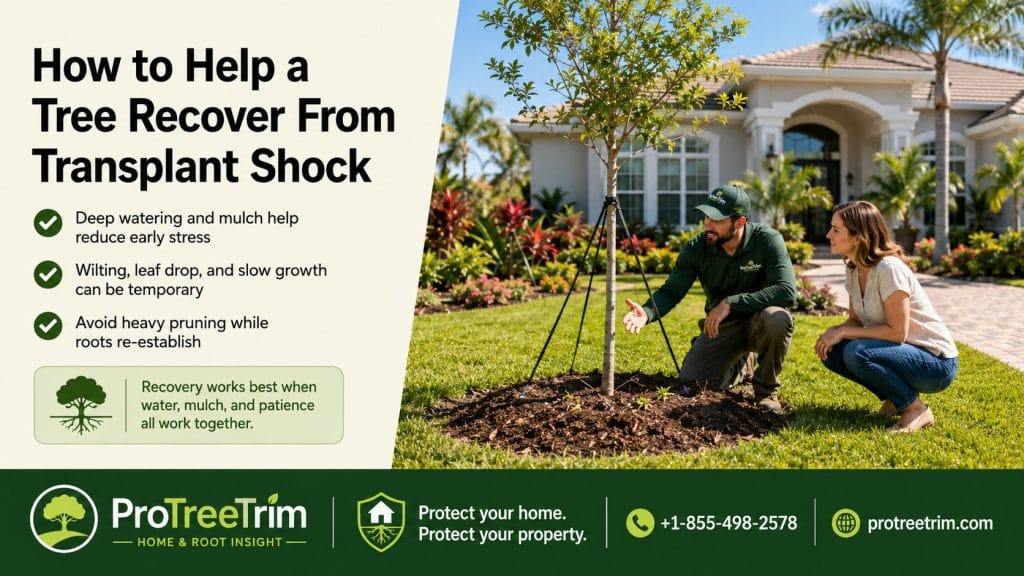
A tree in transplant shock needs correct planting depth, balanced watering, proper mulch, trunk protection, and patience. It usually does not need panic fertilizer or heavy pruning.
Some wilting, browning, yellowing, or leaf drop can happen after planting. The real concern is whether the tree stabilizes and produces healthy new growth. If symptoms worsen, the root flare is buried, soil stays soggy, the tree leans, or branches die back, the tree needs closer attention.
If you are unsure whether your newly planted or moved tree is recovering normally or failing from transplant shock, ProTreeTrim can help connect homeowners with local tree service support. Call +1-855-498-2578 or visit protreetrim.com.
FAQs
Can a tree recover from transplant shock?
Yes, many trees can recover if planting depth, watering, mulch, and site conditions are corrected early enough.
How long does transplant shock last?
It depends on tree size, species, root damage, planting quality, weather, and aftercare. Small trees often recover faster than large established trees.
Should I fertilize a tree in transplant shock?
Usually not as a first step. Focus first on water balance, planting depth, root flare visibility, mulch, and root recovery.
Should I prune a tree after transplanting?
Only remove dead, broken, cracked, or damaged branches. Heavy pruning can add stress and reduce the tree’s energy production.
ProTreeTrim™ can help you take the next step.
If you are dealing with a damaged tree, fallen branch, stump, root issue, palm concern, or storm cleanup question in Florida, call ProTreeTrim for tree service support.