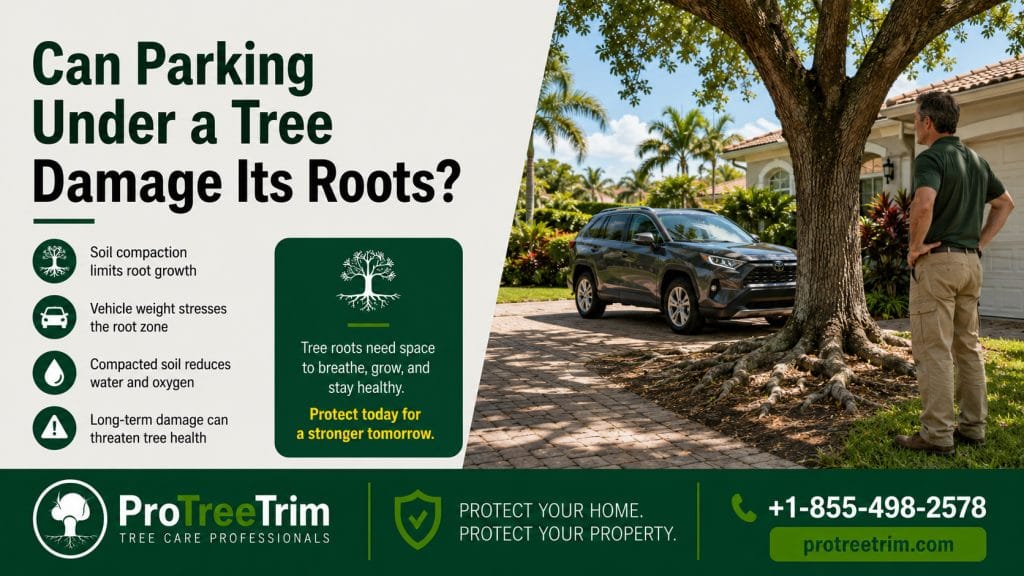
Parking under a tree once or twice is usually not the issue. The problem starts when cars, trailers, boats, work trucks, or delivery vehicles use the root area over and over. The soil can become compacted, water movement changes, roots get less oxygen, and the tree may decline slowly before the canopy shows obvious damage.
The Damage Happens Under the Tires
Tree roots need soil that can hold water and still allow oxygen to move through it. When vehicles repeatedly press down on the same area, the soil particles are squeezed together. University of Minnesota Extension explains that compacted soil has reduced pore space, less large-pore volume, and slower water infiltration and drainage.
That is why parking under a tree can be sneaky. The trunk may never be touched. No branch may break. The yard may still look tidy. But under the tires, roots may be living in soil that has become harder, denser, and less able to support healthy growth.
The risk is greater when the ground is wet. University of Maryland Extension notes that the weight of cars, machinery, garden equipment, people, and pets can compact soil, and that wet soil is especially vulnerable to compaction.
| What happens under the tree | Why it matters |
|---|---|
| Cars park in the same spot daily | Soil compaction builds over time |
| Tires sit near visible roots | Roots may be stressed or damaged |
| Ground stays bare and hard | Water and oxygen movement may be reduced |
| Parking happens after rain | Wet soil compacts more easily |
| Trailers or boats are stored there | Long-term weight can worsen soil conditions |
| Delivery or construction vehicles cross the root zone | One heavy event can still create damage |
Look for Slow Canopy Changes
A tree may not react right away. That is what makes parking damage easy to miss.
Months later, a homeowner may notice smaller leaves, early leaf drop, dead branch tips, thinning on the side closest to the parking area, or branches dropping more often after storms. The tree may be blamed for “getting old” or “getting diseased,” but the root zone may be part of the story.
University of Maryland Extension lists soil compaction as a common soil problem that can lead to poor root growth, drowned roots, root and crown rots, and other stress issues. For a homeowner, the simple version is this: if roots cannot function well, the canopy eventually shows it.
Check the parking area after rain. Does water puddle where tires sit? Does the surface stay hard and bare? Are roots exposed or scraped? Is mulch missing because tires keep pushing it aside? Are pavers, driveway edges, or nearby walkways also lifting or settling?
What to Do Instead
The best fix is to stop the repeated pressure before the tree shows decline. If vehicles need to park nearby, move the parking area outside the main root zone as much as possible. If that is not realistic, use a defined driveway or parking surface designed for vehicle load rather than bare soil over roots.
Do not try to solve the problem by piling soil over the compacted area. Added soil can bury roots and reduce oxygen even more. Do not cut exposed roots just to make the ground smoother. Large roots may be part of the tree’s support system.
A proper mulch ring can help protect the root area from traffic if the site allows it. University of Maryland Extension says organic mulch over tree roots can help prevent soil compaction, and its mulching guidance also notes that mulch can protect plants from mower and trimmer injury when used as a safety zone. Keep mulch shallow and away from the trunk; the goal is to protect the soil, not bury the base of the tree.
When Parking Damage Becomes a Tree-Risk Concern
Compacted soil is usually a slow tree-health issue at first. It becomes more urgent when the tree also has dead limbs, trunk cracks, mushrooms near the base, exposed roots, a new lean, or large branches over a roof, driveway, pool cage, walkway, fence, or parked vehicles.
If construction vehicles, storm cleanup trucks, or heavy equipment recently crossed the area, document it. Take photos of the full tree, parking pattern, root area, soil condition, dead branches, and nearby structures. ISA’s TreesAreGood construction guidance recommends defining a tree protection zone during work so roots and soil are not damaged by construction activity.
If you are unsure whether repeated parking, compacted soil, root stress, or dead limbs point to a larger tree problem, ProTreeTrim can help connect homeowners with local tree service support. Call +1-855-498-2578 or visit protreetrim.com.
FAQs
Is parking under a tree once harmful?
Usually not. Repeated parking in the same root area is the bigger concern because compaction builds over time.
How can I tell if parking is stressing a tree?
Look for hard bare soil, puddling, exposed or scraped roots, smaller leaves, early leaf drop, dead branch tips, or thinning on the side near the parking area.
Can I add soil to fix ruts under a tree?
Be careful. Adding soil can bury roots and reduce oxygen. Fix the traffic pattern first before changing grade around the tree.
Can mulch protect tree roots from parking damage?
Mulch can help reduce light foot traffic and protect soil, but it is not a parking pad. Vehicles should stay off the root zone whenever possible.
ProTreeTrim™ can help you take the next step.
If you are dealing with a damaged tree, fallen branch, stump, root issue, palm concern, or storm cleanup question in Florida, call ProTreeTrim for tree service support.