
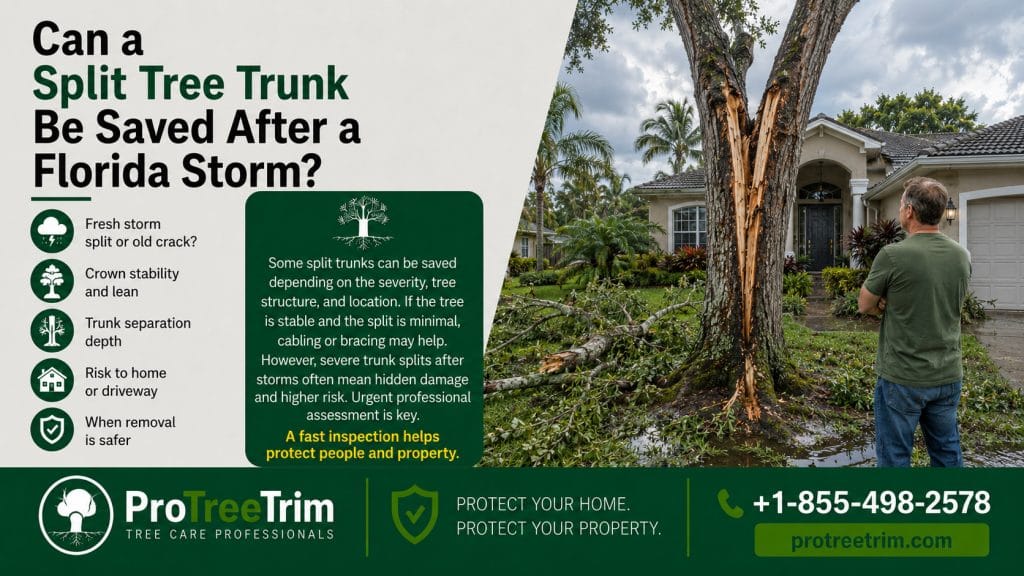
A split tree trunk after a Florida storm is never something to brush off. Some trees with minor cracks may be evaluated for pruning or support, but a deep split through the main trunk can point to serious structural weakness. The next step depends on where the split is, how fresh it looks, and what the tree could hit if it fails.
Look at the Split Without Getting Under the Tree
A trunk split can happen during wind, heavy rain, lightning, or when a large limb tears away from the main stem. From the ground, you may see exposed wood, torn bark, a vertical crack, or two stems beginning to separate.
Do not push on the trunk, pull branches, or cut anything to “see how bad it is.” A split trunk can shift suddenly, especially if heavy limbs are still attached above it. Keep people, pets, vehicles, and lawn equipment away from the fall zone until the tree is checked.
The location of the split matters. A surface crack on an old wound is different from a fresh opening that runs deep through the trunk. A split between two major stems is also more concerning if one side leans toward the house, driveway, pool cage, fence, or neighbor’s yard.
| What you notice | Why it matters |
|---|---|
| Fresh exposed wood | Suggests recent storm movement |
| Crack runs deep into the trunk | May affect structural strength |
| Two stems pulling apart | Can become unstable under weight |
| Bark tearing downward | Often shows force from limb failure |
| Split faces a roof or driveway | Raises urgency because of the target |
| Soil lifting near the base | May mean root movement is also involved |
When Saving the Tree May Not Be Realistic
A homeowner may want to save a large shade tree, especially an oak that has been part of the yard for years. That is understandable. But saving the tree has to mean saving it safely, not just leaving it standing.
A tree with a deep split through the main trunk, a new lean, lifted roots, or large hanging limbs may be beyond simple trimming. Cutting off one branch does not fix a trunk that is separating. In some cases, cabling or structural support may be discussed by qualified professionals, but it is not a cure-all and is not appropriate for every damaged tree.
If the split tree is close to a bedroom, roofline, pool enclosure, septic area, driveway, or utility line, the decision becomes more urgent. The question is not only whether the tree is alive. It is whether the remaining structure can safely stand through the next storm, rain event, or windy afternoon.
Before cleanup, take photos from multiple angles. Show the full tree, the split, the trunk base, nearby structures, and any fallen limbs. If the tree damaged a fence, roof, pavers, irrigation, or pool screen, document the damage before any debris is moved.
If you are unsure whether a split tree trunk, storm-damaged limb, stump, or root issue needs professional attention, ProTreeTrim can help connect Florida homeowners with local tree service support. Call +1-855-498-2578 or visit protreetrim.com.
FAQs
Does a split trunk always mean the tree must be removed?
Not always, but a deep or fresh split through the main trunk is a serious concern and should be evaluated carefully.
Can I cut off the split side myself?
Avoid it. Removing one side of a split tree can suddenly shift the weight and make the remaining trunk unstable.
Should I take photos before tree cleanup?
Yes. Photograph the split, full tree, trunk base, fallen limbs, and nearby property damage before cutting or hauling begins.
ProTreeTrim™ can help you take the next step.
If you are dealing with a damaged tree, fallen branch, stump, root issue, palm concern, or storm cleanup question in Florida, call ProTreeTrim for tree service support.