Exposed tree roots are common in many yards. Sometimes they are a normal part of a mature tree’s root system. Other times, they point to erosion, compacted soil, shallow rooting, drainage problems, mower damage, or a tree that no longer fits its location.
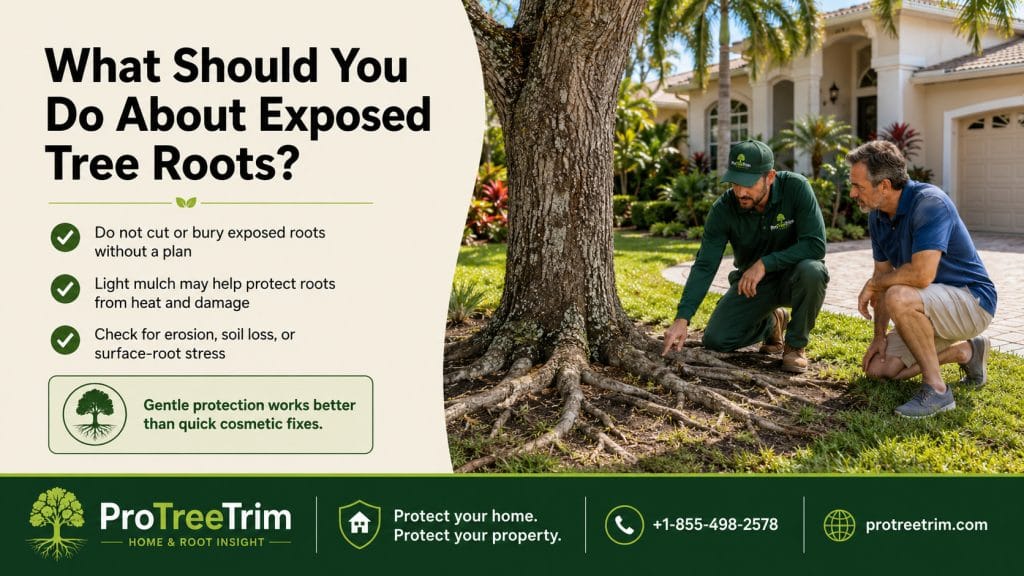
The most important thing to know is this: do not cut exposed roots just because they are visible. Large roots may be helping the tree stay alive and stable.
Exposed Roots Are Not Always a Problem
Tree roots do not always stay deep underground. Many important roots grow in the upper soil layers where oxygen, water, and nutrients are available. As a tree matures, some roots may become visible at the surface.
Exposed roots may be normal when:
- the tree is mature
- the roots are close to the trunk
- the tree canopy looks healthy
- the soil is not washing away badly
- roots are not being cut or damaged
- the tree is not leaning
- roots are not lifting major hardscape
- mowing is the main inconvenience
Visible roots can be inconvenient without being dangerous.
Why Tree Roots Become Exposed
Roots may become exposed for several reasons. The cause matters because the response should match the problem.
| Cause | What it may mean |
|---|---|
| Normal mature growth | Roots naturally expand near the surface |
| Soil erosion | Rain, runoff, or slope may be removing soil |
| Compacted soil | Roots stay near the surface where oxygen is available |
| Shallow soil | Roots have limited depth to grow |
| Heavy foot traffic | Soil wears away around roots |
| Mowing damage | Lawn equipment exposes and injures roots |
| Poor drainage | Roots may grow higher to avoid low oxygen soil |
| Construction or grading | Soil changes may expose or damage roots |
A root that appears after heavy rain may be different from a root that has slowly enlarged over many years.
Do Not Cut Large Exposed Roots
Cutting exposed roots can harm the tree. Large roots may provide water, nutrients, and stability. Removing them may weaken the tree, increase decline, or affect how well it holds during wind and saturated soil.
Root cutting is especially risky when roots are:
- close to the trunk
- large in diameter
- supporting a leaning tree
- on the side opposite the lean
- near a driveway or structure
- part of a mature shade tree
- already damaged by construction
- connected to a stressed canopy
A root that is annoying to mow over may still be important to the tree.
Covering Roots With Soil Is Not Always Safe
Many homeowners want to bury exposed roots with soil. A thin layer may sometimes be acceptable, but deep soil can suffocate roots and bury the root flare. Roots need oxygen. Piling soil over them can create stress.
Avoid:
- adding several inches of soil over roots
- burying the trunk base
- covering the root flare
- packing soil tightly over roots
- creating a raised bed against the trunk
- adding soil to force grass to grow
- hiding roots under heavy material
If roots are exposed because soil has eroded, the answer is not always to dump soil back on top. Drainage and erosion should be addressed too.
Mulch Is Usually Better Than Grass Over Roots
Trying to mow grass around exposed roots often causes repeated damage. Mower blades can nick roots. String trimmers can damage the trunk base. Thin grass may struggle because roots compete for water and shade limits growth.
A mulch bed is often a better solution.
Good mulch around exposed roots can:
- protect roots from mowers
- reduce foot traffic damage
- make the yard look intentional
- help moderate soil moisture
- reduce competition from struggling grass
- protect the trunk from equipment
- make maintenance easier
The mulch should be wide and shallow, not piled deep.
How to Mulch Around Exposed Roots
Mulch should protect roots without burying the tree.
Better mulch habits:
- use a wide mulch bed
- keep mulch shallow
- keep mulch away from the trunk
- leave the root flare visible
- avoid volcano mulching
- do not cover roots with deep piles
- refresh lightly instead of stacking more each year
- avoid landscape fabric around major roots
The goal is protection, not burial.
Do Not Use Rocks to Hide Root Problems
Rocks may look clean, but they are not always tree-friendly. Around exposed roots, rocks can increase heat, make future inspection harder, and complicate root-zone care.
Rocks can be especially problematic when:
- the tree is in full sun
- the soil is already hot or dry
- roots are near pavement
- landscape fabric is installed underneath
- rocks are piled against the trunk
- roots are already stressed
- mowing sends stones into lawn areas
If the goal is to protect exposed roots, organic mulch is usually more forgiving.
Exposed Roots Near Sidewalks
Exposed roots near sidewalks may create tripping concerns or lift concrete panels. This can become a homeowner maintenance issue, especially near public sidewalks, front entries, rental properties, or high-traffic areas.
Do not cut roots casually to fix a sidewalk. The roots may be important to the tree.
Better questions include:
- How close are the roots to the trunk?
- How large are the roots?
- Is the sidewalk lifted badly?
- Can the sidewalk be adjusted?
- Is the tree healthy?
- Is the tree too large for the location?
- Would root cutting affect stability?
- Is removal more realistic than repeated repair?
Sometimes the hardscape can be redesigned. Sometimes the tree and sidewalk are no longer compatible.
Exposed Roots Near Driveways
Driveway roots can be frustrating because they may lift edges, crack surfaces, or interfere with parking. Cutting roots near a driveway may seem like a simple fix, but it can create tree-health and stability problems.
Driveway root conflicts are more serious when:
- roots are large
- roots are close to the trunk
- the tree leans toward the driveway or house
- the driveway damage keeps spreading
- roots were already cut during repairs
- the tree canopy is declining
- the tree is large and mature
- the driveway is used daily
A driveway problem is often a placement problem, not just a root problem.
Exposed Roots Near Patios and Pavers
Pavers and patios can shift when roots grow underneath or when soil settles around roots. Exposed roots near a patio may also make the area uneven or hard to maintain.
Before repairing pavers, consider:
| Question | Why it matters |
|---|---|
| Are roots large and close to trunk? | Cutting may harm stability |
| Are pavers trapping water? | Drainage may affect roots |
| Is the tree healthy? | Declining trees need different decisions |
| Can the patio be adjusted? | Hardscape may be easier to change than roots |
| Is the tree too close? | Long-term conflict may continue |
| Will repair require excavation? | Digging may damage roots |
A paver repair that cuts major roots may create a larger tree problem later.
Exposed Roots and Lawn Problems
Grass often struggles under mature trees because of shade, root competition, dry soil, and foot traffic. Exposed roots make mowing even harder.
Instead of forcing grass to grow, consider:
- expanding mulch beds
- using shade-tolerant groundcovers where appropriate
- redirecting foot traffic
- adding stepping stones carefully
- reducing mowing under the canopy
- avoiding soil buildup over roots
- keeping the trunk base visible
A healthy tree may be more valuable than a perfect patch of grass under it.
Exposed Roots Can Be Damaged by Mowers
Mower damage is one of the biggest risks with exposed roots. Repeated cuts can injure roots, create wounds, and stress the tree over time.
Signs of mower damage include:
- sliced root surfaces
- bark missing from roots
- repeated scars
- exposed fresh wood
- roots drying or cracking
- trunk base damage nearby
- thin grass around roots
A mulch ring or expanded bed can reduce this damage.
Exposed Roots After Heavy Rain
Heavy rain can wash soil away and expose roots suddenly. This may happen on slopes, near downspouts, around drainage paths, or where soil is bare under the canopy.
After heavy rain, check:
- whether soil washed away from the root flare
- whether roots are newly exposed
- whether the tree is leaning
- whether soil lifted on one side
- whether water is pooling near the trunk
- whether erosion is ongoing
- whether downspouts are directing water toward the tree
If roots became exposed because of erosion, the drainage issue should be addressed, not just covered.
Exposed Roots and Tree Stability
Visible roots do not automatically mean the tree is unstable. But root exposure paired with leaning, soil lifting, root damage, or canopy decline is more serious.
Be more cautious if you see:
| Warning sign | Why it matters |
|---|---|
| New lean | Root or soil movement may be involved |
| Soil lifting near roots | Stability concern |
| Roots broken or cut | Support may be reduced |
| Mushrooms near base | Decay or moisture concern |
| Canopy thinning | Root stress may be affecting health |
| Large dead limbs | Tree decline may be broader |
| Trunk cracks | Structural concern |
| Recent construction | Root damage may be likely |
Roots, trunk, and canopy should be evaluated together.
Do Not Build Raised Beds Around Exposed Roots
A raised bed around a tree may look like a tidy solution, but it can harm the tree if soil is piled over roots or against the trunk. Roots need oxygen, and the trunk base should remain visible.
Avoid building a raised bed that:
- buries exposed roots deeply
- covers the root flare
- traps moisture against the trunk
- adds heavy soil over the root zone
- requires cutting major roots
- uses retaining blocks against the trunk
- changes drainage toward the tree
A tree is not a planter post. Its root zone needs air and space.
Exposed Roots Near the House
Roots near a house can make homeowners nervous. It is important not to panic. Roots usually follow moisture, oxygen, and available soil space. The bigger concern may be drainage, soil movement, hardscape conflict, or a large tree planted too close to the structure.
Near the house, check:
- distance from trunk to foundation
- drainage around the home
- roots lifting walkways or patios
- branches touching roof or gutters
- soil moisture patterns
- cracks that already existed
- tree size at maturity
- future access for repair
Do not cut major roots near a house without understanding the tree’s stability.
When Root Removal May Be Considered
Root removal is sometimes discussed, but it should be approached carefully. Removing roots can stress the tree or affect stability. The closer the root is to the trunk and the larger it is, the more caution is needed.
Root cutting may be especially risky when:
- the root is large
- the root is close to the trunk
- several roots would be cut
- the tree is mature
- the tree leans
- the tree is near a house or driveway
- the canopy is already declining
- soil is wet or unstable
In many cases, adjusting the landscape is safer than cutting the root.
When Tree Removal May Be the Real Decision
Sometimes exposed roots reveal that the tree is no longer compatible with the site. If roots are lifting hardscape, the tree is too close to structures, or repeated repairs are needed, removal may be more realistic than root cutting.
Removal may need discussion when:
- driveway damage is severe
- sidewalk lifting creates safety issues
- roots conflict with important repairs
- tree is declining
- tree is too close to house or pool deck
- major roots would need cutting
- tree has trunk or canopy problems too
- the site cannot support the tree long term
A tree can be healthy and still poorly placed.
What Homeowners Should Photograph
Photos help track root exposure and yard conflict.
Take photos of:
- full tree from a distance
- exposed roots near the trunk
- roots near sidewalks or driveways
- trunk base and root flare
- any mower damage
- erosion patterns
- downspouts or drainage paths
- canopy condition
- leaning or soil lifting
- hardscape cracks or lifting
Photos are useful before repairs, pruning, or removal decisions.
What to Do First
A practical first response:
- Do not cut exposed roots.
- Check whether the tree is healthy.
- Look for erosion or drainage issues.
- Stop mowing directly over roots.
- Consider a shallow mulch bed.
- Keep mulch and soil away from the trunk.
- Avoid rocks and fabric over major roots.
- Watch for leaning, soil lifting, or canopy decline.
- Get help before cutting roots or repairing hardscape around them.
The safest first move is usually protection, not removal.
Final Homeowner Takeaway
Exposed tree roots can be normal, especially on mature trees. They become more concerning when they are paired with erosion, mower damage, sidewalk lifting, driveway cracking, drainage problems, leaning, canopy decline, or root cutting.
Do not cut exposed roots casually. Do not bury them under deep soil. A wide, shallow mulch bed is often the safest first improvement. If roots are creating hardscape or safety problems, the decision should consider the whole tree—not just the visible roots.
If you are unsure whether exposed roots should be protected, mulched, repaired around, or evaluated before cutting, ProTreeTrim can help connect homeowners with local tree service support. Call +1-855-498-2578 or visit protreetrim.com.
FAQs
Are exposed tree roots bad?
Not always. Many mature trees naturally have visible surface roots. They become more concerning when paired with erosion, damage, leaning, or hardscape conflict.
Can I cut exposed tree roots?
Do not cut large roots casually. Root cutting can stress the tree or affect stability, especially close to the trunk.
Can I cover exposed roots with soil?
Avoid deep soil over roots or against the trunk. A shallow mulch bed is often safer than burying roots.
What is the best way to protect exposed roots?
A wide, shallow mulch bed that keeps mulch away from the trunk is often the best first step.
ProTreeTrim™ can help you take the next step.
If you are dealing with a damaged tree, fallen branch, stump, root issue, palm concern, or storm cleanup question in Florida, call ProTreeTrim for tree service support.