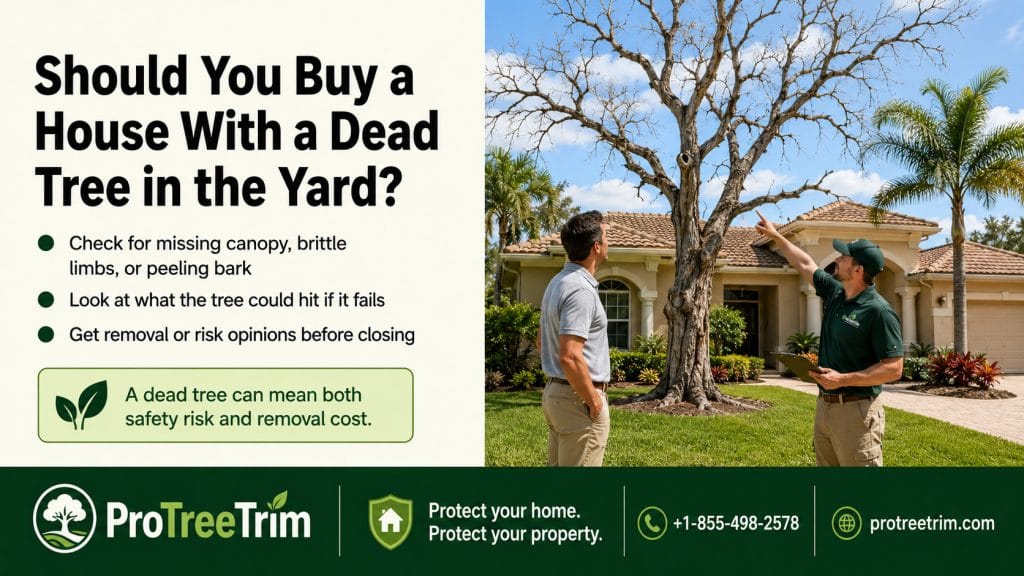
A dead tree in the yard does not automatically mean you should walk away from a house. But it should change the way you look at the property. A dead tree near open space may be a manageable removal project. A dead tree near the roof, driveway, pool cage, fence, utility line, or neighbor’s yard is a bigger question before closing.
Start With What the Tree Could Hit
The most important detail is not that the tree is dead. It is where the tree stands.
A dead tree in a far back corner of a large yard may be less urgent than a smaller dead tree beside the front walkway. A dead pine leaning toward a driveway, a dead oak with limbs over the roof, or a palm near a pool enclosure can create immediate buyer concerns.
| Dead tree location | Why it matters before buying |
|---|---|
| Far back corner of yard | May be a future cleanup cost |
| Near roof or garage | Higher property-damage concern |
| Over driveway or parking area | Vehicles and access may be exposed |
| Near pool cage or patio | Screen, frame, paver, and outdoor-use concerns |
| Along fence or neighbor side | Boundary and cleanup questions may come up |
| Near power or service lines | Utility safety must be handled first |
| Beside walkway or entry | Buyer, guest, and delivery access concern |
A dead tree does not need to fall completely to cause trouble. Large limbs can break first. Bark can loosen. The top can snap. A dead branch over a daily-use area may matter more than the trunk itself.
Ask Whether the Seller Has a Removal Plan
If the tree is obviously dead, ask what the seller knows. When did it die? Was it damaged by a storm? Has anyone looked at it? Was removal quoted but not completed? Is the stump expected to remain?
These questions help you understand whether the tree is a surprise, a known deferred-maintenance item, or part of a recent storm event.
Useful buyer questions include:
- How long has the tree been dead?
- Has it dropped limbs recently?
- Was it damaged in a storm?
- Is there a removal estimate?
- Would stump grinding be included?
- Are there access issues for equipment?
- Is the tree near fences, pool screens, pavers, irrigation, septic, or wires?
- Has the seller kept any tree service records?
Do not rely only on “it has been like that for years.” That may be true, but after closing, the cost and risk become yours.
Think Beyond Tree Removal
Buying a house with a dead tree is not only about cutting the tree down. The finish matters too.
After removal, you may still have a stump, wood chips, exposed roots, uneven ground, damaged sod, or a bare patch in a visible area. If the tree is near a driveway, paver walkway, pool cage, fence, or irrigation line, the job may require more care than a simple open-yard removal.
Possible post-closing costs include:
| Possible cost | Why it may matter |
|---|---|
| Tree removal | Main safety and cleanup work |
| Stump grinding | Often separate from tree removal |
| Debris hauling | Large wood may not be fully removed unless specified |
| Soil or sod repair | Area may look unfinished after removal |
| Fence or paver repair | Falling limbs or roots may have affected hardscape |
| Irrigation repair | Equipment or roots may expose lines |
| Utility coordination | Needed if wires are nearby |
A seller may say, “It just needs to come down.” That may be true, but the buyer should ask what “come down” actually includes.
Check for Related Yard Clues
A dead tree may be isolated. It may also be part of a larger yard pattern.
Look nearby. Are there other declining trees? Is the soil staying wet? Are mushrooms growing near the base? Are roots lifting pavers? Did a previous tree removal leave a stump nearby? Are branches from other trees touching the roof or gutters?
One dead tree is manageable. Several stressed trees near structures may suggest broader maintenance needs after closing.
Also notice access. Can a crew reach the tree without crossing fragile pavers, a narrow side gate, a pool deck, a septic area, or a soft lawn? Hard access can make removal more complicated.
When It May Be Manageable
The dead tree may be manageable if it is small, away from structures, easy to access, and not near wires. In that case, you may simply factor removal and stump grinding into your budget.
It may also be manageable if the seller agrees to handle it before closing and provides a clear invoice showing what was done: removal, stump grinding, debris hauling, and site cleanup.
When to Take It More Seriously
Take the issue more seriously if the dead tree is large, brittle, leaning, close to the house, over a driveway, near a pool cage, touching a fence, or close to utility lines. Also be cautious if large dead limbs are already hanging or dropping.
If a dead tree is near electrical lines, do not treat it as a normal tree removal question. Utility coordination may be needed before any tree work happens.
If you are unsure whether a dead tree, stump, root issue, or removal area should be addressed before or after buying a home, ProTreeTrim can help connect homeowners with local tree service support. Call +1-855-498-2578 or visit protreetrim.com.
FAQs
Is a dead tree a reason not to buy a house?
Not always. It depends on size, location, access, removal cost, stump work, and what the tree could hit if it failed.
Should I ask the seller to remove a dead tree before closing?
If the tree is close to the home, driveway, pool cage, fence, walkway, or utility area, it is reasonable to discuss removal, credit, or documentation during the inspection period.
Does tree removal include stump grinding?
Not always. Stump grinding is often a separate line item, so ask whether it is included before assuming the yard will be fully finished.
What should I photograph during the inspection period?
Photograph the full tree, dead limbs, trunk base, lean direction, nearby roofline, driveway, fence, pool cage, utility area, stump, roots, and access route.
ProTreeTrim™ can help you take the next step.
If you are dealing with a damaged tree, fallen branch, stump, root issue, palm concern, or storm cleanup question in Florida, call ProTreeTrim for tree service support.