
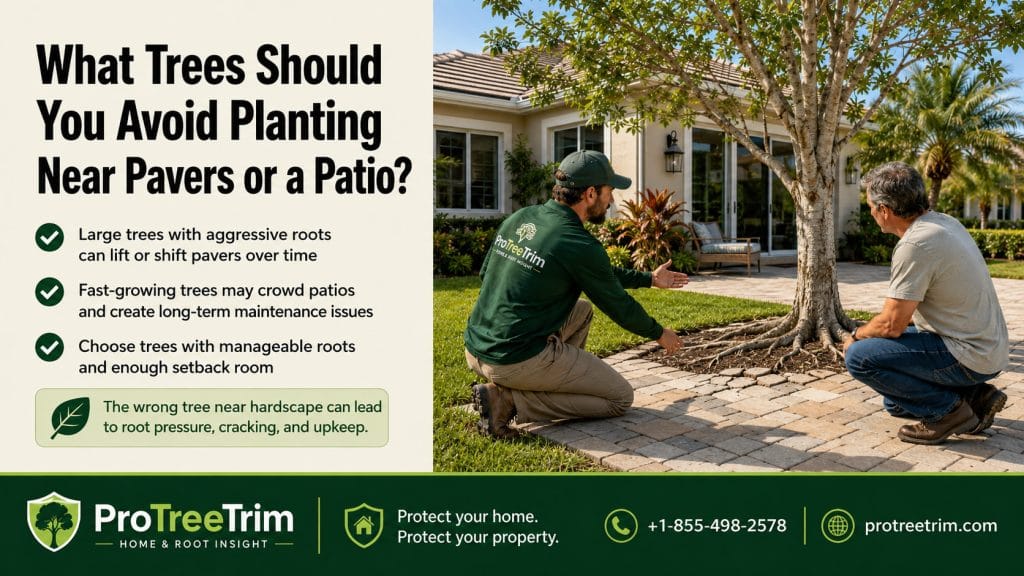
A tree near a patio can make an outdoor space feel cooler, softer, and more private. The wrong tree can turn that same patio into a maintenance problem: lifted pavers, exposed roots, staining fruit, sticky residue, slippery debris, blocked access, and expensive repairs. The best patio tree is not just attractive. It has to fit the hardscape around it.
Pavers and Trees Need Room to Coexist
Pavers, patios, and tree roots are not natural enemies. Problems usually begin when the wrong tree is planted too close, the planting bed is too narrow, or the patio was built without enough root space.
A young tree may look perfect beside a new patio. Years later, roots expand, the trunk widens, the canopy spreads, and the hardscape starts to move. One paver lifts. A corner settles. A root appears at the edge. Water collects in a low spot. Suddenly, the tree is blamed for a problem that started with planning.
| Tree trait | Why it can become a patio problem |
|---|---|
| Large surface roots | Can lift or shift pavers |
| Broad canopy | May drop debris across seating areas |
| Heavy fruit or seed pods | Can stain, slip, or attract pests |
| Sticky residue | Can coat furniture, cushions, and pavers |
| Brittle branches | May drop limbs over outdoor living areas |
| Fast growth | Can outgrow the patio space quickly |
| Dense shade | May keep surfaces damp or slippery longer |
Avoid Trees With Large Surface Roots in Tight Patio Spaces
The biggest hardscape concern is usually root pressure. Not every visible root is a disaster, but large surface roots near pavers can create uneven walking areas and repair headaches.
A patio is a high-use space. People walk barefoot, move chairs, carry food, set up grills, and use the area after rain. A lifted paver may be more than cosmetic if it creates a trip point.
Be cautious with trees that are known for large, expanding, shallow, or surface-rooting habits when the planting area is narrow. A large shade tree may be beautiful in the open yard but frustrating beside a small patio edge.
Before planting, ask:
- How wide will the root system become?
- Is there enough open soil beyond the patio edge?
- Will roots be forced under pavers?
- Is the patio built over compacted soil?
- Will irrigation or runoff pull roots toward the hardscape?
- Can pavers be repaired later without cutting major roots?
If the answer depends on hoping the roots “stay away,” choose another location.
Avoid Messy Trees Over Seating Areas
Every tree drops something. That is not the problem. The problem is what drops, where it lands, and how often it has to be cleaned.
A tree over a patio should be judged more strictly than a tree over open lawn. Leaves in grass may be routine. Fruit, berries, seed pods, sticky drips, flowers, and twigs on pavers can become a daily nuisance.
Be careful with trees that drop:
- staining berries
- large fruit
- heavy seed pods
- sticky sap or honeydew
- hard nuts or acorns
- brittle twigs
- sharp leaves or thorns
- messy flowers that become slippery when wet
A messy tree is not always a bad tree. It may simply belong farther away from the patio.
Think About Shade, Moisture, and Surface Safety
Shade is one of the main reasons homeowners plant trees near patios. Good shade can make the space more comfortable. Too much dense shade can create a different issue.
If a patio stays damp after rain, heavy shade may slow drying. Wet leaves, algae, mildew, or organic debris can make some surfaces slick. In tight yards, dense shade can also make nearby turf or plantings struggle.
The goal is not to avoid shade. The goal is to place the tree so shade improves the patio without turning it into a damp, dirty corner.
A tree placed slightly off to the side may be better than one directly over the seating area.
Do Not Plant Too Close to the Patio Edge
A tree does not need to be far away to work near a patio, but it does need enough room. Planting right at the edge often creates future conflict.
The trunk widens. Roots expand. Mulch spills onto pavers. The canopy grows over furniture. Future pruning becomes harder. If the tree ever needs removal, stump grinding near the patio may be limited or more delicate.
A better planting bed gives the tree room for:
- trunk expansion
- visible root flare
- shallow mulch that stays off the trunk
- root growth away from pavers
- watering without soaking the patio
- future pruning access
- future stump work if removal is ever needed
A tree squeezed into a tiny bed between the patio, fence, and house is usually not a long-term win.
Watch for Patio Trees Near Pool Cages and Rooflines
Many patios sit close to the house, pool cage, lanai, pergola, outdoor kitchen, or fence. That means the tree may create more than one conflict.
A patio tree may eventually touch the roof, drop debris into gutters, rub a screen enclosure, block a gate, or shade an outdoor living area too heavily. The planting decision should consider the whole space, not just the pavers.
Before planting, look around:
| Nearby feature | Why it matters |
|---|---|
| Roofline | Branches may touch shingles or gutters |
| Pool cage | Fronds, limbs, or debris may damage screens |
| Outdoor kitchen | Fruit, sap, or leaves may create cleanup issues |
| Fence | Canopy and roots may cross into boundary areas |
| Side gate | Tree may block future access |
| Irrigation | Overspray can keep trunk or pavers too wet |
| Lighting | Canopy may block fixtures or camera views |
A good patio tree should make the space easier to enjoy, not harder to maintain.
Choose a Tree That Fits the Patio’s Purpose
A patio used for dining needs a cleaner tree than a quiet sitting corner. A patio beside a pool needs a different tree than a patio in a wide backyard. A small townhouse patio needs a different tree than a large rural yard.
Match the tree to how the space is used.
| Patio use | Tree choice should prioritize |
|---|---|
| Outdoor dining | Low mess, non-staining debris, clean canopy |
| Poolside seating | Minimal debris, safe distance from pavers and screens |
| Privacy corner | Moderate size, controlled canopy, good spacing |
| Front entry patio | Clean appearance, manageable roots, good clearance |
| Fire pit area | Branch clearance and debris control |
| Narrow side patio | Small mature size and future access |
A tree that fits the lifestyle of the space will feel intentional for years.
Better Traits for Patio Trees
A better patio tree is usually not the largest or fastest-growing option. It is the one with the right mature size, manageable roots, and reasonable cleanup needs.
Look for trees with:
- appropriate mature height and spread
- moderate root behavior
- strong branch structure
- limited heavy debris
- non-staining fruit or no fruit in the patio area
- canopy that can be maintained without harsh pruning
- good local climate fit
- enough space for future care
No tree is maintenance-free. The goal is normal maintenance, not constant cleanup and repair.
When a Tree Near a Patio Is a Bad Idea
Sometimes the patio area is simply too tight for a tree.
Avoid planting a tree if the only available spot is:
- directly beside the patio edge
- between pavers and a fence with little soil
- under roof overhangs
- against a pool cage
- over buried utilities or irrigation clusters
- in a wet drainage pocket
- where roots will have almost no room
- where future pruning or removal access is impossible
In those cases, a shrub, large container plant, pergola, shade sail, or smaller landscape feature may work better.
What If a Tree Is Already Lifting Pavers?
Do not jump straight to cutting roots. Large roots may be important to the tree’s stability. Cutting them can stress the tree or make it less secure during wind and rain.
The better first step is to understand the conflict:
- How large are the roots?
- How close are they to the trunk?
- Is the tree healthy?
- Are pavers lifting or sinking?
- Is water collecting in that area?
- Has the patio been repaired before?
- Would a root-sensitive paver reset help?
- Is the tree too large for the space?
Sometimes the patio can be adjusted. Sometimes the tree can be managed. Sometimes removal becomes the more practical choice. The answer depends on the site.
Final Patio Planting Test
Before planting near pavers or a patio, picture the tree fully grown.
Will roots lift the surface?
Will debris fall where people sit?
Will shade make the patio better or damp and dark?
Will branches touch the house, fence, or pool cage?
Will future crews be able to reach the tree?
Will this tree still feel like a good idea in 10 years?
If the mature tree creates more work than comfort, choose a smaller tree, move it farther away, or use another landscape feature.
If you are unsure whether a tree is a good fit near your patio, pavers, pool deck, walkway, or outdoor living area, ProTreeTrim can help connect homeowners with local tree service support. Call +1-855-498-2578 or visit protreetrim.com.
FAQs
Can tree roots lift patio pavers?
Yes. Roots can contribute to lifted or uneven pavers, especially when large trees are planted too close or the planting area is narrow.
What trees should not be planted near a patio?
Avoid trees with large surface roots, heavy fruit, staining berries, sticky residue, brittle branches, or mature size that will crowd the patio.
Is shade over a patio always good?
Not always. Shade can make a patio more comfortable, but dense shade may keep surfaces damp, increase debris, and make nearby areas harder to maintain.
Should I cut roots that are lifting pavers?
Not without careful evaluation. Cutting large roots close to the trunk can stress the tree or affect stability.
ProTreeTrim™ can help you take the next step.
If you are dealing with a damaged tree, fallen branch, stump, root issue, palm concern, or storm cleanup question in Florida, call ProTreeTrim for tree service support.