
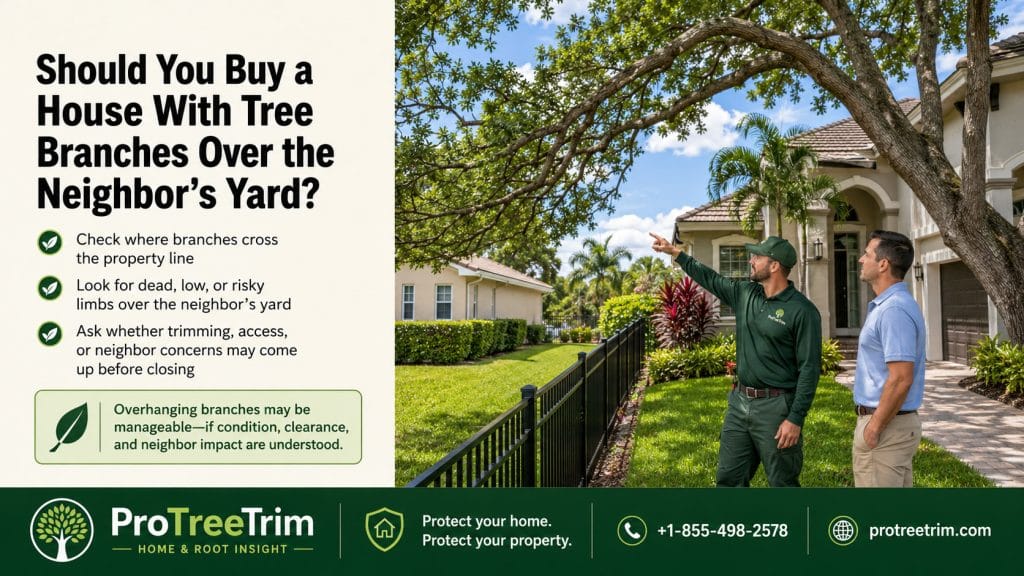
Tree branches hanging over a neighbor’s yard are not automatically a problem. In many neighborhoods, mature trees cross fence lines without causing trouble. The concern begins when those branches are dead, cracked, heavy, storm-damaged, touching a roof, leaning over a pool cage, or already involved in a neighbor dispute.
Start With Branch Condition, Not the Fence Line
A healthy branch over a fence is one thing. A dead limb over a neighbor’s shed, driveway, roof, patio, or pool enclosure is different.
As a buyer, you are not trying to settle property law during a showing. You are trying to understand whether the tree may become your maintenance issue after closing.
| What you see | Why it matters as a buyer |
|---|---|
| Healthy branches over open lawn | May be routine neighborhood tree growth |
| Dead limb over neighbor’s property | Higher cleanup and liability concern |
| Branches touching neighbor’s roof | Maintenance and relationship issue |
| Limb over pool cage or patio | Repair and storm-damage concern |
| Tree leaning toward fence line | Needs closer look at roots and trunk |
| Roots shifting fence posts | Boundary and repair questions may come up |
| Fresh cuts near property line | Ask what was trimmed and why |
The location matters because it affects future conversations. A branch over an unused lawn corner may be manageable. A heavy limb over a neighbor’s roof can become a stressful issue quickly.
Ask Whether There Has Been a Neighbor Issue
A tree crossing the fence line may never have caused a problem. Or it may already be a topic between the seller and the neighbor.
Ask calmly and directly:
- Has the neighbor ever complained about the tree?
- Has any branch fallen across the fence?
- Has the tree damaged a fence, roof, shed, or pool cage?
- Has the tree been trimmed near the property line?
- Are there invoices or photos from recent tree work?
- Is the tree healthy, or are there dead limbs on the neighbor-facing side?
- Does the tree lean more after storms or heavy rain?
You are not looking for drama. You are looking for history. A mature tree with routine trimming is different from a tree that has already caused damage and still has unresolved limbs over the boundary.
Look at the Fence, Roots, and Ground
Branches are only part of the story. Walk the fence line if access is allowed.
Look for fence posts pushed out of alignment, roots lifting panels, soil cracks near the trunk, exposed roots, old stump areas, or branches rubbing the fence. A tree can create a property-line concern above ground and below ground at the same time.
Also check whether the tree is close to anything that would make future work difficult: a narrow side gate, pool cage, shed, paver patio, septic area, irrigation lines, or overhead utility lines. A tree near a boundary can be more expensive to trim or remove if crews need careful access and coordination.
Do Not Accept Vague Reassurance Alone
“It has always been fine” may be true. But once you buy the house, the tree becomes your maintenance concern.
If the tree is large, leaning, dead, cracked, or hanging over the neighbor’s property, ask for more than a casual answer. Tree service records, trimming invoices, before-and-after photos, or seller notes can help you understand what has been done.
Avoid assuming the neighbor will handle everything on their side. Also avoid assuming you will be able to cut freely without limits. Tree and property-line questions can vary by state, city, HOA, and specific facts. If a dispute already exists, get proper real estate, insurance, or legal guidance before closing.
When the Issue May Be Manageable
Branches over a neighbor’s yard may be manageable if the tree is healthy, the limbs are not dead or cracked, the neighbor has not raised concerns, and there is no visible damage to fences, roofs, sheds, or pool areas.
In that case, the tree may simply be part of the property’s mature landscape. You may want to budget for routine pruning, but it does not need to become a dealbreaker.
When to Slow Down Before Buying
Take it more seriously if the tree is dead, leaning toward the neighbor’s home, dropping limbs, splitting at the trunk, pushing the fence, or already connected to a neighbor complaint.
Also slow down if the branches are near power lines. That is not a normal pruning question. Utility safety should come before any tree work.
If you are unsure whether boundary branches, fence-line roots, dead limbs, or a neighbor-facing tree issue should be handled before or after buying a home, ProTreeTrim can help connect homeowners with local tree service support. Call +1-855-498-2578 or visit protreetrim.com.
FAQs
Is it bad to buy a house with tree branches over the neighbor’s yard?
Not necessarily. Healthy branches over a fence can be normal. Dead, cracked, leaning, or damage-causing branches deserve closer attention.
Should I ask the seller if the neighbor complained about the tree?
Yes. It is reasonable to ask whether there have been complaints, damage, trimming requests, or past tree work near the property line.
Can I trim branches over the neighbor’s side after buying?
Do not assume. Property-line tree rules can depend on local law, HOA rules, and the specific situation. Get proper guidance if a dispute or major trimming is involved.
What should I photograph during the inspection period?
Photograph the full tree, branches over the fence, trunk base, roots, fence line, neighbor-facing limbs, and any visible damage or fresh pruning cuts.
ProTreeTrim™ can help you take the next step.
If you are dealing with a damaged tree, fallen branch, stump, root issue, palm concern, or storm cleanup question in Florida, call ProTreeTrim for tree service support.