
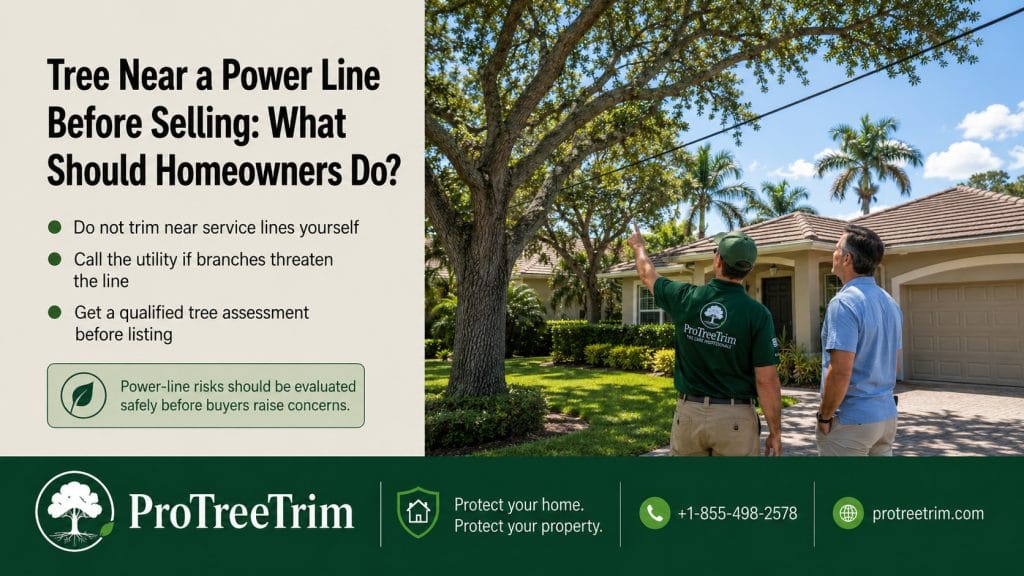
A tree near a power line can make buyers nervous before they even ask about the roof, fence, or driveway. The safest first step is not trimming. It is identifying whether an electrical line may be involved, contacting the utility when needed, and documenting what was done before the home is listed.
Do Not Treat Power-Line Trees Like Normal Pruning
A branch close to a roof is a tree-maintenance issue. A branch close to a power line is a safety issue first.
From the ground, homeowners may not know whether a line is electric, communication, service-related, or utility-managed. Guessing is not worth the risk. FPL tells customers to keep at least 10 feet away from any power line, including the end of any object they are holding or carrying, and warns that even nonmetallic ladders and equipment can conduct electricity.
OSHA also distinguishes ordinary tree work from line-clearance tree trimming. Its guidance describes line-clearance tree trimmers as workers with specialized training who may work within 10 feet of energized power lines and equipment under specific safety requirements.
| What a buyer may notice | Why it matters before selling |
|---|---|
| Branches close to overhead wires | Safety and utility coordination concern |
| Palm fronds hanging near a service line | Not a normal DIY trimming job |
| Tree leaning toward utility area | Buyer may ask whether it is getting worse |
| Dead limb near wires | Utility or qualified line-clearance help may be needed |
| Recent storm damage near line | Documentation becomes more important |
| Tree touching or tangled in wires | Stay away and contact the utility or emergency help |
Call the Utility Before Scheduling Tree Work
If a tree, branch, or palm frond is touching or very close to an electrical line, call the utility first. A regular tree crew may still be needed later for cleanup, pruning, removal, debris hauling, or stump grinding, but the electrical question comes first.
This is especially important before selling because a rushed pre-listing trim can create more risk than it solves. A seller may want the yard to look cleaner for photos, but a branch near a line should not become a ladder, pole saw, or rope job.
If a line is down, sagging, tangled, or storm-damaged, keep people and pets away. ESFI advises people to always assume a downed power line is live and avoid going near it or anything in contact with it.
What to Document Before Listing
Once the utility issue has been addressed, keep the record simple and factual. Buyers do not need a dramatic story, but they may ask what happened and who handled it.
Save:
| Record | Why it helps |
|---|---|
| Wide photos before work | Shows the tree, line area, and nearby property |
| Utility report or service note | Shows the electrical issue was reported |
| Tree service invoice | Documents pruning, removal, cleanup, or hauling |
| After photos | Shows clearance or completed cleanup |
| Fence, roof, gutter, or screen repair receipts | Connects related property repairs |
| Stump grinding or debris notes | Explains the finished condition of the yard |
Do not say the tree is “safe forever” or that the line “will never be an issue again.” A better seller answer is factual: the utility was contacted, the tree work was completed after that step, debris was removed, and the records are available.
Should You Remove the Tree Before Selling?
Not always. A tree near a power line may need monitoring, utility coordination, selective pruning, or removal depending on the site. The decision depends on the tree’s condition, species, growth pattern, lean, branch structure, and whether it will keep growing into the same conflict.
Removal may deserve discussion if the tree is dead, leaning toward the line, repeatedly dropping limbs, too close to the service area, or likely to create recurring utility conflicts. But removal also creates follow-up work: stump grinding, chip cleanup, soil settling, sod, mulch, or fence repair.
For listing photos, the goal is not to erase every tree near a utility line. The goal is to avoid showing an obvious safety concern that buyers will immediately question.
If you are unsure whether a tree, palm, limb, stump, or root issue near utility lines should be handled before listing your home, ProTreeTrim can help connect homeowners with local tree service support after the electrical safety concern is addressed. Call +1-855-498-2578 or visit protreetrim.com.
FAQs
Should I trim a tree near a power line before selling?
Not yourself. If an electrical line may be involved, contact the utility first. Tree trimming near energized lines is not ordinary yard pruning.
Will buyers care about trees near utility lines?
Often, yes. Buyers may worry about safety, storm damage, future trimming, service-line problems, and whether the seller handled the issue properly.
Can a regular tree company trim near power lines?
Only properly trained line-clearance workers should work close to energized power lines. OSHA describes this as specialized work, not routine pruning.
What should I keep after the issue is handled?
Save utility notes, tree service invoices, before-and-after photos, debris hauling records, and any related roof, fence, gutter, or screen repair receipts.
ProTreeTrim™ can help you take the next step.
If you are dealing with a damaged tree, fallen branch, stump, root issue, palm concern, or storm cleanup question in Florida, call ProTreeTrim for tree service support.