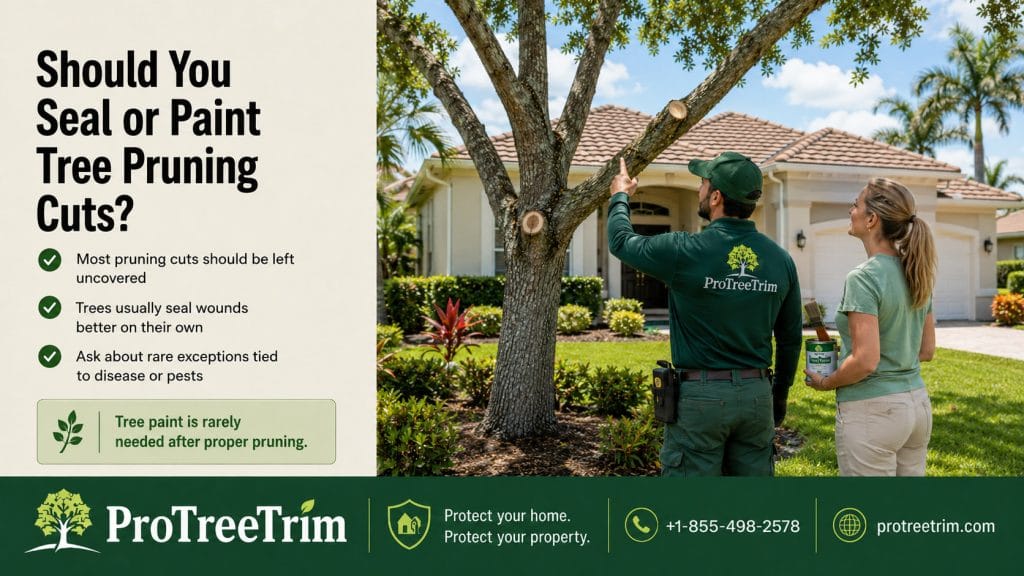
In most cases, you should not seal or paint tree pruning cuts. A clean, well-placed cut is usually better than covering the wound with tar, paint, or a thick dressing. Trees do not heal like skin. They grow new wood around wounds and compartmentalize damaged tissue over time. Covering the cut often does less good than homeowners expect.
The Cut Matters More Than the Coating
When a branch is removed, the tree’s ability to respond depends heavily on where and how the cut was made. A proper cut just outside the branch collar gives the tree the best chance to close over the wound naturally.
A poor cut creates a bigger problem. A flush cut removes protective collar tissue. A long stub leaves dead wood sticking out. A torn limb can rip bark down the trunk. No amount of black pruning paint fixes those mistakes.
| What happened | Better homeowner response |
|---|---|
| Small branch cleanly removed | Usually leave the cut uncovered |
| Large limb flush-cut against trunk | Do not paint it and assume it is fixed |
| Long stub left behind | Proper corrective pruning may be needed |
| Bark torn during storm damage | Avoid peeling more bark; get guidance if large |
| Limb removed near roof or driveway | Document the work and monitor the area |
| Cut is oozing sap | Usually observe; do not rush to seal |
| Cut is near wires | Utility safety comes before tree work |
Why Wound Sealers Usually Do Not Help
Pruning paint feels logical. A cut looks like an open wound, so homeowners want to cover it. The problem is that trees are not built like people or animals. They do not regenerate damaged tissue in the same way. They isolate the injured area and grow around it.
A coating may make the cut look tidy, but it can also trap moisture, hide decay, or give a false sense of security. If the cut was poorly made, the sealer does not make it a good cut. If the tree is already stressed by roots, drought, construction, pests, or decay, paint does not solve those problems either.
The better “treatment” is usually:
- make proper cuts
- avoid cutting into the branch collar
- avoid leaving stubs
- avoid tearing bark
- remove dead or broken limbs safely
- protect the tree from repeat stress
- monitor the wound over time
When a Product Might Be Recommended
There are narrow cases where a specific product may be recommended for a particular pest or disease concern in a particular region. That is not the same as sealing every pruning cut as a habit.
This is why homeowners should be careful with one-size-fits-all advice. A product used under local arborist or extension guidance for a disease concern is different from brushing black sealant on every cut after routine trimming.
If someone recommends wound dressing, ask why:
- Is there a known local pest or disease concern?
- Is this for a specific tree species?
- Is timing part of the recommendation?
- Is the product being used for prevention, not cosmetic appearance?
- Who is making the recommendation?
If the answer is simply “that is how we always do it,” be cautious.
What to Do After a Large Branch Is Removed
Large pruning cuts deserve attention, but not usually paint. Watch the cut over time. A healthy tree may form callus tissue around the edge. The process can be slow, especially on older trees or large wounds.
You should be more alert if the cut is paired with other warning signs:
- soft or hollow wood
- mushrooms near the trunk
- sawdust-like material
- bark peeling around the wound
- oozing with foul smell
- dead limbs above the cut
- cracks spreading from the cut area
- new leaning after rain or wind
One large pruning cut is not automatically a crisis. But a large wound on a stressed or declining tree should not be ignored.
Storm-Damaged Cuts Are Different From Planned Pruning
Storm damage often leaves torn branches, splintered wood, and ripped bark. This is not the same as a clean pruning cut. The goal after storm damage is usually to remove broken, hanging, or hazardous wood safely and make clean corrective cuts where possible.
Do not try to “glue” bark back with sealant. Do not paint over shredded wood and assume the tree is protected. Do not cut more than necessary just to make the damage look clean.
If a broken limb is high, heavy, over a roof, over a driveway, near a pool cage, or near utility lines, this is professional work. Storm-damaged branches can move unpredictably.
Do Not Fill Cavities or Hollow Areas
Some homeowners want to seal hollow trunks, fill cavities, or cover old wounds with foam, concrete, tar, or paint. That usually creates more problems than it solves.
A cavity is not fixed by filling it. The real question is whether the tree has enough sound wood, stable roots, and safe structure for its location. A hollow tree in an open area is one concern. A hollow tree with large limbs over a house, driveway, pool cage, or walkway is another.
Covering the opening may hide moisture, insects, decay, or movement that should remain visible for future inspection.
How to Help the Tree After Pruning
The best aftercare is usually boring but effective.
Keep mowers and string trimmers away from the trunk. Pull mulch back from the bark. Avoid piling soil or mulch over the root flare. Do not overwater or fertilize just because pruning happened. Avoid heavy additional pruning unless there is a clear safety reason.
If the pruning was done because the tree was touching a roof, blocking a driveway, or damaged by a storm, take photos after the work. Save the invoice and note what was removed. That documentation can help if you later sell the home, file a claim, or need follow-up tree work.
When to Call for Help
A small clean branch cut from the ground usually does not need special treatment. Larger cuts, bad cuts, torn limbs, storm splits, or wounds on trees near valuable property deserve more caution.
Get help when:
- a large limb was removed near the trunk
- bark tore down the trunk
- the tree was topped or over-pruned
- the cut is near a crack or cavity
- dead limbs remain above the wound
- the tree is leaning or has root movement
- the wound is near a roof, driveway, pool cage, fence, or walkway
- utility lines are nearby
If you are unsure whether a pruning wound, storm-damaged limb, or old cut needs professional attention, ProTreeTrim can help connect homeowners with local tree service support. Call +1-855-498-2578 or visit protreetrim.com.
FAQs
Should I put pruning paint on tree cuts?
Usually no. A clean, proper cut is normally better than covering the wound with paint, tar, or sealant.
Why do tree services sometimes use wound dressing?
In some specific pest or disease situations, a product may be recommended locally. That is different from sealing every cut as routine practice.
What if the cut is leaking sap?
Some sap flow after pruning or injury can be normal depending on the tree and season. Watch for other signs such as foul odor, soft wood, insects, cracks, or spreading dieback.
Can a bad pruning cut be fixed with sealant?
No. Sealant does not correct a flush cut, stub, torn bark, or oversized wound. Proper corrective pruning may be needed if the cut creates a future issue.
ProTreeTrim™ can help you take the next step.
If you are dealing with a damaged tree, fallen branch, stump, root issue, palm concern, or storm cleanup question in Florida, call ProTreeTrim for tree service support.