
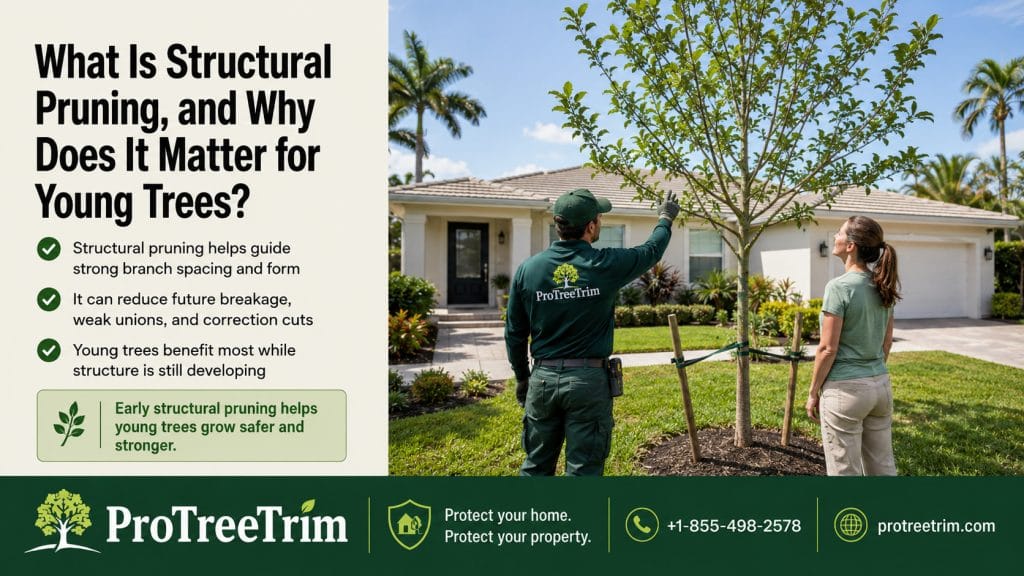
Structural pruning is the careful training of a young tree so it develops a stronger trunk, better branch spacing, and fewer weak attachments as it matures. It is not about making the tree look smaller. It is about preventing future problems while the branches are still small enough to correct.
Young Trees Are Easier to Guide Than Mature Trees
Many homeowners wait until a tree is large before thinking about pruning. By then, the tree may already have heavy low limbs, competing trunks, crowded branches, or weak unions that are difficult to correct without large cuts.
ISA’s homeowner guidance says pruning young trees helps develop strong structure and desirable form, and trees pruned properly while young often need less corrective pruning as they mature.
That is the value of structural pruning. A small cut today may prevent a large wound later.
| Young tree issue | Why it matters later |
|---|---|
| Two competing leaders | May create a weak split point as the tree grows |
| Low vigorous limbs | May become large branches that block access later |
| Branches clustered together | Can create crowding and weak structure |
| Rubbing branches | Bark wounds may form over time |
| Narrow branch angles | May create weaker attachments |
| Branches growing toward roof or driveway | Future clearance pruning may be harder |
The Goal Is Strong Form, Not a Perfect Shape
A young tree does not need to look like a mature tree on day one. In fact, removing too much too early can hurt its development.
Lower temporary branches can help a young tree develop trunk taper and protect the trunk while the tree is establishing. The trick is to manage those branches so they do not become large permanent limbs in the wrong place.
UF/IFAS structural pruning guidance recommends reducing low vigorous branches that will likely be in the way later and preventing branches from becoming too large compared with the trunk.
For homeowners, that means structural pruning is often gradual. You do not strip the young tree bare. You guide it over time.
Watch for Competing Leaders
One of the most important structural issues is a competing leader: two upright stems growing as if both want to become the main trunk. This is common in young shade trees and can become a weak point as the tree gets larger.
UF/IFAS guidance on pruning at planting says codominant stems should be reduced or removed so one leader is present to the top of the tree.
A small competing stem may be easy to correct. A large codominant trunk on a mature tree can be much harder, more expensive, and riskier to manage.
Do Not Remove Every Lower Branch at Once
Some homeowners want a young tree to have a tall, clean trunk immediately. That can be a mistake.
Colorado State University Extension’s young shade tree pruning guidance describes temporary branches as branches that will be removed later as the tree grows. The key idea is that some lower branches are part of the training process, not permanent branches that must be removed right away.
A better approach is gradual:
- keep useful temporary branches small
- remove broken or rubbing branches
- favor one strong central leader where appropriate
- shorten branches that are too vigorous in the wrong place
- avoid large unnecessary cuts
- raise the canopy over time, not all at once
Structural Pruning Can Prevent Bigger Yard Problems
A young tree planted near a driveway, walkway, roofline, fence, or pool cage needs extra attention. Poor branch structure can turn into future clearance, storm, or property-risk issues.
Structural pruning can help prevent:
| Future problem | Early pruning goal |
|---|---|
| Large limb over driveway | Guide branch placement early |
| Branches rubbing roof | Redirect or remove problem limbs while small |
| Weak split in trunk | Correct competing leaders early |
| Heavy low limbs | Manage temporary branches gradually |
| Crowded canopy | Improve spacing before branches get large |
| Storm breakage at weak unions | Reduce defects before the tree matures |
This does not mean pruning can make every tree perfect. Species, site, weather, soil, roots, and planting location all matter. But early structure work gives the tree a better chance.
When Homeowners Should Not Prune Aggressively
Structural pruning should be careful, not harsh. Avoid heavy cutting when the young tree is newly planted, drought-stressed, flooded, damaged by construction, or struggling with small leaves, dieback, or poor establishment.
Also avoid topping, cutting the main leader randomly, or removing most of the lower branches in one visit. That kind of work can create the very problems structural pruning is supposed to prevent.
If the tree was planted too close to the house, driveway, utility line, or pool cage, pruning may help for a while, but it may not solve the placement problem forever.
What to Ask Before Hiring Help
A good structural pruning plan should sound specific.
Ask:
- Are there competing leaders?
- Which branches are temporary?
- Are any branches too large compared with the trunk?
- Are branches rubbing, crossing, or growing toward structures?
- How much live canopy will be removed?
- Will the tree keep enough lower growth while it develops?
- Is this a one-time cut or a staged pruning plan?
Be careful if the answer is simply, “We will clean it up.” Young-tree pruning should be more thoughtful than that.
If you are unsure whether a young tree needs structural pruning, branch correction, roofline planning, or a better planting-location decision, ProTreeTrim can help connect homeowners with local tree service support. Call +1-855-498-2578 or visit protreetrim.com.
FAQs
What is structural pruning?
Structural pruning is the training of a young tree to develop a stronger trunk, better branch spacing, and fewer weak attachments as it matures.
When should structural pruning start?
It often starts while the tree is young, after it has had time to establish, and when small branch problems can be corrected without large cuts.
Should all lower branches be removed from a young tree?
No. Some lower branches may be temporary and useful while the tree develops. They should be managed gradually, not stripped all at once.
Why are competing leaders a problem?
Competing leaders can create weak unions or future split points. Correcting them while the tree is young is usually easier than dealing with a large defect later.
ProTreeTrim™ can help you take the next step.
If you are dealing with a damaged tree, fallen branch, stump, root issue, palm concern, or storm cleanup question in Florida, call ProTreeTrim for tree service support.