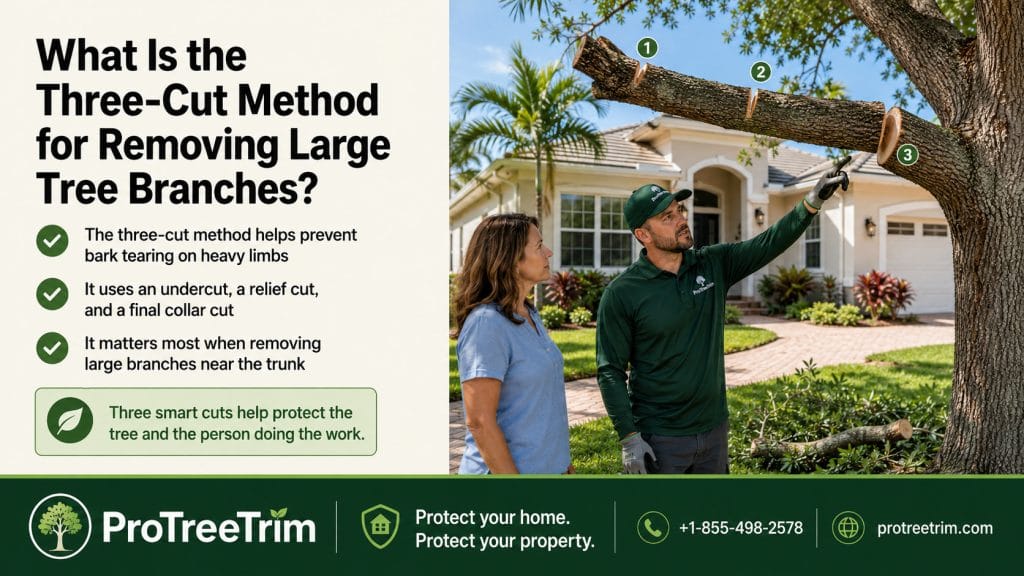
The three-cut method is a pruning technique used to remove a large branch without tearing bark down the trunk. It removes the branch’s weight first, then finishes with a clean cut just outside the branch collar. For homeowners, it is useful to understand—but large, high, or risky branches should still be left to a professional crew.
Why Large Branches Should Not Be Cut in One Pass
A small twig can usually be removed with one clean cut. A large limb is different.
When a heavy branch is cut from the top in one pass, its weight can pull downward before the cut is complete. That can rip bark down the trunk or tear into the branch collar. The branch may also swing, split, or fall in a direction the homeowner did not expect.
That is why large limbs are handled differently. The goal is not only to remove the branch. The goal is to protect the trunk, avoid bark tearing, control the limb’s weight, and leave a final cut the tree can respond to properly.
| Wrong approach | What can happen |
|---|---|
| One top cut on a heavy limb | Bark may tear down the trunk |
| Flush cut against trunk | Branch collar tissue can be damaged |
| Long stub left behind | Dead stub may decay over time |
| Cutting overhead from ladder | Branch can fall, swing, or knock the ladder |
| Cutting near wires | Serious electrical hazard |
| Cutting storm-damaged limb under tension | Limb may move unpredictably |
The Three Cuts Explained
The three-cut method is simple in concept.
The first two cuts remove the branch’s weight. The final cut removes the remaining stub at the proper location.
| Cut | Purpose |
|---|---|
| First cut | A small undercut on the underside of the branch, away from the trunk |
| Second cut | A top cut farther out from the trunk to remove the branch weight |
| Third cut | The final clean cut just outside the branch collar |
The first undercut helps stop bark from tearing back toward the trunk. The second cut removes the heavy outer portion of the limb. Once the weight is gone, the remaining stub can be removed more safely and cleanly.
The final cut matters most for the tree. It should not be flat against the trunk, and it should not leave a long stub. It should stay just outside the branch collar.
Why the Branch Collar Still Matters
The branch collar is the slightly swollen area where the branch meets the trunk or a larger limb. A proper final cut preserves that area.
Cutting into the collar creates a larger wound and damages tissue the tree uses to close around the injury. Leaving a stub creates dead wood that can decay before the wound closes. Both mistakes can create long-term problems.
A clean final cut should look intentional, not hacked. The branch is gone, but the trunk has not been shaved flat.
This Is Not Always a DIY Technique
Understanding the three-cut method does not mean every homeowner should remove large branches.
A branch can be technically “cuttable” and still unsafe for DIY. If the branch is high, heavy, cracked, over a structure, near a driveway, hanging after a storm, or close to utility lines, the risk is not just the cut. It is the fall path, weight, tension, and property below.
Hire help when the branch is:
- over a roof, driveway, pool cage, fence, patio, or walkway
- too heavy to control from the ground
- higher than you can safely reach without a ladder
- cracked, hanging, or storm-damaged
- near electrical or service lines
- attached to a leaning, hollow, or declining tree
- large enough that a bad cut could tear bark down the trunk
A professional crew may use rigging, lowering lines, climbing gear, lifts, or sectional removal. That is very different from simply making three cuts.
When the Three-Cut Method Helps Most
The method is most useful when removing a limb large enough that its weight could tear bark. It is commonly relevant for lower limbs, storm-broken branches, dead branches, and clearance pruning where a branch is being removed back to the trunk or a larger limb.
It may be part of:
| Situation | Why careful cutting matters |
|---|---|
| Dead limb removal | Prevents bark tear while removing deadwood |
| Roofline clearance | Protects trunk while solving structure contact |
| Driveway clearance | Removes branch safely from high-use area |
| Storm cleanup | Corrects broken limbs without enlarging damage |
| Fence or pool cage pruning | Reduces risk of falling branch damage |
| Mature tree pruning | Avoids large avoidable wounds |
The method is not a reason to remove branches without purpose. A large live branch should still have a clear reason for removal.
Do Not Use the Method to Justify Over-Pruning
Some homeowners learn a pruning technique and then apply it too freely. That can be a mistake.
The three-cut method helps remove a branch properly. It does not answer whether the branch should be removed in the first place.
Before removing a large live limb, ask:
- Is the branch dead, cracked, rubbing, or hazardous?
- Is it touching a roof, gutter, fence, pool cage, or driveway?
- Is it blocking a walkway or vehicle access?
- Would a smaller reduction cut solve the issue instead?
- Will removing it unbalance the canopy?
- Is the tree already stressed?
- Is the cut going to create a large wound on a mature tree?
Sometimes the best pruning decision is to leave the branch alone.
Watch for Old Bad Cuts
If a tree has old stubs, torn wounds, or flush cuts, the three-cut method may help explain what went wrong in the past. You may see water sprouts around old cuts, decay pockets, peeling bark, or deadwood near a previous pruning site.
Do not rush to “fix” every old wound. Some old damage cannot be undone. A long stub may sometimes be corrected. A flush cut cannot be restored. A torn limb may need careful cleanup if it is still ragged or unsafe.
If old cuts are large, near the trunk, or paired with mushrooms, trunk cracks, leaning, or dead limbs, the tree needs a broader look than pruning technique alone.
The Best Cut Is Planned Before the Saw Starts
Good pruning starts before the first cut. A branch should be removed for a clear reason, with a safe plan for where it will fall or how it will be lowered.
Before approving branch removal, ask:
- Which branch is being removed?
- Why does it need to come off?
- Will the branch weight be removed before the final cut?
- Will the final cut preserve the branch collar?
- Is anything below the branch at risk?
- Will debris be hauled away?
- Are utility lines nearby?
A clean cut is important. A safe work plan matters even more.
If you are unsure whether a large branch should be removed, reduced, or left alone, ProTreeTrim can help connect homeowners with local tree service support. Call +1-855-498-2578 or visit protreetrim.com.
FAQs
What is the three-cut method in tree pruning?
It is a method for removing large branches by first making an undercut, then removing the branch weight with a second cut, and finishing with a clean final cut outside the branch collar.
Why not cut a large branch in one cut?
A heavy branch can tear bark down the trunk before the cut is complete. The three-cut method helps prevent that damage.
Can homeowners use the three-cut method themselves?
Only on small, low, manageable branches where the work can be done safely from the ground. Large, high, heavy, or structure-threatening branches should be handled professionally.
Where should the final pruning cut be made?
The final cut should be just outside the branch collar—not flush against the trunk and not leaving a long stub.
ProTreeTrim™ can help you take the next step.
If you are dealing with a damaged tree, fallen branch, stump, root issue, palm concern, or storm cleanup question in Florida, call ProTreeTrim for tree service support.