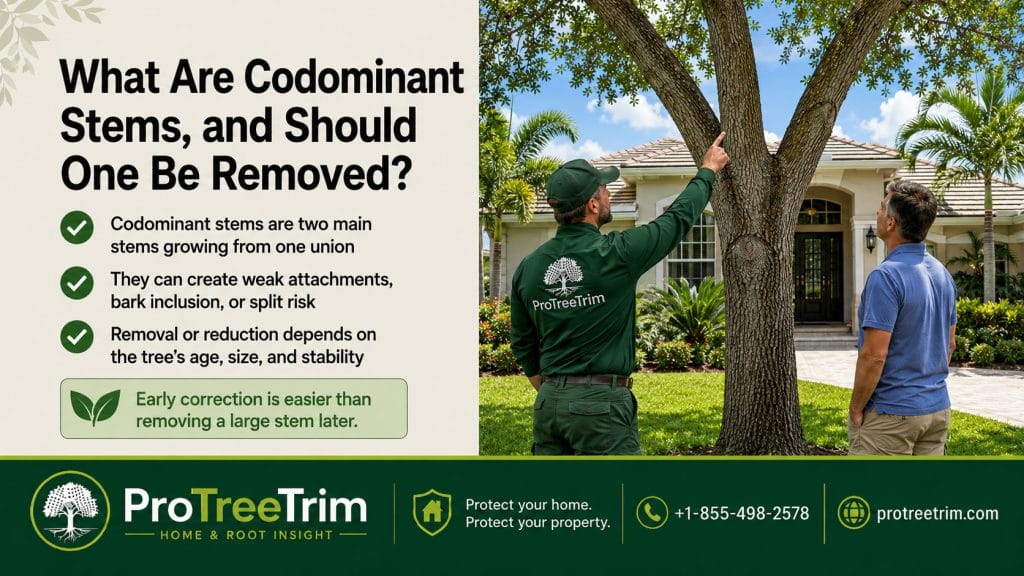
Codominant stems are two or more main stems growing upward from the same area of a tree, often competing to be the central trunk. They are common in many landscape trees. Sometimes they remain stable for years. Other times, they create a weak union that can split during wind, heavy rain, or as the tree gets larger.
What Codominant Stems Look Like
A healthy tree often has one clear main trunk with smaller branches spaced along it. A codominant tree looks more like it has two trunks rising together from the same point.
This can happen low on the trunk or higher in the canopy. On young trees, it may look harmless. On mature trees, the two stems may become heavy, tall, and difficult to correct without major cuts.
| What you see | Why it matters |
|---|---|
| Two upright stems of similar size | They may compete instead of forming one main leader |
| Tight V-shaped fork | The union may be weaker than a wide branch angle |
| Bark trapped between stems | Included bark can reduce strong wood connection |
| Crack forming at the fork | Splitting risk deserves attention |
| One stem leaning over roof or driveway | Location increases concern |
| Deadwood near the fork | Stress or decay may be involved |
| Old pruning cuts around the union | Past correction may have been attempted |
Why Some Codominant Stems Become Weak
The concern is not simply that the tree has two stems. The concern is how those stems are attached.
When two stems grow tightly together, bark can become trapped between them. This is often called included bark. Instead of forming a strong wood-to-wood connection, the two stems may press together with bark in the middle. As both stems grow larger, that tight union can become a natural split point.
A wide, well-attached branch union may be stable. A narrow V-shaped fork with a crack, swelling, or included bark deserves more caution.
Young Trees Are Easier to Correct
Codominant stems are usually easiest to manage when the tree is young. A small competing leader can often be shortened or removed before it becomes a large trunk-sized stem.
That is why structural pruning matters. A small correction on a young tree may prevent a much larger problem later.
A young-tree plan may include:
- choosing one main leader
- reducing the competing stem gradually
- removing small rubbing branches
- keeping enough canopy for healthy growth
- avoiding large unnecessary cuts
- checking the tree again as it grows
The goal is not to make the young tree look perfect overnight. The goal is to guide it toward stronger structure.
Mature Trees Need More Caution
On a mature tree, removing one codominant stem may mean removing a large part of the canopy. That can create a major wound, change weight distribution, and stress the tree.
Sometimes removal of one stem makes sense. Sometimes reduction pruning is better. Sometimes cabling or support may be discussed. Sometimes the tree simply needs monitoring. In severe cases, if the union is cracked or the tree threatens a house, driveway, pool cage, fence, or walkway, removal of the whole tree may become part of the conversation.
This is not a casual DIY decision on a large tree. A mature codominant stem can be heavy, dangerous, and structurally complicated.
When One Stem May Need to Be Removed or Reduced
Action may make sense when the defect is still small enough to correct or when the risk is clear.
Pay closer attention if:
- the fork is narrow and V-shaped
- bark is trapped between the stems
- a crack is visible at the union
- one stem is leaning toward the home
- one side has large dead branches
- the tree has storm damage
- the split point is over a driveway, roof, patio, or pool cage
- the tree has already lost a major limb from the same area
A small codominant stem on a young tree may be a routine pruning issue. A large codominant oak over a bedroom is a different level of concern.
Do Not Cut One Large Stem Without a Plan
Removing one large stem from a codominant tree can leave a huge wound and change the tree’s structure quickly. If the remaining stem depends on the removed side for balance, the tree may become awkward or more exposed.
Before approving work, ask:
- Is this a young-tree correction or mature-tree risk work?
- How large is the stem being removed?
- Is there included bark or a visible crack?
- Would reduction be safer than full removal?
- Is the tree healthy enough for this cut?
- What could the stem hit if it failed?
- Will the finished tree be balanced?
- Are utility lines, rooflines, or pool cages involved?
A good answer should be specific. “We’ll just cut one side off” is not enough of a plan.
When Monitoring May Be Reasonable
Not every codominant tree needs immediate cutting. Monitoring may be reasonable when the tree is healthy, the union is wide, there are no cracks, no included bark is visible, and the tree is not threatening an important target.
Monitoring should still be intentional. Take photos of the fork from the same angle every few months or after major storms. Watch for widening cracks, bark splitting, leaning, dead limbs, or sudden canopy changes.
If the tree is near a house, driveway, pool cage, fence, walkway, or neighbor’s property, monitoring should be more cautious than if the tree stands in open space.
Storm Season Makes Weak Unions More Important
Codominant stems often become more noticeable before storm season because homeowners start looking for wind risks. That is smart, but the answer is not always heavy pruning.
A storm-minded review should include:
- dead limbs
- cracks at forks
- included bark
- leaning stems
- root movement
- trunk decay
- branches touching the roof
- limbs over high-use areas
Pruning can reduce some branch risks, but it cannot magically strengthen a cracked fork. If the main union is compromised, the tree may need a larger plan.
The Best Time to Address Codominant Stems
For young trees, earlier is usually better. Correcting a competing leader while it is small is easier, cleaner, and less stressful than removing a large stem later.
For mature trees, timing depends on the level of risk. A cracked union over a driveway should not wait for the perfect season. A stable structure issue in a healthy tree may be planned during a more suitable pruning window.
The reason for the work matters more than the calendar.
Final Homeowner Takeaway
Codominant stems are not automatically dangerous, but they deserve attention. The earlier they are identified, the easier they are to manage. On mature trees, the decision should be careful, especially when the fork sits above a roof, driveway, pool cage, fence, or walkway.
If you are unsure whether codominant stems, included bark, cracks, or weak branch unions need pruning, reduction, support, or removal planning, ProTreeTrim can help connect homeowners with local tree service support. Call +1-855-498-2578 or visit protreetrim.com.
FAQs
Are codominant stems always bad?
No. Some trees with multiple stems remain stable for years. The concern rises when the union is narrow, cracked, includes trapped bark, or is located above something important.
Can one codominant stem be removed?
Sometimes, especially when the tree is young. On mature trees, removing one large stem can create a major wound and should be planned carefully.
What is included bark?
Included bark happens when bark becomes trapped between two stems, preventing a stronger wood connection from forming between them.
Should codominant stems be fixed before hurricane season?
If the union is cracked, weak, or above a roof, driveway, pool cage, fence, or walkway, it should be checked before storm season rather than ignored.
ProTreeTrim™ can help you take the next step.
If you are dealing with a damaged tree, fallen branch, stump, root issue, palm concern, or storm cleanup question in Florida, call ProTreeTrim for tree service support.