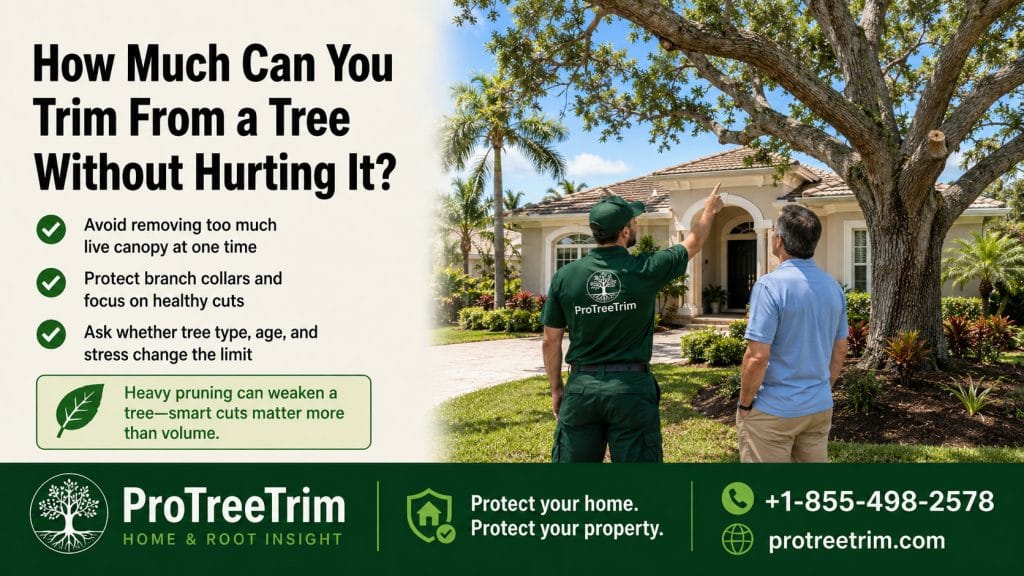
A tree can usually handle careful pruning, but it may struggle after aggressive cutting. The safe amount depends on the tree’s species, age, health, season, branch size, and why the pruning is being done. Removing a dead limb is one thing. Cutting away a large part of the live canopy because the tree “looks too big” is another.
Start With the Reason for Trimming
Before asking how much can be removed, ask why the tree is being trimmed at all.
Some pruning has a clear purpose: removing dead branches, clearing roof contact, improving driveway clearance, reducing rubbing limbs, or removing storm-damaged wood. Other pruning is more vague: “thin it out,” “make it smaller,” “let more light in,” or “cut it back hard.”
That difference matters. Trees are not shrubs. A tree that is cut too aggressively may respond with weak sprouts, sun-exposed bark, poor structure, or a thinner canopy that struggles during heat, drought, or storms.
| Reason for trimming | Better approach |
|---|---|
| Dead limb over driveway | Remove the dead limb carefully |
| Branch touching roof | Create selective clearance |
| Low limb blocking walkway | Raise only what is needed |
| Dense canopy | Avoid unnecessary thinning unless there is a clear reason |
| Tree too close to house | Consider long-term management, not one hard cut |
| Storm-damaged limb | Remove damaged wood and check structure |
| “Tree is too tall” | Avoid topping; discuss whether the tree is wrong for the site |
Removing Live Canopy Is Different From Removing Deadwood
Dead branches are no longer helping the tree. Removing them is usually less stressful than removing healthy live limbs.
Live branches are different. They produce energy, shade bark, support structure, and help the tree respond to stress. If too much live canopy is removed at once, the tree may have less ability to recover, especially if it is already dealing with drought, root damage, compacted soil, construction stress, pests, or decay.
A younger, vigorous tree may tolerate moderate structural pruning better than an older stressed tree. A large mature tree near a roof, driveway, pool cage, or power line may need a slower, more careful plan.
The safest pruning is usually specific, not dramatic.
The Problem With “Cut It Back Hard”
Hard cutting can make a tree look controlled for a short time, but it often creates future problems.
When large branches are cut back without regard for structure, the tree may push out fast sprouts around the cuts. Those sprouts can be weakly attached and may need repeated maintenance. The tree may also lose natural shape, shade, and energy-producing leaf area.
This is why topping is such a poor solution for most shade trees. It may reduce height quickly, but it does not create a safer, healthier, or better-structured tree. It often creates the next pruning problem.
If a tree has become too large for its space, the real issue may be placement. A tree growing into the roofline, driveway, utility corridor, or pool cage every year may need a long-term pruning plan, species-specific care, or in some cases removal and replacement—not repeated heavy cutting.
What Homeowners Should Check Before Approving Tree Work
Before a crew cuts large live branches, ask what the goal is. A clear pruning scope should explain which branches are being removed and why.
Ask:
- Are we removing deadwood, live branches, or both?
- Which branches are touching the roof, driveway, fence, or pool cage?
- Are any large limbs cracked, rubbing, or poorly attached?
- How much live canopy will be removed?
- Will the cuts preserve the tree’s natural structure?
- Is the tree already stressed by drought, roots, soil, or pests?
- Will the work create clearance without overcutting?
- Are utility lines involved?
Be cautious if the only plan is “we will cut it way back.” That may sound simple, but it is not a tree-care strategy.
When Less Pruning Is the Better Choice
Sometimes the best decision is to remove only what is necessary and leave the tree alone.
This is especially true when the tree is stressed. A tree with small leaves, early leaf drop, dead branch tips, root damage, trunk wounds, mushrooms near the base, or a recent construction history may not benefit from heavy live pruning.
It may still need deadwood removal or hazard reduction. But that is different from thinning or reducing the whole canopy for appearance.
A good rule for homeowners: prune for a reason, not because the tree looks inconvenient.
When More Serious Action May Be Needed
If the tree is repeatedly growing into the roof, lifting hardscape, leaning toward the house, dropping large limbs, or blocking utility clearance, pruning may not solve the underlying problem.
In that case, the decision may be bigger:
- Can selective pruning manage the issue?
- Is the tree too close to the structure?
- Is the species wrong for the space?
- Is the tree declining or structurally compromised?
- Would removal be safer or more practical long term?
- Should a smaller replacement tree be planted somewhere else?
Do not let repeated hard trimming become the default solution for a tree that no longer fits the site.
If you are unsure whether a tree needs light pruning, deadwood removal, roofline clearance, or a larger long-term plan, ProTreeTrim can help connect homeowners with local tree service support. Call +1-855-498-2578 or visit protreetrim.com.
FAQs
Can trimming too much kill a tree?
It can seriously stress a tree, especially if too much live canopy is removed at once or the tree is already weak from roots, drought, pests, or decay.
Is removing dead branches harmful?
Usually no. Deadwood removal is different from cutting healthy live branches. Large dead limbs over roofs, driveways, or walkways should be handled carefully.
Is tree topping ever a good idea?
For most homeowner shade trees, topping is a poor practice because it removes too much canopy and often creates weak regrowth.
How do I know if a tree was over-pruned?
Warning signs include large fresh cuts, a stripped canopy, many weak sprouts after cutting, sun-exposed limbs, or a tree that looks unbalanced after the work.
ProTreeTrim™ can help you take the next step.
If you are dealing with a damaged tree, fallen branch, stump, root issue, palm concern, or storm cleanup question in Florida, call ProTreeTrim for tree service support.