
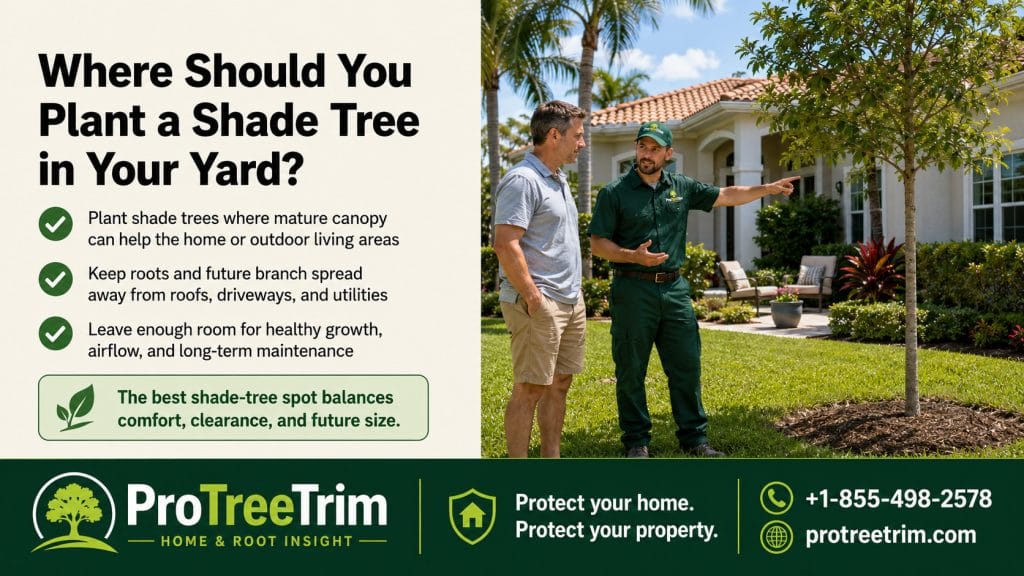
A shade tree can be one of the best long-term improvements you make to a yard. It can make outdoor spaces more comfortable, soften the look of the home, improve privacy, and give the property a more established feel. But shade trees become problems when they are planted too close to roofs, driveways, sidewalks, pool cages, fences, septic areas, or utility lines.
Start With the Shade You Actually Want
Before choosing the planting spot, decide what you want the shade to do.
Do you want to cool a patio in the afternoon? Shade a driveway? Protect a west-facing window? Make the backyard more usable? Create privacy from a neighbor? Each goal may point to a different planting location.
| Shade goal | Better planting thought |
|---|---|
| Shade the patio | Plant off to the side, not directly over seating if debris will be a problem |
| Shade the driveway | Leave room for roots, vehicle clearance, and future pruning |
| Shade west-facing windows | Consider mature canopy spread and roofline distance |
| Add backyard privacy | Avoid planting too tight against the fence |
| Cool a front yard | Do not block the front door, address, or walkway |
| Shade a pool area | Avoid heavy debris directly over water or screen panels |
| Reduce heat near hardscape | Make sure roots have enough soil space |
A good shade tree should solve a specific yard problem without creating three new ones.
Do Not Plant Too Close to the House
A young shade tree may look far enough from the house when it is small. That can be misleading. Large shade trees need room for their canopy, trunk, and roots to expand.
If planted too close, the tree may eventually:
- touch the roof
- clog gutters with leaves
- rub siding or soffits
- block windows
- drop limbs over bedrooms or garages
- make roof repairs harder
- require repeated pruning
- become difficult to remove later
The better approach is to place the tree where its mature canopy can shade the home without constantly fighting the structure.
Think About Afternoon Sun
In many yards, the hottest and least comfortable areas are those hit by strong afternoon sun. A shade tree can help, but placement matters.
If the goal is to reduce heat near the home or patio, look at where the sun hits in the afternoon. A tree placed randomly in the center of the yard may not shade the area you actually use. A tree placed too close to the house may shade the wall but create roof and gutter problems later.
A better planting location often sits far enough away from the structure that the canopy can grow naturally while still casting shade where it is useful.
Keep Shade Trees Away From Utility Conflicts
Large shade trees should not be planted under power lines. They also should not be placed where mature branches will grow into service lines, street-side utility corridors, or access points.
If there are overhead wires, choose a smaller tree or move the shade tree to a different part of the property. A shade tree that must be topped or severely cut back every few years is the wrong tree for that spot.
Also think about underground utilities before digging. Irrigation, septic components, drainage pipes, gas, electric, cable, and water lines can all complicate planting and future root growth.
Leave Room for Roots, Not Just Branches
Shade trees need root space. A tree planted in a narrow strip between a driveway and sidewalk may struggle or eventually lift hardscape. A tree surrounded by pavers may look beautiful at first, then become a root and repair problem later.
Look at the ground before planting.
| Ground condition | Why it matters |
|---|---|
| Narrow planting strip | Roots may have limited space |
| Compacted soil | Root growth and water movement may suffer |
| Nearby driveway | Roots and pavement may conflict over time |
| Sidewalk close by | Future lifting or trip hazards may appear |
| Pool deck nearby | Roots, debris, and access may become issues |
| Poor drainage | Young roots may stay too wet |
| Downspout runoff | Roots may follow wet soil patterns |
A shade tree with no root space is a future maintenance problem.
Do Not Shade the Wrong Area
Shade is useful, but too much shade in the wrong place can create new problems.
A dense shade tree directly over turf may make grass thin out. A tree over a pool may increase debris and reduce sun on the water. A tree over a patio may make the space cooler but also drop leaves, flowers, fruit, or sticky residue onto furniture.
Before planting, ask what will sit under the mature canopy:
- lawn
- patio furniture
- pool water
- driveway
- roof
- walkway
- garden bed
- children’s play area
- fence line
- outdoor kitchen
The tree should match how the space is used.
Plan for Debris
Every shade tree drops something. Leaves are normal. But some trees drop heavy seed pods, acorns, fruit, brittle twigs, sticky residue, flowers, or branches. That matters when the tree is placed over high-use areas.
A messy tree over open lawn may be manageable. The same tree over a driveway, pool, patio, roof valley, or front walkway may become frustrating.
Think carefully before planting a heavy-debris tree where cleanup will be constant or where falling material could damage property.
Avoid Blocking Access
Shade trees should not be planted where they will block future access to the yard.
This is easy to overlook. A tree may fit nicely beside a side gate or fence when young. Years later, the trunk, roots, and branches may block equipment, tree crews, fence repair, septic service, pool equipment, drainage work, or emergency access.
Before planting, check:
- side gates
- fence repair areas
- septic access
- pool equipment
- driveway access
- narrow side yards
- utility meters
- drainage paths
- future pruning space
A shade tree should make the property more usable, not harder to service.
Think About the View From Inside the House
A shade tree affects indoor rooms too. Planted well, it can soften harsh sunlight, frame a window, and make the home feel more private. Planted poorly, it can block too much light, scrape windows, or make rooms feel dark.
Stand inside the home and look out. Where would the tree improve the view? Where would it block light or feel too close? A good planting spot often gives shade and privacy without crowding the glass or roofline.
Front Yard vs. Backyard Placement
Front-yard shade trees affect curb appeal. Backyard shade trees affect comfort and privacy. Both can be valuable, but they carry different risks.
| Location | Main planning concern |
|---|---|
| Front yard | Curb appeal, driveway, walkway, roofline, visibility |
| Backyard | Patio, pool cage, fence, privacy, access |
| Side yard | Tight space, utility lines, gates, roof proximity |
| Near street | Sidewalks, curbs, visibility, municipal rules |
| Near fence | Neighbor concerns, pruning access, roots and posts |
A tree that belongs in a broad backyard may be too large for a front entry bed. A tree that works near the street may not be right beside a pool cage.
Choose the Tree and Location Together
Do not pick the tree first and then force it into the yard. Choose the tree and location together.
A large shade tree needs a large future space. A medium tree may work near a patio if debris is manageable. A small tree may be better near the house. A narrow tree may fit where a broad canopy would be wrong.
The right decision comes from matching:
- mature height
- canopy spread
- root behavior
- branch strength
- debris type
- local soil and water conditions
- available space
- future maintenance access
- the shade goal
A beautiful tree in the wrong place is still the wrong tree.
A Simple Shade Tree Placement Test
Before planting, stand in the proposed spot and picture the tree at full size.
Will branches touch the roof?
Will roots lift the driveway or sidewalk?
Will debris fall into the pool or patio?
Will the tree block a gate, window, or walkway?
Will utility lines be a problem?
Will a crew be able to prune or remove it later?
Will this tree still look intentional in 15 years?
If the mature tree creates too many conflicts, move it or choose a smaller tree.
Final Homeowner Takeaway
The best place to plant a shade tree is where it can grow naturally, shade the area you actually use, and avoid long-term conflicts with the house, roof, driveway, sidewalk, pool cage, fence, utilities, and septic system.
A shade tree should become an asset, not a maintenance battle. Good placement at the beginning is much easier than roofline pruning, root repair, stump grinding, or removal later.
If you are unsure where a shade tree should go in your yard, ProTreeTrim can help connect homeowners with local tree service support. Call +1-855-498-2578 or visit protreetrim.com.
FAQs
Where is the best place to plant a shade tree?
The best spot depends on what you want to shade and how large the tree will become. It should have enough room for mature branches and roots without crowding structures or utilities.
Should a shade tree be planted close to the house?
Not usually. It should be far enough away that mature branches do not touch the roof, gutters, siding, windows, or service areas.
Can a shade tree damage a driveway or sidewalk?
It can contribute to lifted or uneven hardscape if planted too close or in a narrow soil space. Root behavior and available soil matter.
Is it better to plant a shade tree in the front yard or backyard?
Either can work. Front-yard trees affect curb appeal and driveway access; backyard trees affect privacy, patios, pool areas, fences, and outdoor comfort.
ProTreeTrim™ can help you take the next step.
If you are dealing with a damaged tree, fallen branch, stump, root issue, palm concern, or storm cleanup question in Florida, call ProTreeTrim for tree service support.