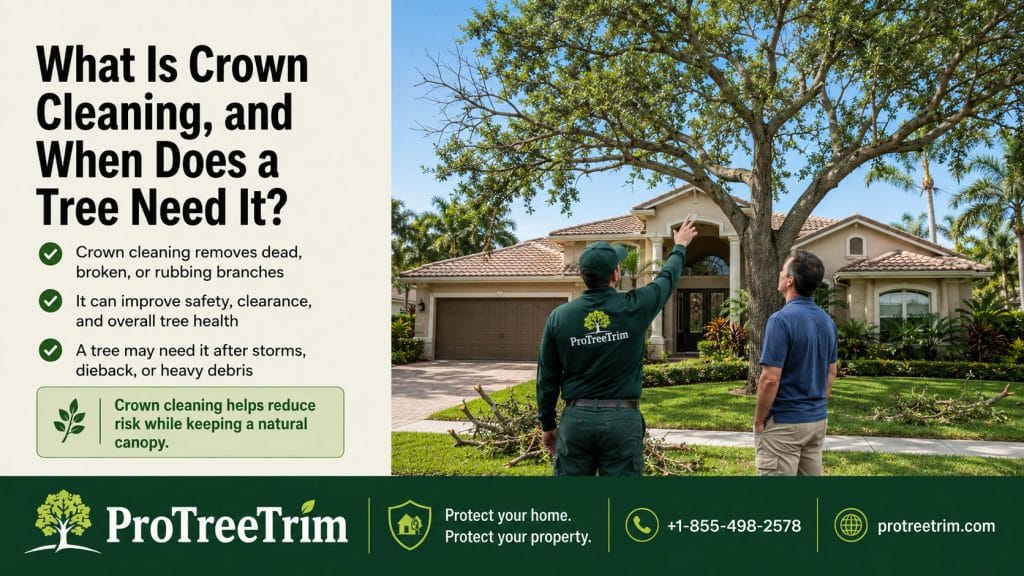
Crown cleaning is a careful pruning approach that removes dead, dying, diseased, broken, weak, or poorly attached branches from a tree’s canopy. It is not the same as thinning, topping, or “cutting the tree back.” Done well, crown cleaning improves safety, appearance, and tree structure without removing healthy live branches unnecessarily.
Crown Cleaning Is Targeted Pruning
The word “cleaning” can sound cosmetic, but crown cleaning is more specific than making a tree look neat. It focuses on branches that no longer belong in the canopy because they are dead, broken, diseased, rubbing, weakly attached, or likely to fail.
ISA pruning terminology defines crown cleaning as the removal of dead, dying, diseased, crowded, weakly attached, low-vigor branches, and watersprouts from the crown. Purdue Extension describes crown cleaning as a pruning method that reduces tree risk and improves appearance by removing dead, dying, diseased, broken, or poorly attached branches.
| What crown cleaning removes | Why it matters |
|---|---|
| Dead branches | Reduces obvious limb-drop concerns |
| Broken limbs | Prevents hanging or torn branches from worsening |
| Diseased branches | May limit spread or remove weakened wood |
| Rubbing branches | Reduces bark injury and future weak spots |
| Weakly attached limbs | Helps address poor structure |
| Water sprouts or low-vigor growth | Cleans up weak or poorly placed growth |
| Small storm-damaged branches | Restores a cleaner, safer canopy |
Crown Cleaning Is Not Canopy Thinning
Homeowners often mix up crown cleaning and thinning. They are not the same.
Crown cleaning removes problem branches. Canopy thinning removes selected live branches to increase light, reduce density, or improve structure. Thinning can be useful in the right situation, but it can also be overdone. Crown cleaning is usually more conservative because it does not remove healthy canopy without a reason.
A mature tree with a few dead limbs may need crown cleaning, not thinning. A tree with crowded live branches may need structural pruning. A tree that is too large for the space may need reduction or a bigger site decision. The right pruning type depends on the actual problem.
When Crown Cleaning Makes Sense
Crown cleaning is often a good first step when a tree looks messy, has visible deadwood, or has gone through storms, drought, or years without careful pruning.
It may make sense when you see:
- dead limbs over a driveway, walkway, roof, patio, or pool cage
- broken branches after wind or storms
- branches rubbing against each other
- old deadwood inside a green canopy
- small hanging limbs caught in the tree
- weak sprouts after past heavy pruning
- branches touching fences, sheds, gutters, or screens
- dead palm-like debris in nearby trees, where applicable
This type of pruning is especially useful before storm season, before listing a home, after storm cleanup, or when a tree has not been maintained for several years.
Why Deadwood Removal Should Be Done Carefully
Removing dead branches sounds simple, but the cut still matters. UF/IFAS guidance on dead branch removal says dead branch tissue should be removed without injuring the collar; cutting into the collar means cutting into trunk tissue.
That is why “just cut off the dead stuff” can still go wrong. Flush cuts, torn bark, long stubs, and cuts into the branch collar can create larger wounds than necessary.
A good crown cleaning job should leave the tree looking natural. It should not leave big stubs, stripped limbs, or a hollow-looking canopy.
What Crown Cleaning Does Not Fix
Crown cleaning can improve a tree, but it does not solve every tree problem.
It will not fix:
- root damage
- trunk decay
- a new lean
- major storm splitting
- poor planting location
- branches growing into power lines
- roots lifting driveways or sidewalks
- a tree that is too large for the available space
If a tree has mushrooms at the base, trunk cracks, lifted roots, a serious lean, or large limbs over a structure, crown cleaning may be only one part of the conversation. The tree may need a broader condition review.
Crown Cleaning Before Storm Season
Crown cleaning can be a practical storm-prep step when the tree has dead, broken, or weak branches. Removing obvious deadwood before wind season may reduce small-to-medium limb drop around roofs, driveways, fences, and pool areas.
But crown cleaning should not turn into storm panic cutting. Removing every interior branch or stripping the canopy does not automatically make a tree safer. A better storm-minded approach is targeted: remove deadwood, address cracked or hanging limbs, clear roof contact, and avoid unnecessary live-canopy loss.
Crown Cleaning Before Selling a Home
For sellers, crown cleaning can improve curb appeal without making the tree look aggressively cut. A tree with large dead limbs over the driveway or front walk can worry buyers quickly. A cleaned-up canopy often looks more maintained.
Useful pre-listing crown cleaning may include:
- deadwood over the front entry
- dead limbs above the driveway
- small broken branches visible from the street
- branches touching gutters or roof edges
- deadwood over pool cages, patios, or walkways
- old storm-damaged branches still hanging in the canopy
Keep the invoice and before-and-after photos. That documentation can help answer buyer or inspection questions.
When Crown Cleaning Should Be Left to a Professional
Small, reachable dead twigs may be manageable for some homeowners. Large dead limbs, overhead branches, storm-damaged limbs, and branches over property are different.
Hire help when branches are:
- high in the canopy
- over a roof, driveway, pool cage, fence, or walkway
- large, cracked, or hanging
- near utility lines
- attached to a leaning or damaged tree
- too heavy to control safely from the ground
Do not use ladders, ropes, pole saws, or chainsaws near electrical lines. If utility lines are involved, the utility should be contacted first.
What to Ask Before Approving Crown Cleaning
A good pruning scope should be clear. Before work starts, ask:
- Are you removing deadwood only, or live branches too?
- Are there broken or hanging limbs?
- Are any branches touching the roof, gutter, fence, or pool cage?
- Will the natural shape of the tree be preserved?
- Will cuts avoid the branch collar?
- Will debris be hauled away?
- Are any utility lines involved?
- Does the tree show bigger concerns beyond deadwood?
Be cautious if the plan sounds vague, such as “we will clean it up real good.” Crown cleaning should be targeted, not random cutting.
The Best Result Looks Subtle
A good crown cleaning job may not look dramatic from the street. That is often the point.
The tree should look healthier, cleaner, and safer, but not stripped. The canopy should still have natural shape. Healthy branches should remain. Dead, broken, weak, or poorly attached material should be gone.
If you are unsure whether a tree needs crown cleaning, thinning, roofline clearance, or a larger long-term plan, ProTreeTrim can help connect homeowners with local tree service support. Call +1-855-498-2578 or visit protreetrim.com.
FAQs
Is crown cleaning the same as pruning?
Crown cleaning is one type of pruning. It focuses on removing dead, dying, diseased, broken, weak, or poorly attached branches from the canopy.
Does crown cleaning remove live branches?
Usually only when there is a clear reason, such as weak attachment, rubbing, disease, or poor structure. It should not remove healthy live canopy unnecessarily.
Can crown cleaning make a tree safer?
It can reduce obvious branch-related concerns, especially deadwood or broken limbs over high-use areas. It does not fix root, trunk, lean, or decay problems by itself.
How often does a tree need crown cleaning?
There is no one schedule for every tree. It depends on species, age, storm exposure, health, location, and whether dead or broken branches are present.
ProTreeTrim™ can help you take the next step.
If you are dealing with a damaged tree, fallen branch, stump, root issue, palm concern, or storm cleanup question in Florida, call ProTreeTrim for tree service support.