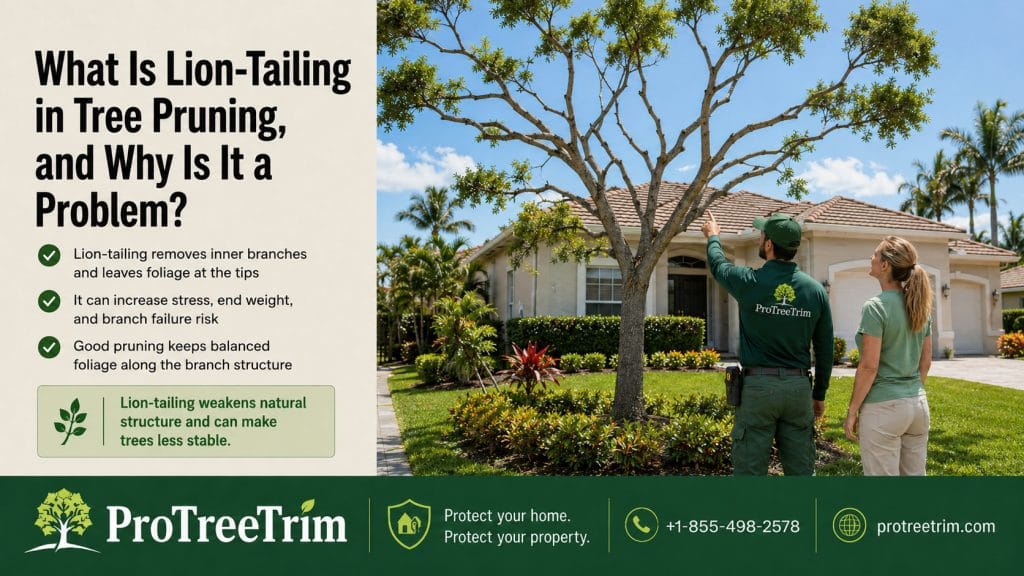
Lion-tailing is a poor pruning practice where most of the small interior branches are removed, leaving foliage only at the ends of long limbs. The tree may look “cleaned out” at first, but the result can be weaker structure, more sun exposure, poor weight distribution, and a higher chance of future limb problems.
What Lion-Tailing Looks Like
A lion-tailed tree often looks open in the middle and heavy at the edges. The main limbs are long and bare, with tufts of leaves only near the tips. From a distance, the tree may look neat or “thinned,” but up close it has lost much of the interior growth that helps balance the canopy.
This often happens when someone is trying to “let wind pass through,” “open up the tree,” or “make it look cleaner.” The intention may be good. The cut pattern is the problem.
| Healthy selective pruning | Lion-tailing |
|---|---|
| Removes specific dead, rubbing, or weak branches | Removes too much inner growth |
| Keeps natural branch structure | Leaves long bare limbs |
| Preserves balanced foliage | Leaves foliage mostly at the tips |
| Solves a clear problem | Makes the canopy look hollow |
| Avoids unnecessary live cuts | Removes live interior branches without purpose |
Why Interior Branches Matter
Interior branches are not just clutter. They help shade limbs, distribute movement, support the tree’s energy production, and keep weight from sitting only at the branch ends.
When too many inner branches are removed, the tree can become tip-heavy. Long limbs may move more in wind because the weight is concentrated far from the trunk. Bark that used to be shaded may become exposed to sudden sun. The tree may also respond by producing fast, weak sprouts along the limbs or near old cuts.
A tree does not become safer just because you can see through it more easily. A better-structured tree is not necessarily the emptiest-looking tree.
Lion-Tailing Is Often Mistaken for Storm Preparation
Homeowners sometimes ask crews to thin a tree heavily before storm season because they believe an open canopy is safer. That idea sounds reasonable, but it can lead to the wrong cuts.
Storm-minded pruning should focus on real defects:
- dead limbs
- cracked branches
- hanging storm-damaged wood
- rubbing limbs
- branches touching rooflines
- overextended limbs with poor structure
- weak attachments
- clearance around driveways, walkways, pool cages, and fences
It should not strip the interior canopy just to make the tree look airy. A tree with long bare limbs and heavy leaf clusters at the ends may be less balanced after the work, not better prepared.
Why It Creates Future Maintenance
Lion-tailing often creates a cycle. After the interior is stripped, the tree may push out new sprouts. Those sprouts grow quickly, crowd the branch, and make the tree look messy again. Then the homeowner calls for pruning again, and the same poor pattern gets repeated.
Over time, this can leave the tree with large old cuts, weak regrowth, sun-exposed limbs, and a canopy that never regains a natural structure.
It can also change buyer perception if the home is being sold. A lion-tailed tree may look recently “worked on,” but not necessarily well maintained. Buyers may see bare limbs, heavy tips, and fresh cuts and wonder whether the tree was cut hard because of storm damage, roof conflict, or decline.
What Better Pruning Looks Like
Good pruning should have a reason behind every meaningful cut.
A better pruning plan may include:
| Pruning goal | Better approach |
|---|---|
| More roof clearance | Remove or reduce branches touching the roof |
| Less deadwood | Crown clean dead, broken, and weak branches |
| Better driveway access | Raise selected lower limbs carefully |
| Less rubbing | Remove one of the crossing branches |
| Better structure | Reduce or remove weakly attached limbs |
| Storm preparation | Address defects, not random interior growth |
| More light | Consider selective pruning plus landscape changes |
The tree should still look natural after the work. The inside should not be completely bare. The branch tips should not carry all the foliage.
What to Ask Before a Crew Thins a Tree
Before approving canopy thinning, ask what will be removed and why. A good answer should be specific. A vague answer like “we’ll open it up” can lead to over-thinning.
Ask:
- Are you removing deadwood or live branches?
- Will interior branches be preserved where possible?
- Are any long limbs already overextended?
- Will this create bare limbs with foliage only at the ends?
- Are roof, driveway, walkway, or pool cage conflicts being solved?
- Is the tree healthy enough for live pruning?
- Will the canopy still look balanced afterward?
- Are we avoiding lion-tailing?
If the tree is already stressed by drought, root damage, construction, flooding, pests, or trunk wounds, be even more cautious with live-branch removal.
Can a Lion-Tailed Tree Be Fixed?
Sometimes it can be improved, but usually not in one visit.
The goal is not to cut more aggressively. The better approach may be gradual correction: remove deadwood, reduce overextended limbs carefully, preserve better-positioned sprouts where appropriate, and avoid repeating the same stripping pattern.
A severely lion-tailed tree may need several seasons of careful management. If it also has trunk cracks, root problems, mushrooms near the base, a strong lean, or large limbs over structures, the conversation may need to include risk, not just appearance.
When to Get Help
If your tree has been lion-tailed, do not rush to “fix” it by cutting more. Take photos of the whole canopy, branch structure, trunk base, and any limbs over the roof, driveway, pool cage, fence, or walkway.
Professional help makes sense when the tree has:
- long bare limbs with heavy tips
- weak sprouts after past pruning
- large old cuts
- dead branches
- roofline conflicts
- storm damage
- leaning or root movement
- branches over high-use areas
If you are unsure whether a tree has been over-thinned, lion-tailed, or needs a safer pruning plan, ProTreeTrim can help connect homeowners with local tree service support. Call +1-855-498-2578 or visit protreetrim.com.
FAQs
Is lion-tailing the same as thinning?
No. Proper thinning removes selected branches for a clear reason. Lion-tailing removes too much interior growth and leaves foliage mostly at branch tips.
Why is lion-tailing bad for trees?
It can create long bare limbs, poor weight distribution, sun exposure, weak regrowth, and repeated future pruning problems.
Does lion-tailing help trees survive storms?
Not necessarily. Removing dead, cracked, or weak branches can help, but stripping the interior canopy can make branch structure worse.
Can a lion-tailed tree recover?
Sometimes, but correction is usually gradual. The tree may need careful pruning over time rather than another heavy cut.
ProTreeTrim™ can help you take the next step.
If you are dealing with a damaged tree, fallen branch, stump, root issue, palm concern, or storm cleanup question in Florida, call ProTreeTrim for tree service support.