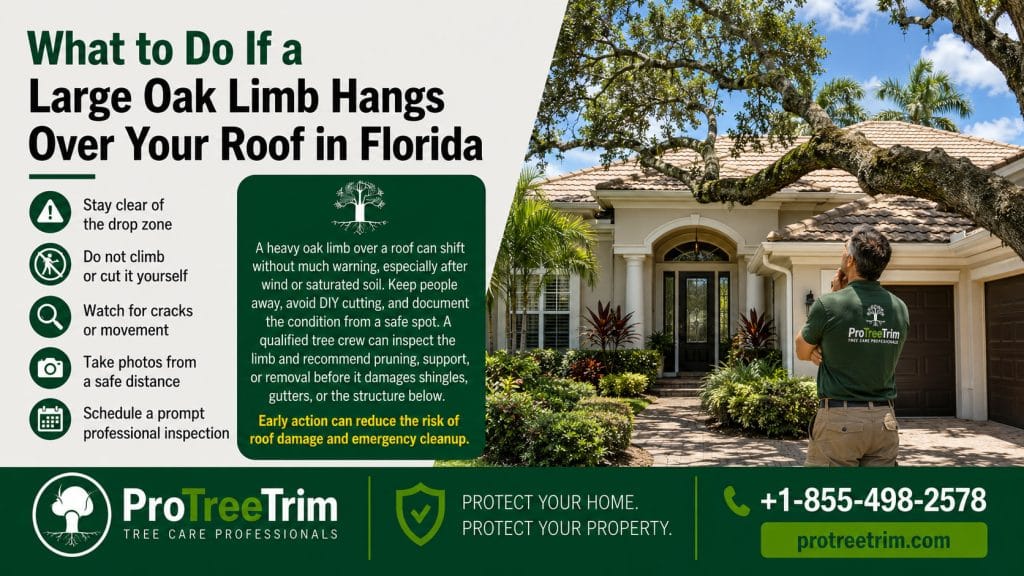
A large oak limb hanging over your roof is not automatically an emergency, but it should not be ignored. In Florida, heavy limbs, summer storms, saturated soil, and older pruning wounds can turn a roofline branch into a real property concern. The next right step depends on the limb’s condition, weight, attachment point, and what lies below it.
Look at the Limb, Not Just the Leaves
Live oaks can look strong because their canopies are full and green. But leaves do not tell you whether a large limb has a crack, weak attachment, hidden decay, or too much weight extending away from the trunk.
Start from the ground. Is the limb touching shingles, scraping gutters, or hanging low over the roof edge? Does it cross above a bedroom, garage, pool cage, driveway, or patio? Is the branch unusually long and heavy compared with the rest of the canopy?
Also look where the limb connects to the trunk. Old wounds, bark seams, cracks, mushrooms, cavities, or a tight V-shaped union can make the branch more concerning. You do not need to diagnose the tree yourself, but you should notice whether something looks different from last season.
| What you notice | Why it matters |
|---|---|
| Limb touches shingles or gutters | Repeated rubbing can cause damage |
| Long branch extends over roof | More weight sits above the structure |
| Crack near branch connection | May indicate structural stress |
| Deadwood above roofline | Can fall during wind or rain |
| Limb rests on another branch | Cutting may shift weight suddenly |
| Roof access is tight | Cleanup may need careful planning |
Do Not Make a Quick Roofline Cut Yourself
A large oak limb is heavy. Cutting it from the wrong point can cause the branch to swing, split, or drop onto the roof, gutter, fence, or pool screen. Even a “small” section can be heavier than it looks, especially after rain.
Avoid climbing onto the roof or using a ladder against the tree. If the limb is near a power service line, stop and contact the utility or qualified help before any discussion of trimming. Electrical risk is not a homeowner’s pruning job.
Take clear photos from the yard. Capture the full oak, the limb over the roof, the branch connection, and any existing roof or gutter contact. If you have older photos, compare them to see whether the limb has sagged, grown closer, or changed angle.
Not every overhanging oak limb needs removal. Some may be carefully reduced or pruned. Others may signal a larger tree risk if paired with trunk cracks, root movement, decay, or repeated limb drop.
If you are unsure whether an oak limb, roof-adjacent tree, stump, or root issue needs professional attention, ProTreeTrim can help connect Florida homeowners with local tree service support. Call +1-855-498-2578 or visit protreetrim.com.
FAQs
Does every oak limb over a roof need to be removed?
No. The limb’s size, condition, attachment, roof contact, and storm exposure matter more than location alone.
Can I trim an oak limb over my roof myself?
Avoid it. Large roofline limbs can shift suddenly and damage shingles, gutters, pool screens, or nearby structures.
Should I worry if the limb only touches the gutter?
Yes, it is worth checking. Light contact can become more damaging when exposed to wind, rain, or repeated movement.
ProTreeTrim™ can help you take the next step.
If you are dealing with a damaged tree, fallen branch, stump, root issue, palm concern, or storm cleanup question in Florida, call ProTreeTrim for tree service support.