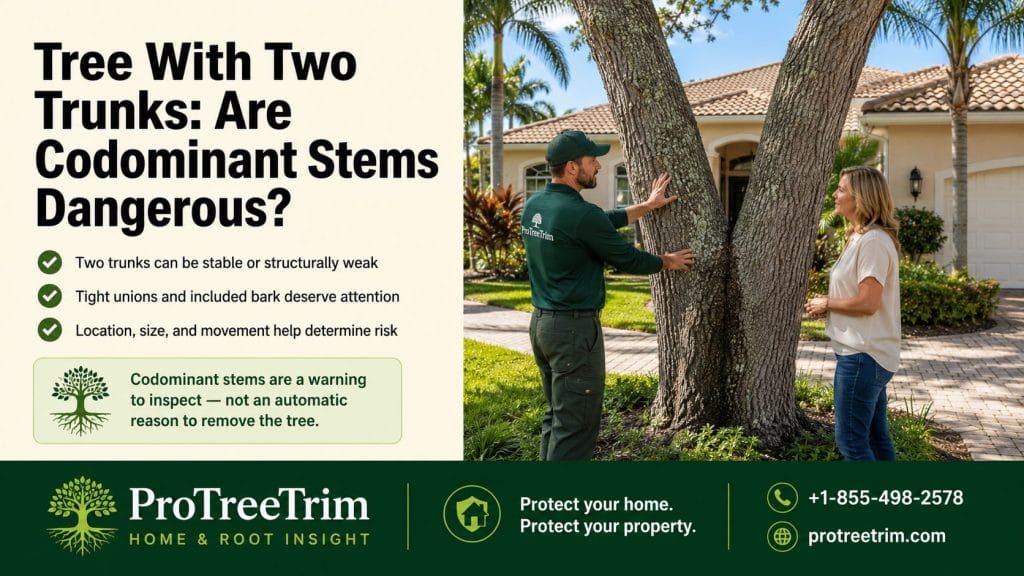
A tree with two trunks is not always dangerous. Many trees naturally develop multiple stems and stand for years without obvious problems. But when two main trunks grow closely together with a narrow V-shaped union, trapped bark, cracking, or heavy canopy weight, the tree may be more likely to split during wind, rain, or storms.
This condition is often called codominant stems. The concern is not simply that the tree has two trunks. The concern is how strongly those trunks are attached to each other.
The key homeowner question is: does the union look strong, wide, and stable—or tight, cracked, and squeezed?
What Are Codominant Stems?
Codominant stems are two or more main stems that grow from the same area and compete to be the central trunk. Instead of one dominant trunk with smaller branches, the tree forms two major leaders.
Codominant stems may look like:
- a tree split into two main trunks
- a narrow V-shaped crotch
- two large stems of similar size
- bark squeezed between stems
- a dark seam between trunks
- a crack running below the union
- one trunk leaning away from the other
- a heavy canopy divided into two large sides
Some codominant trees are manageable. Others develop weak unions that can split.
The Shape of the Union Matters
A wide U-shaped union is usually stronger than a tight V-shaped union. A narrow V shape can trap bark between the stems, preventing strong wood-to-wood connection.
| Union shape | What it may suggest |
|---|---|
| Wide U-shaped union | Often stronger attachment |
| Tight V-shaped union | Included bark or weak attachment possible |
| Dark seam between stems | Moisture, trapped bark, or decay concern |
| Crack below union | Splitting may already be starting |
| One stem much heavier | Load imbalance possible |
| Stems rubbing together | Wounding and decay risk |
| Union over house/driveway | Higher consequence if failure occurs |
A two-trunk tree is not automatically a problem. A tight, cracked union is more concerning.
What Is Included Bark?
Included bark happens when bark becomes trapped between two stems instead of being pushed outward as the tree grows. Bark does not bond like wood. If bark is trapped inside the union, the stems may not be strongly connected.
Included bark is more likely when:
- the union is narrow
- stems grow upright and close together
- both stems are large
- the crotch forms a tight V
- there is a dark line in the union
- water collects between stems
- cracks start below the union
- the tree has heavy canopy weight above
Included bark can make a tree look solid from a distance while the attachment is weaker than expected.
Why Two-Trunk Trees Split
Splitting often happens when weight, wind, rain, decay, or poor structure overloads the union. The tree may stand for years, then fail during one storm or after the union slowly weakens.
Common contributors include:
- narrow V-shaped union
- included bark
- heavy limbs on both stems
- one stem leaning outward
- storm loading
- saturated soil
- decay in the union
- old topping or poor pruning
- cracks that were ignored
- codominant stems left uncorrected when young
Failure can be sudden, especially when the crack is hidden inside the union.
Warning Signs in a Two-Trunk Tree
A tree with codominant stems deserves closer attention when visible warning signs appear.
Look for:
| Warning sign | Why it matters |
|---|---|
| Crack between stems | Splitting may be underway |
| Dark seam in the union | Moisture or decay may be present |
| Oozing or sap | Wound stress or decay possible |
| Mushrooms near union or base | Decay concern |
| One stem leaning outward | Load may be increasing |
| Bark squeezed between stems | Included bark possible |
| Large dead limbs | Tree health or structure issue |
| Canopy weight over house | Consequences are higher |
| Recent storm damage | Weak union may have been stressed |
The more signs present, the less comfortable “just watching it” becomes.
A Healthy Canopy Does Not Always Mean a Strong Union
A codominant tree can look leafy and healthy while the union is structurally weak. Leaves show that the tree is alive. They do not prove that the attachment between trunks is strong.
A two-trunk tree may still have:
- full leaves
- strong seasonal growth
- good shade
- no obvious dead branches
- normal color
- good-looking bark
But the union may still have included bark, hidden cracking, or internal decay.
Cracks Below the Union Are Serious
A crack running down from the point where two trunks meet is one of the more concerning signs. This may show that the stems are beginning to separate.
Be cautious when the crack is:
- fresh
- widening
- deep
- dark or wet
- paired with oozing
- on the side facing a lean
- below a heavy canopy
- near a house, driveway, or walkway
A cracked union can worsen during wind or heavy rain.
Dark Lines Between Stems
A dark line between two trunks may simply be shaded bark, but it can also indicate trapped moisture, included bark, decay, or a crack beginning to open.
Check whether the dark line is:
- dry or wet
- shallow or deep
- widening over time
- oozing sap or dark fluid
- collecting debris
- surrounded by dead bark
- located below a heavy stem
- paired with canopy decline
If the seam looks wet, soft, or cracked, it deserves attention.
Oozing From a Codominant Union
Sap or dark oozing from a union can indicate stress, wounds, decay, or trapped moisture. Clear sap from a small wound may be less concerning, but dark or foul-smelling ooze is more serious.
Oozing becomes more concerning when it appears with:
- cracking
- soft wood
- bark separation
- ants or insects
- mushrooms
- dead limbs above
- one stem pulling away
- storm damage
Do not seal or fill the union. The structure needs to be understood.
Dead Limbs on One Side
If one stem of a codominant tree is declining, the structure may become more complicated. Dead limbs can increase branch-fall risk, and uneven canopy weight can change how the tree responds to wind.
Watch for:
- one side thinning
- dead branches on one stem
- smaller leaves on one side
- bark loss on one trunk
- fungus near one stem base
- cracks only on one side
- one stem leaning away
- past pruning imbalance
A two-trunk tree with one declining stem may need a different decision than a fully healthy tree.
Storm Risk and Codominant Stems
Codominant stems often become most concerning during storms. Wind can push each stem in different directions. Rain can add weight to the canopy. Saturated soil can reduce root stability. If the union is weak, splitting risk increases.
Storm risk is higher when:
- the union is narrow
- the tree has heavy canopy weight
- one stem leans toward a structure
- the union already has a crack
- large limbs extend over the roof
- the tree has been topped
- decay is present
- the tree is exposed to strong wind
A codominant tree near a target should be reviewed before storm season, not only after damage occurs.
Two Trunks Near a House
A codominant tree near a house deserves a higher level of caution because one stem may split and fall even if the whole tree does not uproot.
Check whether either stem could hit:
- roof
- bedroom
- driveway
- parked vehicle
- patio
- pool cage
- fence
- sidewalk
- neighbor property
- service line
The tree’s location changes the urgency.
Can Codominant Stems Be Fixed?
Sometimes, especially when the tree is young. Structural pruning can help train one dominant leader and reduce future weakness. But once a mature tree has two large trunks, the options become more limited.
Possible approaches may include:
- structural pruning when young
- reducing weight on one stem
- removing deadwood
- improving roof clearance
- monitoring cracks
- discussing cabling or bracing in select cases
- removing one stem if appropriate and safe
- full removal if risk is too high
The right choice depends on tree size, union condition, decay, location, and targets.
Young Trees Are Easier to Correct
Codominant stems are best addressed early. A young tree with two competing leaders may be pruned to encourage one stronger central trunk.
Young-tree correction may help when:
- stems are still small
- the tree is healthy
- cuts can be made without large wounds
- one leader can be selected
- structure can be improved gradually
- the tree is not already split
Waiting until both stems are large makes correction much harder.
Mature Two-Trunk Trees Need Careful Decisions
A mature codominant tree cannot always be “fixed” with one cut. Removing one large stem may create a major wound, destabilize the tree, or leave an unbalanced canopy. Heavy pruning can also stress the tree.
For mature trees, ask:
- Is the union cracked?
- Is included bark visible?
- Is decay present?
- Does one stem lean toward a target?
- Are large limbs dead?
- Has the tree split before?
- Is the canopy too heavy on one side?
- Could reduction pruning reduce load?
- Is removal safer than repeated corrective work?
Mature codominant trees require judgment, not guesswork.
Cabling and Bracing: Helpful or False Confidence?
Cabling and bracing may help support certain weak unions, but they are not magic repairs. They do not remove decay, reverse a severe split, or make a failing tree safe forever.
Support systems may be considered when:
- the tree has value
- the defect is manageable
- decay is not severe
- the union has not failed badly
- pruning alone is not enough
- the tree can be monitored
- the installation is appropriate
Cabling or bracing may not be appropriate when:
- the union is severely split
- lower trunk decay is present
- the tree is declining badly
- roots are unstable
- one stem is already failing
- the tree stands over high-risk targets
- removal is the safer option
Hardware should never be installed casually.
Do Not Strap the Trunks Together Yourself
Homeowners sometimes try to wrap, strap, bolt, rope, or chain two trunks together. This can create new wounds, restrict growth, trap moisture, girdle the tree, or give a false sense of safety.
Avoid:
- wrapping rope around trunks
- using ratchet straps
- screwing hardware into the tree
- chaining stems together
- drilling without expertise
- filling the union with foam or cement
- sealing the crack with caulk
- tying branches together
A weak union needs proper assessment, not DIY restraint.
Topping Makes Codominant Problems Worse
Topping a codominant tree is not a safe solution. Cutting the top off can create large wounds, weak regrowth, decay points, and future limb failure.
Topping may make the tree look shorter, but it can leave:
- decay-prone cuts
- weak sprouts
- unbalanced canopy
- sun-exposed bark
- stress response growth
- repeated maintenance problems
- worse long-term structure
If a two-trunk tree is too large or too risky, proper pruning or removal is usually safer than topping.
Root Problems Can Add to the Risk
A codominant union is above ground, but roots still matter. A tree with weak upper structure and compromised roots may be more concerning.
Check for:
- soil lifting near the base
- new lean
- exposed broken roots
- root cutting from construction
- driveway or sidewalk root damage
- mushrooms near root flare
- buried root flare
- trunk base cavities
- saturated soil
A weak union plus root instability is a higher-risk combination.
After a Storm, Inspect the Union
After high wind or heavy rain, look closely at the point where the trunks meet. Small changes can matter.
Check for:
- new crack
- widening seam
- fresh sap
- torn bark
- one stem leaning more
- hanging limbs
- broken branches
- soil lifting
- new sounds in wind
- branch split near the union
Do not stand under the tree while inspecting if large cracked limbs are overhead.
When Monitoring May Be Reasonable
Monitoring may be reasonable when:
- the union is broad and U-shaped
- no crack is visible
- no included bark is obvious
- canopy is balanced
- no large dead limbs are present
- tree is away from high-value targets
- no decay signs are visible
- the tree has stood stable for years
Take photos periodically so changes are easier to notice.
When to Act Quickly
Act sooner when a codominant tree has:
| Warning sign | Why it matters |
|---|---|
| Crack between trunks | Splitting may be starting |
| Narrow V-shaped union | Weak attachment possible |
| Included bark | Poor wood connection |
| One stem leaning toward house | Higher consequence |
| Oozing or dark seam | Moisture/decay concern |
| Large dead limbs | Branch failure risk |
| Mushrooms near base or union | Decay concern |
| Storm damage | Structure may be newly weakened |
| Soil lifting | Root movement possible |
| Trunk movement in wind | Failure risk may increase |
A two-trunk tree with multiple warning signs should not be ignored.
What Homeowners Should Photograph
Take photos of:
- full tree from several angles
- the union close up
- any crack or seam
- canopy balance
- one stem leaning away
- dead limbs
- oozing or dark staining
- base and root flare
- mushrooms or cavities
- nearby house, driveway, patio, or walkway
Photos help compare changes and explain the concern clearly.
What to Do First
A practical first response:
- Identify whether the union is U-shaped or tight V-shaped.
- Look for cracks, dark seams, included bark, or oozing.
- Check whether either stem leans toward a target.
- Look for dead limbs or canopy imbalance.
- Inspect the base for root or decay signs.
- Do not strap or bolt the trunks yourself.
- Do not top the tree.
- Photograph the union and whole tree.
- Get help if the union is cracked, narrow, decayed, or near structures.
The goal is to evaluate structure before wind or storm load tests it.
Final Homeowner Takeaway
A tree with two trunks is not automatically dangerous, but codominant stems can become risky when the union is narrow, cracked, decayed, or loaded with heavy canopy weight. Included bark, dark seams, oozing, leaning stems, dead limbs, mushrooms, and storm damage all increase concern.
Young trees can often be trained before the problem becomes serious. Mature two-trunk trees require more careful judgment. Do not strap, seal, bolt, or top the tree yourself.
If you are unsure whether a two-trunk tree is stable, needs pruning, can be supported, or should be removed, ProTreeTrim can help connect homeowners with local tree service support. Call +1-855-498-2578 or visit protreetrim.com.
FAQs
Is a tree with two trunks dangerous?
Not always. The risk depends on the union shape, included bark, cracks, decay, lean, canopy weight, and nearby targets.
What is included bark?
Included bark is bark trapped between two stems, preventing a strong wood-to-wood connection and increasing splitting risk.
Can codominant stems be fixed?
Young trees can often be improved with structural pruning. Mature trees may need pruning, support, monitoring, or removal depending on risk.
Should I tie two tree trunks together?
No. DIY straps, ropes, chains, or bolts can damage the tree and create false confidence. Structural concerns should be evaluated properly.
ProTreeTrim™ can help you take the next step.
If you are dealing with a damaged tree, fallen branch, stump, root issue, palm concern, or storm cleanup question in Florida, call ProTreeTrim for tree service support.