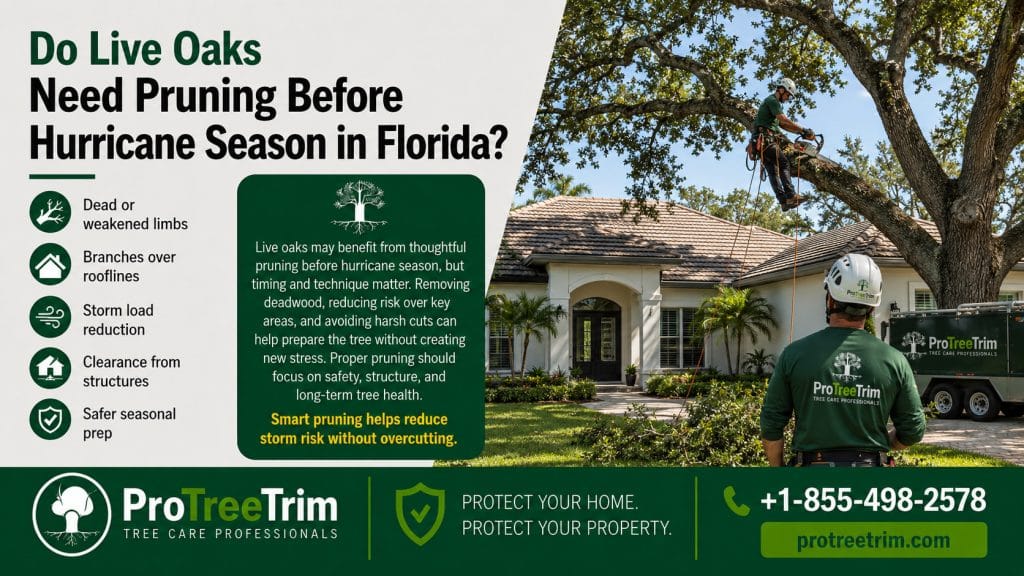
Live oaks do not automatically need heavy pruning before hurricane season, but they should be checked for dead limbs, weak branch unions, overextended branches, roof contact, and canopy imbalance. In Florida yards, the goal is not to make an oak “smaller.” The goal is to reduce specific risks without damaging the tree’s structure.
Good Pruning Is Not the Same as Cutting More
A mature live oak can be one of the strongest features in a Florida yard, but its wide canopy can also hold heavy limbs over roofs, driveways, pool cages, fences, and parked vehicles. Before storm season, homeowners should look for branches that are dead, cracked, rubbing, hanging low, or stretching far over a structure.
UF/IFAS says correct pruning is an important part of helping trees survive hurricanes. Their guidance notes that for trees taller than about 15 feet, homeowners should hire a certified arborist before hurricane season; the arborist may remove dead branches, shorten overly long limbs, address cracked branches, and trim low branches near the roof.
That does not mean stripping the interior of the tree or removing large amounts of healthy canopy. Over-pruning can leave a tree unbalanced and may create weak regrowth. A live oak should still look like a live oak when the work is done.
| What to look for | Why it matters |
|---|---|
| Dead limbs over the roof | Can fall during wind or rain |
| Long horizontal limbs | May carry heavy weight far from the trunk |
| Cracks near branch unions | Can indicate structural stress |
| Branches touching shingles or gutters | Can rub harder during wind |
| Heavy canopy on one side | May increase imbalance concerns |
| Old pruning wounds or cavities | May deserve a closer look |
What Florida Homeowners Should Ask Before Pruning
Ask the crew what they plan to remove and why. A good answer should mention specific targets for limbs, clearance, deadwood, structure, or safety. Be cautious if someone suggests topping the oak, removing most interior branches, or making large cuts simply to “let wind pass through.”
Also, think about the work area. If the oak stands over pavers, a driveway, a pool enclosure, irrigation lines, or a septic area, access planning matters almost as much as pruning. Large oak limbs are heavy and need to be lowered or removed without damaging the property below.
Do not wait until a hurricane watch is issued to schedule major pruning. By then, weather, crew availability, and safe working conditions may already be limited.
If you are unsure whether a live oak limb, roofline branch, stump, or root issue needs attention before storm season, ProTreeTrim can help connect Florida homeowners with local tree service support. Call +1-855-498-2578 or visit protreetrim.com.
FAQs
Should live oaks be topped before hurricane season?
No. Topping is not proper storm preparation and can create long-term structural problems.
What oak limbs should be checked first?
Start with dead, cracked, overextended, roof-touching, or low-hanging limbs near homes, driveways, pool cages, and walkways.
Can I prune a large live oak myself?
Avoid major oak pruning yourself, especially if the tree is tall, limbs are heavy, or branches are near roofs, structures, or utility lines.
ProTreeTrim™ can help you take the next step.
If you are dealing with a damaged tree, fallen branch, stump, root issue, palm concern, or storm cleanup question in Florida, call ProTreeTrim for tree service support.