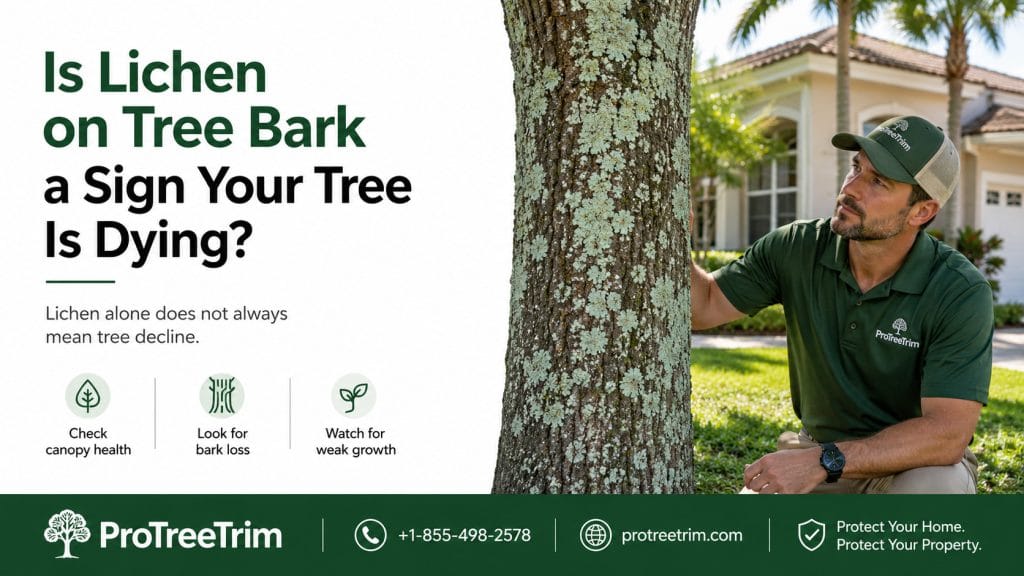
Lichen on tree bark does not usually mean the tree is dying. Those gray, green, white, or crusty patches are often harmless organisms growing on the bark surface. The part homeowners should pay attention to is not the lichen itself, but whether the tree also has thinning leaves, dead limbs, slow growth, bark wounds, or root problems.
Lichen Is Usually Not the Villain
Lichen is easy to mistake for fungus, mold, or disease. It can look rough, scaly, leafy, powdery, or crust-like on trunks and branches. That appearance makes many homeowners think the tree is being attacked.
UF/IFAS describes lichens as combinations of fungi and algae that are harmless to plants and commonly found on tree trunks and branches. Its guidance is simple: no treatment is needed because lichens are a natural part of tree bark surfaces.
University of Maryland Extension gives similar homeowner guidance, noting that lichen, algae, and mosses grow harmlessly on tree trunks and do not need control. It also notes that lichens are often associated with good air quality and may be easier to see on slower-growing trees.
| What you notice | What it usually means |
|---|---|
| Gray-green patches on bark | Often harmless lichen |
| Lichen on older branches | Common on slower-growing bark |
| Lichen on a full, healthy canopy tree | Usually not a concern by itself |
| Heavy lichen plus thinning canopy | Look for tree stress, not lichen damage |
| Lichen with dead limbs | Check the larger tree condition |
| Lichen near cracks or wounds | The wound matters more than the lichen |
Why Lichen Often Shows Up on Stressed Trees
Here is where homeowners can get confused. Lichen may be harmless, but it is often more visible on trees that are not growing strongly.
UF/IFAS Extension explains that when a tree’s health is compromised by age, disease, soil moisture changes, construction, or other stress, growth may slow. Lichen keeps growing at its own pace, so it may become more noticeable on bark as the tree declines for unrelated reasons.
That does not mean lichen caused the decline. It means lichen can draw your eye to a tree that deserves a broader check.
Look at the canopy. Is it thinning? Are dead branches appearing at the top? Has one side stopped leafing out normally? Are limbs dropping after storms? Then look at the base. Are roots exposed, buried, or lifting soil? Is mulch piled against the trunk? Is water collecting after rain or irrigation?
A tree covered in lichen but otherwise full, stable, and growing may not need any action. A tree with lichen, dead limbs, trunk cracks, mushrooms near the base, or a new lean is a different conversation.
What Homeowners Should Not Do
Do not scrape lichen off the bark. Removing it can injure bark and create wounds where none were needed. Do not spray randomly, either. If the tree is stressed, the answer is usually not “kill the lichen.” It is to understand why the tree is growing slowly, thinning, or declining.
Instead, take photos from a few angles:
- full tree and canopy
- lichen-covered trunk or branches
- trunk base and root flare
- dead limbs or thinning areas
- nearby driveway, pavers, pool cage, irrigation, or drainage issues
- any bark wounds, cracks, or mushrooms
Those photos help you separate a cosmetic bark surface issue from a real tree-health or property-risk issue.
If you are unsure whether lichen is simply growing on the bark or showing up on a tree that is already stressed, ProTreeTrim can help connect homeowners with local tree service support. Call +1-855-498-2578 or visit protreetrim.com.
FAQs
Should I remove lichen from my tree?
Usually no. Lichen is generally harmless, and scraping it off can damage the bark.
Does lichen mean my tree is sick?
Not by itself. Lichen can grow on healthy trees, but heavy growth may be easier to notice when a tree is growing slowly or the canopy is thinning.
Can lichen kill tree branches?
No. Lichen grows on the bark surface and does not feed on the tree the way a parasite would. Look for other causes if branches are dying.
When should I worry about lichen on bark?
Worry more if the tree also has dead limbs, thinning canopy, trunk cracks, mushrooms, soft wood, root movement, or a new lean.
ProTreeTrim™ can help you take the next step.
If you are dealing with a damaged tree, fallen branch, stump, root issue, palm concern, or storm cleanup question in Florida, call ProTreeTrim for tree service support.