
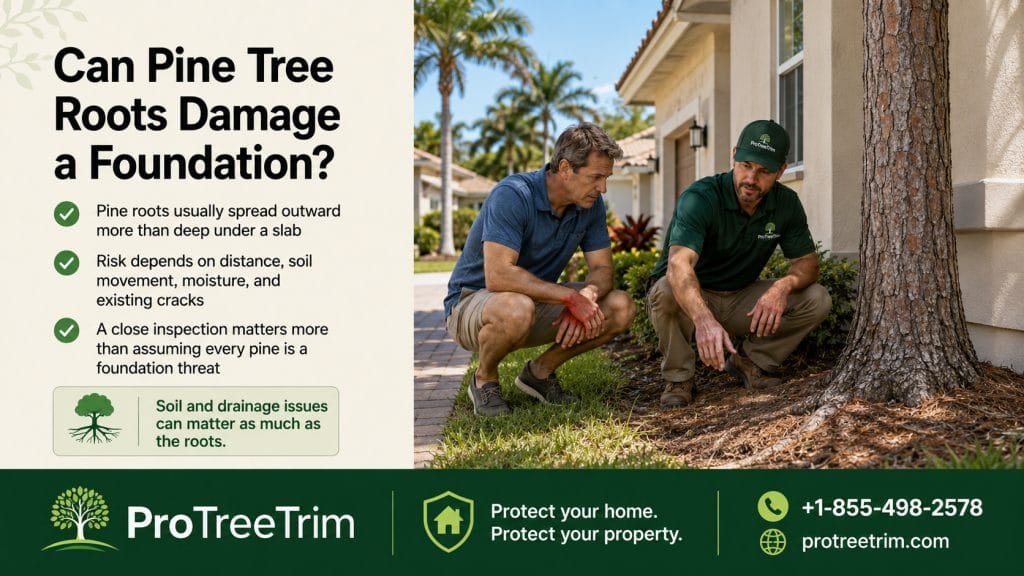
Pine tree roots can create problems near homes, but they usually do not “attack” or break a sound foundation by force. Most foundation issues involve a mix of soil movement, drainage, existing cracks, construction conditions, moisture changes, and tree placement.
That does not mean pine roots should be ignored. A large pine planted too close to a house can create root, drainage, driveway, walkway, roofline, and storm-risk concerns over time. The real question is not simply “Can pine roots damage my foundation?” It is “Is this pine too close to the house, and are there signs of soil, root, or structural conflict?”
Pine Roots Usually Follow Moisture and Oxygen
Tree roots grow where conditions support them. They need oxygen, moisture, and available soil space. Pine roots often spread outward through the upper soil layers rather than growing straight down like a deep anchor.
Roots may grow toward:
- moist soil
- loose soil
- cracks or gaps in hardscape
- drainage areas
- irrigation leaks
- foundation-side planting beds
- downspout discharge zones
- compacted areas where oxygen is still available near the surface
Roots are opportunistic. They usually follow favorable conditions rather than drilling through solid materials.
Roots May Exploit Existing Weaknesses
A common misunderstanding is that roots break strong foundations directly. More often, roots may enter existing cracks, gaps, drainage paths, or disturbed soil areas if moisture and space are available.
Pine roots may become part of a problem when:
| Condition | Why it matters |
|---|---|
| Existing foundation cracks | Roots may follow openings or moisture |
| Poor drainage near the house | Moisture patterns may draw roots closer |
| Soil shrink-swell movement | Foundation stress may come from soil changes |
| Downspouts discharge near roots | Water encourages root growth near the wall |
| Foundation-side planting beds stay wet | Root activity may increase in that zone |
| Walkway or patio cracks exist | Roots may worsen nearby hardscape movement |
| Tree is very close to the home | Canopy, roots, and maintenance conflicts overlap |
The root is often not the only cause. It may be one factor in a larger site problem.
Distance From the House Matters
A small pine far from the house is usually a different concern than a mature pine growing close to the wall, driveway, patio, or roofline. The closer the trunk is to the structure, the more carefully the situation should be watched.
Ask:
- How close is the trunk to the foundation?
- Is the pine mature or still growing rapidly?
- Are roots visible near the house?
- Is the soil washing away near the wall?
- Are sidewalks, pavers, or driveway edges lifting?
- Do branches touch the roof or gutters?
- Is the pine leaning toward the house?
- Are there cracks, drainage problems, or wet areas near the foundation?
The foundation question should be evaluated along with the whole tree and yard layout.
Visible Roots Near the House Are Not Automatic Foundation Damage
Seeing pine roots near the house can be alarming, but visible roots do not automatically mean the foundation is being damaged. Many roots grow near the surface, especially in compacted or shallow soil.
Visible roots become more concerning when they appear with:
- new or widening cracks in hardscape
- soil pulling away from the foundation
- water pooling near the wall
- lifted walkway or driveway sections
- roots pressing against patio or paver edges
- tree lean toward the house
- dead branches over the roof
- trunk cracks or root decay signs
A root by itself is a clue. A root plus structural or drainage symptoms deserves closer attention.
Drainage Is Often the Bigger Issue
Poor drainage near the house can create more trouble than the roots alone. Water collecting near the foundation can affect soil movement, encourage root growth, and contribute to moisture problems.
Check for:
- downspouts emptying near the pine
- gutters overflowing near the foundation
- water pooling after rain
- soil erosion around roots
- mulch piled against the wall
- planting beds sloping toward the house
- irrigation spraying the foundation area
- wet soil that stays soggy
Fixing drainage may reduce root attraction and protect the home better than cutting roots blindly.
Do Not Cut Pine Roots Near the Foundation Without Evaluation
Cutting roots may seem like the simplest way to protect the foundation. But cutting large pine roots near the trunk or near the house can harm the tree and may affect stability.
Root cutting is especially risky when:
| Root situation | Why caution matters |
|---|---|
| Root is large | It may support tree health or stability |
| Root is close to the trunk | Stability risk increases |
| Several roots would be cut | Tree stress increases |
| Pine leans toward the house | Root loss may worsen risk |
| Soil is wet or loose | Anchoring matters more |
| Tree has dead top or thinning canopy | Pine may already be stressed |
| Roots run under hardscape | Repair and tree stability overlap |
A root problem should be evaluated before cutting. A weakened pine near a home can become a larger concern than the original root.
Pine Roots and Slab Foundations
With slab foundations, homeowners may notice cracks in nearby patios, walkways, driveways, or floor areas and blame the tree. Sometimes roots are involved. Sometimes soil movement, drainage, settlement, or construction conditions are the larger issue.
Near slab homes, check:
- drainage around the slab
- root distance from the slab edge
- cracks in patios or walkways
- irrigation leaks
- soil erosion
- settling around the home
- tree lean
- canopy health
If there are signs of actual foundation movement, a structural or foundation professional may be needed. A tree service can help with the tree side, but foundation diagnosis should not be guessed from roots alone.
Pine Roots and Basement Walls
In homes with basements or below-grade walls, roots may follow moisture near cracks, drains, or wet soil. They are more likely to exploit existing openings than push through sound walls.
Be more cautious if you see:
- water intrusion
- roots near cracks
- damp soil against the wall
- drainage failures
- foundation-side trees planted tightly
- root growth near old utility penetrations
- cracks widening over time
If water is entering the home, drainage and foundation evaluation should come before assuming the pine is the only problem.
Pine Roots Near Driveways and Walkways
Even if pine roots are not damaging the foundation, they may affect hardscape near the house. Driveways, sidewalks, entry walks, and patio pavers are often more vulnerable than the foundation itself.
Pine roots may contribute to:
- lifted sidewalk panels
- cracked driveway edges
- uneven pavers
- raised patio sections
- drainage changes near the house
- trip hazards near entries
- mowing difficulty around surface roots
These issues are real property conflicts, even if the foundation remains sound.
Branches and Rooflines May Be a Bigger Immediate Concern
A pine close enough to raise foundation concerns may also be close enough to affect the roof. Pine needles, cones, dead branches, and overhanging limbs can create maintenance issues.
Check whether the pine has:
- branches touching roof shingles
- limbs over gutters
- dead branches over the house
- pine needles collecting in roof valleys
- cones dropping on roof or driveway
- branches near service lines
- canopy leaning toward the structure
Sometimes the above-ground risk is more urgent than the root question.
Pine Trees Near Houses Can Be Storm Concerns
Pines can be tall, and location matters. A pine near a house, driveway, or neighbor property should be watched for stability and canopy health. Root damage, saturated soil, lean, dead tops, and trunk defects can all affect risk.
Be more cautious if the pine has:
| Warning sign | Why it matters |
|---|---|
| New lean toward the house | Stability concern |
| Soil lifting near roots | Root movement may be occurring |
| Dead top | Serious decline or breakage concern |
| Large dead limbs | Falling-branch risk |
| Bark holes or sawdust-like material | Pest or decay concern |
| Mushrooms near base | Decay or moisture concern |
| Trunk crack | Structural issue may exist |
| Recent root cutting | Stability may be reduced |
A pine near a house should be evaluated as a whole tree, not only as a root system.
Can Pine Roots Grow Into Pipes?
Pine roots may grow toward leaking or damaged pipes because moisture and nutrients are attractive. Roots usually do not break intact pipes by force, but they can enter existing cracks, joints, or weak points.
Root-pipe concerns are more likely when:
- pipes are old or damaged
- leaks are present
- soil stays wet
- roots are already near utility paths
- sewer or drain lines have cracks
- the tree is planted close to the utility route
If pipe issues exist, plumbing or utility inspection may be needed along with tree evaluation.
Foundation Cracks Need Proper Diagnosis
If you see foundation cracks, sticking doors, uneven floors, wall movement, or water intrusion, do not assume the pine tree is the only cause. Foundation issues can involve soil, drainage, construction, settlement, moisture, and structural conditions.
A tree service can help answer:
- Is the tree too close to the home?
- Are roots visible near hardscape?
- Is the tree leaning or declining?
- Would root cutting be risky?
- Is removal safer than pruning?
- Are branches creating roof or storm concerns?
A foundation professional may be needed to answer:
- Is the foundation moving?
- Are cracks structural or cosmetic?
- Is drainage affecting the foundation?
- Is repair needed?
- Are roots actually involved?
Both sides may matter.
Should You Remove a Pine Near the Foundation?
Not automatically. A healthy pine near a house may be manageable if it has enough space, the roots are not creating hardscape conflict, drainage is good, branches are maintained, and there are no stability concerns.
Removal may need discussion when:
- the pine is very close to the house
- roots are lifting walkways, driveway, or patio near the foundation
- branches hang over the roof
- the tree leans toward the home
- the top is dead or declining
- trunk defects are visible
- root cutting would be required for repairs
- drainage or access problems keep recurring
- the tree is too large for the site
The decision should be based on risk, condition, and placement—not fear alone.
What About Cutting the Pine Down but Leaving the Stump?
If a pine is removed because of foundation or hardscape concerns, leaving the stump may still create a yard issue. The stump can interfere with grading, pavers, replanting, lawn repair, or future access.
Stump grinding may help when:
- the stump is close to a walkway
- the stump affects lawn use
- the area needs regrading
- roots or stump create trip hazards
- the tree was removed from a front yard
- replanting or sod is planned
Grinding the stump will not instantly remove every root underground, but it can improve surface restoration.
Replanting Near the House
If a pine is removed, do not replace it with another large tree too close to the same foundation area. The replacement should fit the mature space.
Before replanting, consider:
- mature height
- mature root spread
- distance from foundation
- distance from driveway and walkways
- roofline clearance
- overhead utilities
- drainage
- maintenance access
- future pruning needs
The best time to prevent root conflict is before planting.
What Homeowners Should Photograph
Photos help track whether the pine, roots, or foundation-side yard conditions are changing.
Take photos of:
- full pine and house together
- trunk distance from the foundation
- visible roots near the house
- driveway, walkway, or paver damage
- drainage after rain
- downspouts and gutters
- trunk base and root flare
- pine canopy and dead branches
- any lean
- foundation cracks or wall concerns
Photos are useful before calling a tree service, contractor, or foundation professional.
What to Do First
A practical first response:
- Do not cut pine roots immediately.
- Check drainage around the foundation.
- Photograph roots, hardscape, and the whole tree.
- Look for pine lean, dead top, or trunk issues.
- Check whether branches touch the roof.
- Note any driveway, sidewalk, or paver lifting.
- Separate foundation diagnosis from tree diagnosis.
- Get help before root cutting or removal decisions.
A calm inspection is better than a fear-based cut.
Final Homeowner Takeaway
Pine tree roots do not usually break a sound foundation by brute force. But they can contribute to problems when a pine is planted too close to a house, roots follow moisture near existing cracks, drainage is poor, hardscape is lifting, or the tree is large and poorly placed.
Do not cut major pine roots casually. Check drainage, hardscape, tree health, lean, and roofline conflicts first. If there are real foundation symptoms, involve the right foundation or structural professional. If the pine itself is too close, declining, leaning, or creating recurring property conflicts, removal may be worth discussing.
If you are unsure whether pine roots, drainage, driveway lifting, or tree placement are creating a problem near your home, ProTreeTrim can help connect homeowners with local tree service support. Call +1-855-498-2578 or visit protreetrim.com.
FAQs
Can pine tree roots crack a foundation?
Pine roots usually do not break sound foundations by force, but they may exploit existing cracks, moisture paths, or soil problems.
Should I cut pine roots near my house?
Do not cut large pine roots without evaluation. Root cutting can stress the tree or affect stability, especially near the trunk.
How close is too close for a pine tree near a house?
It depends on the pine species, mature size, soil, drainage, and home layout. A large pine close to the house deserves closer monitoring.
Should I remove a pine tree near my foundation?
Not always. Removal may be considered if the pine is too close, leaning, declining, lifting hardscape, touching the roof, or interfering with repairs.
ProTreeTrim™ can help you take the next step.
If you are dealing with a damaged tree, fallen branch, stump, root issue, palm concern, or storm cleanup question in Florida, call ProTreeTrim for tree service support.