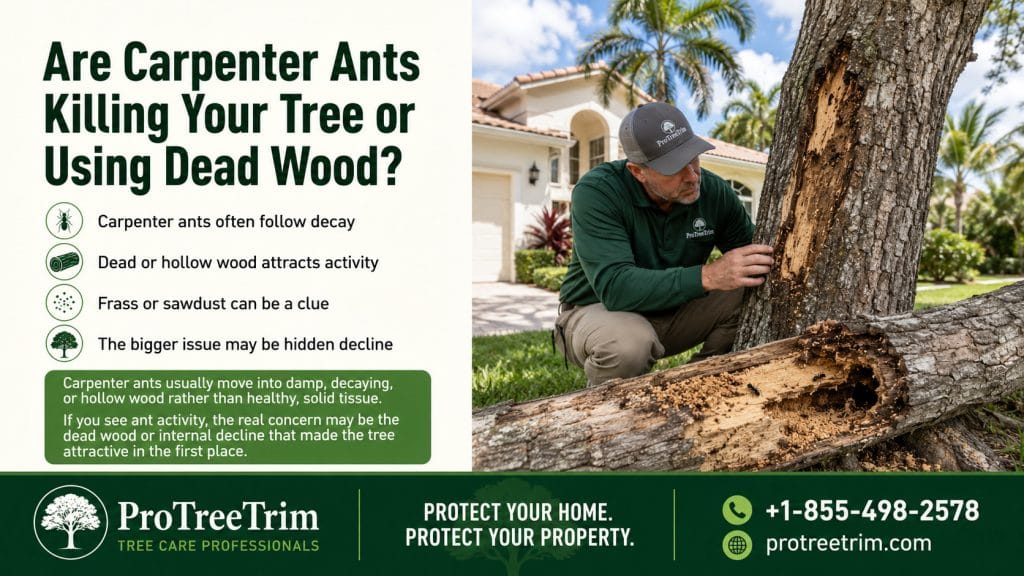
Carpenter ants in a tree usually mean there is already softened, decayed, or damaged wood available. They do not eat wood the way termites do. They excavate galleries for nesting. The bigger homeowner question is not only “How do I kill the ants?” It is “Why was this tree suitable for ants in the first place?”
Carpenter Ants Often Point to an Existing Weak Spot
Seeing large black ants moving in and out of a tree can be unsettling. Add a little sawdust at the base, and it is easy to assume the ants are destroying a healthy tree from the inside.
Often, the story is more complicated. Iowa State University Extension explains that carpenter ants cannot eat wood; they discard sawdust as they chew tunnels and chambers, usually in rotted or decayed wood inside trees. It also notes that carpenter ants are not directly harmful to the tree and are often taking advantage of soft, weak wood already present.
Michigan State University Extension makes the same practical point: trees with carpenter ants are generally already weakened by rot or moisture damage, and seeing many ants does not automatically mean the tree is in immediate decline.
| What you notice | What it may suggest |
|---|---|
| Large ants entering a cavity | Decayed or hollow wood may already exist |
| Sawdust-like material near the trunk | Ants may be excavating galleries |
| Ants around an old pruning wound | The wound may have exposed wood to moisture |
| Ants plus soft or hollow wood | Decay is a bigger concern |
| Ants plus dead limbs above | Tree stress may be spreading |
| Ants on a tree near the house | Also consider whether they are entering structures |
Look for the Condition That Attracted Them
The ants are usually not the first problem. A tree may have become attractive to carpenter ants because of an old storm wound, mower damage, pruning cut, broken limb, fungal decay, moisture pocket, or hollow area.
Start with the trunk. Do you see a cavity, crack, old wound, peeling bark, soft wood, or dark wet area? Then look up. Are branches dying back above the ant activity? Is the canopy thinning on one side? Are large limbs hanging over a roof, driveway, pool cage, fence, or walkway?
North Carolina State Extension notes that carpenter ants expel sawdust and frass through openings and create smooth galleries inside wood. That detail helps explain why the debris on the ground matters, but it does not tell you the tree’s full structural condition by itself.
Do not dig into the trunk, pour chemicals into cavities, or seal the opening just to stop seeing ants. That may hide the evidence without addressing decay, wounds, or limb risk.
When Carpenter Ants Become a Bigger Homeowner Concern
Carpenter ants in an old tree far from the house may be mainly a tree-health and monitoring issue. Carpenter ants in a tree beside a deck, roofline, garage, wood fence, or patio deserve a broader look.
The tree may need attention if there are signs of structural weakness: hollow trunk, trunk crack, mushrooms at the base, large dead limbs, a new lean, or repeated branch drop. The ant activity may be one clue in a larger pattern.
There is also a house-side concern. Carpenter ants can nest in structures when moist or damaged wood is available, and University of Minnesota Extension notes that damage to structural wood can happen slowly over time when colonies are present. If ants are moving from the tree toward the home, deck, window trim, or damp wood, a pest professional may be appropriate in addition to tree review.
What to Do Before Treating or Removing Anything
Take photos first: the full tree, ant activity, sawdust, holes, cavities, trunk base, dead limbs, and nearby structures. Clear the sawdust gently, then check later to see whether it returns. Note whether activity increases after rain, irrigation, or warm weather.
Also write down what may have stressed the tree: storm damage, pruning, construction, trenching, mower injury, drought, overwatering, or soil staying wet around the base.
Do not remove the tree only because ants are present. Also do not ignore the ants if the tree has decay, hollow areas, or heavy limbs over a high-use area. The right decision depends on the tree’s structure, location, and what it could hit if it failed.
If you are unsure whether carpenter ants, decay, trunk wounds, or dead limbs point to a larger tree issue, ProTreeTrim can help connect homeowners with local tree service support. Call +1-855-498-2578 or visit protreetrim.com.
FAQs
Do carpenter ants eat tree wood?
No. Carpenter ants excavate wood to make tunnels and chambers, but they do not eat wood the way termites do.
Do carpenter ants mean my tree is dying?
Not automatically. They often indicate that softened, decayed, or damaged wood is already present, but the tree’s overall condition still needs to be judged separately.
Should I spray carpenter ants in a tree?
Not as the first step. Identify why the ants are there. If the tree has decay, cavities, dead limbs, or structural concerns, spraying alone may not solve the real problem.
When should I worry more?
Worry more if ant activity appears with sawdust, hollow wood, trunk cracks, mushrooms, dead limbs, a new lean, or branches over a roof, driveway, pool cage, fence, or walkway.
ProTreeTrim™ can help you take the next step.
If you are dealing with a damaged tree, fallen branch, stump, root issue, palm concern, or storm cleanup question in Florida, call ProTreeTrim for tree service support.