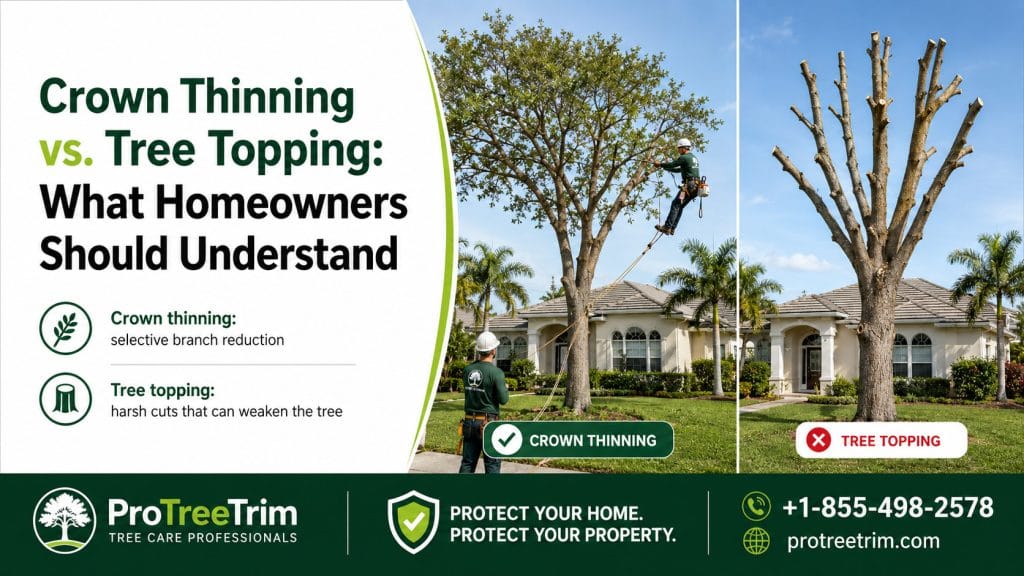
Crown thinning and tree topping are very different. Crown thinning is selective pruning with a purpose. Tree topping is a harsh cutback that removes large parts of the canopy or main branches. If a tree feels too dense, too tall, or too close to the roof, homeowners should understand the difference before approving work.
Crown Thinning Has to Have a Reason
Good pruning is not just cutting until the tree looks lighter. A careful crown thinning job removes selected branches to address a specific issue: deadwood, crowded branches, rubbing limbs, limited clearance, or weight on an overextended branch.
ISA’s TreesAreGood guidance says each pruning cut can change tree growth, so no branch should be removed without a reason. Common reasons include removing dead branches, improving form, increasing safety, and corrective or preventive work.
That point matters in a real yard. A live oak over a driveway, a shade tree near a pool cage, or a branch touching the roof may need targeted work. But thinning should not strip out the inside of the tree or leave long bare limbs with foliage only at the ends. That kind of “lion-tail” look can leave branches poorly balanced.
| Pruning choice | What it usually means |
|---|---|
| Selective crown thinning | Removes specific branches for a reason |
| Deadwood removal | Takes out dead or broken branches |
| Clearance pruning | Creates space from roof, walkway, driveway, or structure |
| Weight reduction | Shortens or reduces a problem limb carefully |
| Topping | Cuts major branches or stems back harshly |
| Hatracking | Leaves few or no leaves on branches |
Topping Looks Fast, Then Causes New Problems
Tree topping may look like a quick solution for a tree that feels too tall. The problem is what happens after the cut.
UF/IFAS explains that topped stems and branches can decay, causing weakness, and the sprouts that grow from those cuts are poorly attached for several years. Miami-Dade’s hurricane tree preparation guidance also tells homeowners never to “top” or “hatrack” trees and not to remove more than 25 percent of the tree canopy for storm preparation.
A topped tree may look smaller at first. Later, it can push out fast upright shoots near the cut ends. Those shoots may create a denser, weaker, harder-to-manage canopy than the one the homeowner was trying to fix.
This is especially important near homes, driveways, fences, pavers, and screen enclosures. A bad pruning job over a pool cage or roofline can leave the tree with future failure points right where you least want them.
Questions to Ask Before the Crew Starts
Before approving crown work, ask for plain-language answers:
- Which branches are being removed?
- What problem does each major cut solve?
- How will the canopy look after the work?
- Will large limbs be lowered or dropped?
- Are there pavers, irrigation lines, septic areas, or pool screens under the work zone?
- Is the crew recommending thinning, reduction, deadwood removal, or topping?
If the answer is only “we’ll cut it way back,” pause. That is not a pruning plan.
Crown thinning can be useful when done carefully. Topping is usually a sign that the real issue has not been addressed: the tree may be too close to the house, poorly structured, storm-damaged, or simply being handled with the wrong approach.
If you are unsure whether a tree needs crown thinning, roofline clearance, limb reduction, or removal planning, ProTreeTrim can help connect homeowners with local tree service support. Call +1-855-498-2578 or visit protreetrim.com.
FAQs
Is crown thinning good for a tree?
It can be when done selectively and for a clear reason. Removing branches without purpose can stress or unbalance the tree.
Is tree topping the same as pruning?
No. Topping is a harsh cutback of major stems or branches and is widely discouraged because it can lead to decay and weak regrowth.
Will topping make a tree safer before storms?
Not necessarily. It may create weak sprouts and large wounds, which can become future problems during wind or rain.
What should I ask instead of “Can you thin it out?”
Ask which limbs are risky, which cuts are needed, how much canopy will be removed, and how nearby property will be protected.
ProTreeTrim™ can help you take the next step.
If you are dealing with a damaged tree, fallen branch, stump, root issue, palm concern, or storm cleanup question in Florida, call ProTreeTrim for tree service support.