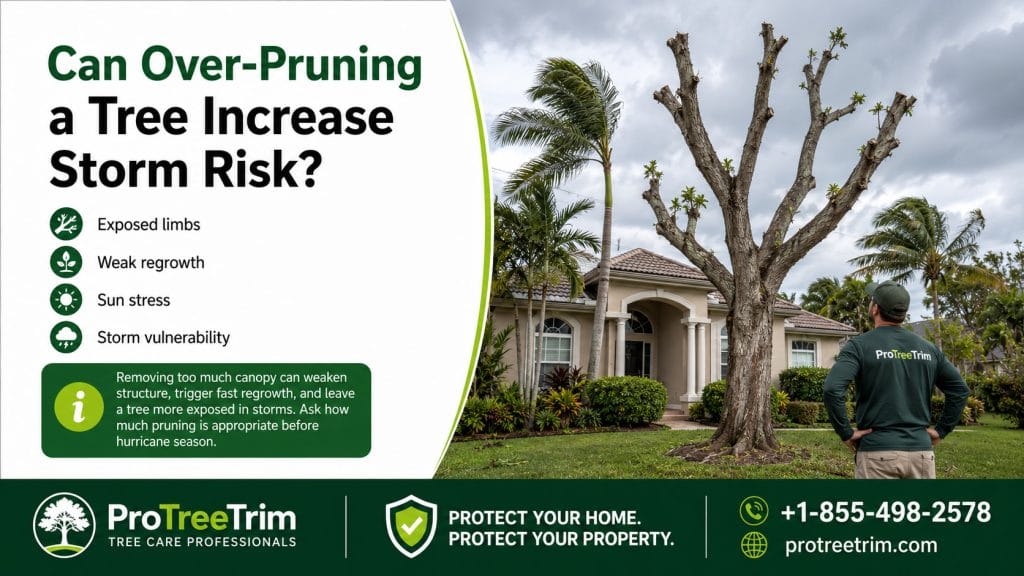
A freshly trimmed tree can look cleaner and safer from the driveway, but that first impression can be misleading. Over-pruning may remove too much live canopy, expose limbs to new stress, encourage weak regrowth, or leave the tree poorly balanced before wind and rain arrive. Good storm prep is selective. It is not stripping the tree down.
Why “More Cutting” Is Not Always Safer
Homeowners often ask for heavy pruning because a tree feels too large near the house, roof, driveway, or pool cage. The concern is fair. Large limbs over structures deserve attention.
The problem is assuming that every extra cut lowers risk.
ISA’s TreesAreGood guidance says each pruning cut can change tree growth and that no branch should be removed without a reason. That principle matters most with mature trees, where careless cuts can create wounds, shift weight, and change future growth patterns.
In storm-prone yards, the goal is usually to reduce specific problems: dead limbs, cracked branches, overextended limbs, weak branch attachments, roof contact, or poor clearance. UF/IFAS notes that structural pruning can reduce later storm damage by shortening or thinning weak, poorly attached, overextended, or overly long branches. That is very different from taking out large amounts of canopy just because the tree looks dense.
| What homeowners may request | Why it can backfire |
|---|---|
| “Take a lot off the top” | Can become topping or harsh reduction |
| “Thin it out as much as possible” | May strip useful interior growth |
| “Make it windproof” | No pruning can guarantee storm performance |
| “Cut all the heavy limbs” | May unbalance the remaining canopy |
| “Remove branches before the storm arrives” | Rushed cuts can leave debris and bad wounds |
| “Clean up the palm for hurricanes” | Palms should not be aggressively hurricane-cut |
The Problem With Stripping the Canopy
Over-pruning often leaves a tree with too much weight at the ends of long limbs, too little interior foliage, or a canopy that no longer distributes wind and weight naturally. In arboriculture, homeowners may hear terms like “lion-tailing” or “over-lifting.” In plain language, that means too many smaller interior or lower branches were removed, leaving long bare limbs with foliage mostly at the tips.
UF/IFAS Miami-Dade Extension warns against lion-tailing and overlifting in hurricane preparation, noting that removing all lower branches can leave too much weight at the top of the canopy. It also states that palms do not need hurricane pruning.
Miami-Dade’s hurricane tree preparation guidance gives homeowners a clear warning: never “top” or “hatrack” a tree, do not cut the root system, and do not remove more than 25 percent of the canopy for storm preparation. It also reminds residents to dispose of cut branches properly because loose branches and stumps can become storm debris.
That last point is easy to overlook. A last-minute pruning job that leaves piles of branches near the curb, fence, or driveway may create a new storm problem instead of solving one.
Watch for Weak Regrowth After Harsh Cuts
One reason over-pruning causes long-term trouble is the regrowth that follows. A severely cut tree may push out fast shoots near pruning wounds. Those shoots can make the tree look lively again, but they may not be as well attached as natural branches.
UF/IFAS notes that water sprouts can be triggered by stress, including topping, over-pruning, improper thinning, storm damage, root damage, drought, and disease. The advice is not simply to remove every sprout; it is to understand what caused the sprouting and correct the underlying problem where possible.
That is especially relevant for trees near roofs, parked vehicles, sidewalks, pool screens, and fences. A tree that was cut hard two years ago may now have dense, upright shoots growing exactly where the homeowner wanted less risk.
Better Questions Before Storm Season
Instead of asking a crew to “cut it back hard,” ask more specific questions:
- Which limbs are actually risky?
- Are there dead, cracked, rubbing, or overextended branches?
- Is the tree being topped, thinned, reduced, or cleaned?
- How much live canopy will be removed?
- Will the remaining canopy be balanced?
- How will limbs be lowered around the roof, pavers, pool cage, irrigation, or fence?
- Will all cut debris be hauled away before storm weather?
A good pruning plan should sound specific. “We need to remove deadwood over the driveway and reduce this overextended limb away from the roofline” is different from “We’ll thin it out a lot.”
If a tree already has a split trunk, lifted roots, decay at the base, a new lean, or large repeated limb failures, pruning may not be enough. That is a different conversation: risk evaluation, removal planning, or staged work.
If you are unsure whether a tree, palm, roofline limb, or overgrown canopy needs careful pruning instead of heavy cutback, ProTreeTrim can help connect homeowners with local tree service support. Call +1-855-498-2578 or visit protreetrim.com.
FAQs
Can over-pruning make a tree weaker?
Yes. Removing too much live canopy can stress the tree, change weight distribution, and encourage weak regrowth.
Is thinning a tree always good before hurricane season?
No. Selective pruning can help, but excessive thinning, topping, lion-tailing, or rushed storm cuts can create new problems.
How much pruning is too much?
It depends on the tree, but Miami-Dade advises homeowners not to remove more than 25 percent of the canopy for hurricane preparation.
Should palms be heavily pruned before storms?
No. Palms generally should not be stripped for hurricane season. Remove dead, broken, or hazardous material carefully, but avoid aggressive hurricane cuts.
ProTreeTrim™ can help you take the next step.
If you are dealing with a damaged tree, fallen branch, stump, root issue, palm concern, or storm cleanup question in Florida, call ProTreeTrim for tree service support.