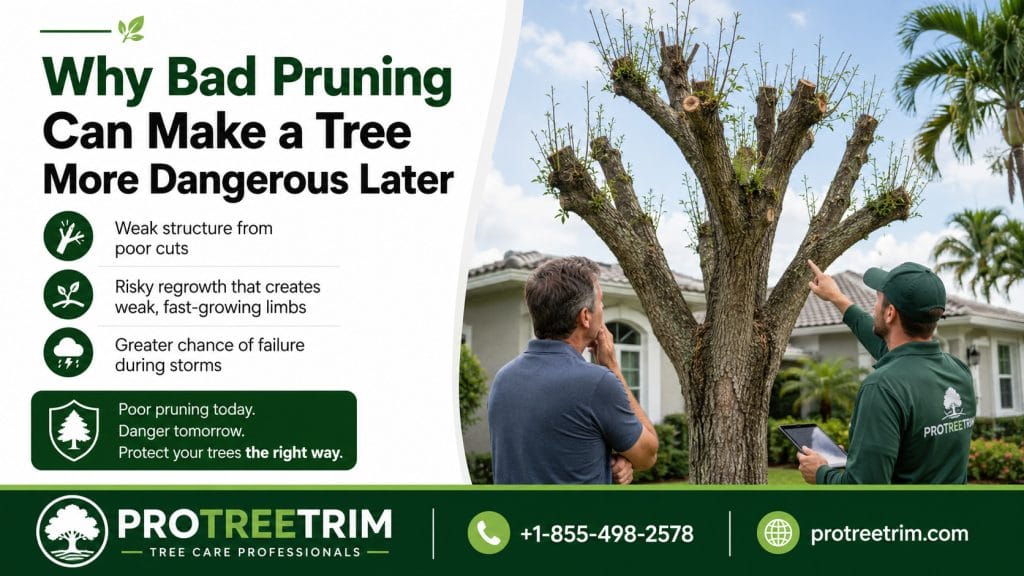
Bad pruning does not always look bad on day one. A tree may look shorter, cleaner, or “opened up” right after the work is done. The real problems often show up later: weak regrowth, large decay-prone cuts, unbalanced limbs, sun-exposed bark, or branches that fail during wind and rain.
A Clean-Looking Cut Is Not Always a Good Cut
Homeowners often approve pruning because a tree feels too tall, too wide, or too close to the roof. Those concerns are real. The mistake is thinking that removing more branches automatically makes the tree safer.
ISA’s TreesAreGood pruning guidance is blunt on the core principle: every cut can change tree growth, so no branch should be removed without a reason. Common reasons include removing dead branches, improving form, and reducing risk—not simply making the tree look smaller.
A bad pruning job may leave the tree with large stubs, torn bark, or cuts made in the wrong place. It may also remove too much living canopy. On mature trees, UF/IFAS notes there should be a very good reason for removing more than 10 percent of live foliage, such as reducing the likelihood of branch failure.
| Bad pruning result | Why it can matter later |
|---|---|
| Large stubs left behind | Can decay instead of closing properly |
| Too much canopy removed | Can stress mature trees |
| Tree topped to reduce height | Encourages weak regrowth |
| Interior stripped heavily | Can leave limbs exposed and unbalanced |
| Wrong limb removed near roof | May shift weight toward the structure |
| Cuts made after storm panic | Creates debris and wounds when conditions are already risky |
Topping Is the Shortcut That Often Backfires
Tree topping is one of the clearest examples of bad pruning. It may make a tree look shorter, but it does not solve the structural issue that made the tree concerning in the first place.
UF/IFAS explains that topped stems and branches can decay, creating weakness, and the sprouts that grow from those cuts are poorly attached for several years. Miami-Dade’s hurricane tree preparation guidance also warns homeowners never to “top” or “hatrack” a tree and advises against removing more than 25 percent of the canopy for storm preparation.
That matters in a real yard. A topped tree near a driveway, roofline, pool cage, fence, or parked vehicle area may look less threatening for a season. Then it pushes out fast new shoots. Those shoots can become long, crowded, and weakly attached, creating a new maintenance and storm-risk problem.
What Good Pruning Should Sound Like
A careful tree crew should be able to explain the purpose of each major cut. You should hear practical reasons, not vague language.
Good explanations sound like:
- “This dead limb over the driveway should be removed.”
- “This branch is rubbing the roofline and needs clearance.”
- “This limb is overextended, so we would reduce it rather than cut the top off.”
- “This tree has a weak union; pruning may reduce weight, but it may not solve the whole risk.”
- “This palm needs dead fronds and seed pods addressed, not a hurricane cut.”
Be cautious if the explanation is only “we’ll make it smaller,” “we’ll let the wind pass through,” or “we’ll cut it way back so you don’t have to worry.” In Florida, that kind of work can leave a tree vulnerable before the next heavy rain or hurricane-season wind.
If you are unsure whether a tree, palm, roofline limb, or overgrown canopy needs proper pruning instead of a harsh cutback, ProTreeTrim can help connect homeowners with local tree service support. Call +1-855-498-2578 or visit protreetrim.com.
FAQs
Can pruning make a tree more likely to fail?
Yes. Poor pruning can leave weak regrowth, decay-prone wounds, imbalance, or large limbs that are more vulnerable later.
Is topping ever a good way to reduce tree height?
For normal landscape trees, topping is widely discouraged because it can create decay and weakly attached sprouts.
How can I tell if a tree was over-pruned?
Warning signs include very few leaves left, large cut ends, stripped interior branches, sudden sun exposure on bark, or a tree that looks unnaturally bare.
What should I ask before approving pruning?
Ask which branches will be removed, why they are being cut, whether the work affects tree structure, and how the crew will protect roofs, pavers, fences, pool cages, and irrigation.
ProTreeTrim™ can help you take the next step.
If you are dealing with a damaged tree, fallen branch, stump, root issue, palm concern, or storm cleanup question in Florida, call ProTreeTrim for tree service support.