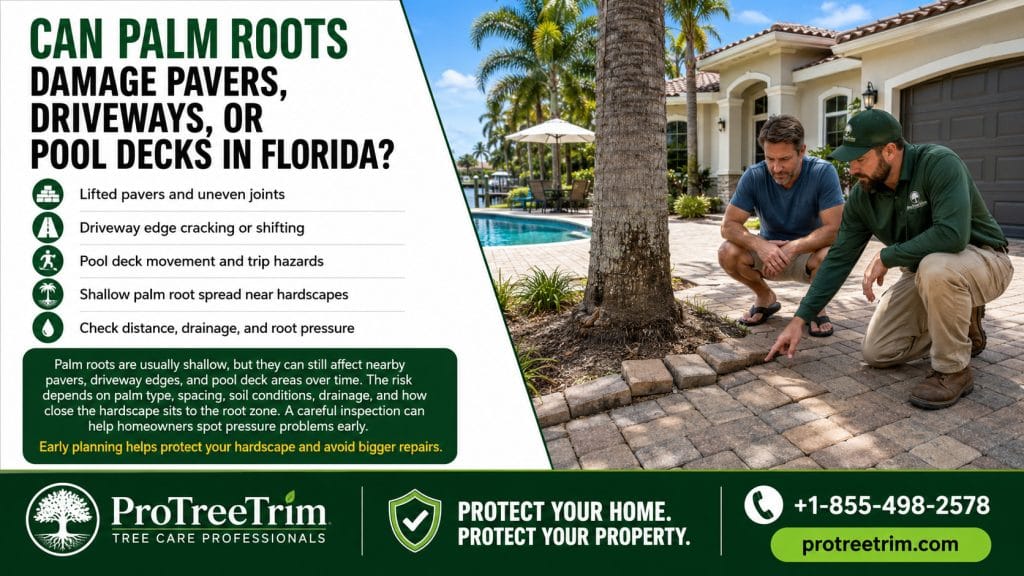
Palm roots are usually different from large shade-tree roots, but they can still create problems in the wrong spot. In Florida yards, palms planted close to pavers, driveways, pool decks, irrigation, or screen enclosures may contribute to lifting, settling, moisture issues, or difficult repairs over time.
Palm Roots Are Different, but Placement Still Matters
Many homeowners hear that palm roots are less aggressive than oak, ficus, or large shade-tree roots. That can be true in a general sense. Palms typically have a dense, fibrous root system rather than a few large woody roots spreading from the trunk.
But “less aggressive” does not mean “no concern.” A palm planted in a tight bed between a driveway and the house still has to grow somewhere. Roots may fill the nearby soil, interfere with irrigation repairs, crowd edging, or make paver work more difficult. If the palm is near a pool deck, the issue may be a combination of roots, sandy soil, water movement, and hardscape settling.
Look at the pattern. One loose paver may simply be a base or installation issue. A raised area that begins near the palm and extends along a patio edge or walkway warrants closer attention.
| What you notice | What it may suggest |
|---|---|
| Pavers lifting near palm base | Roots, settling, or base movement may be involved |
| Pool deck edge feels uneven | Soil and root pressure may be changing support |
| Irrigation repairs near palm keep failing | Roots and shallow lines may be sharing space |
| Soil stays wet around palm | Drainage or sprinkler issues may be contributing |
| Palm trunk very close to hardscape | Future access and repair may be harder |
| Palm stump left beside pavers | Grinding and cleanup need careful planning |
Check Water, Access, and Future Repairs
Before blaming the palm alone, check the moisture. Is a sprinkler head hitting the same area every day? Does rainwater drain toward the palm bed? Is mulch packed against the trunk? Wet soil can make hardscape movement more noticeable and may complicate root issues.
Also, think about future access. If the palm eventually needs trimming, removal, or stump grinding, can a crew reach it without crossing fragile pavers, pool plumbing, screen supports, or narrow side-yard landscaping? A palm that looked perfect when small may become expensive to work around once it crowds the driveway or pool cage.
Do not start cutting roots just to flatten a surface. Even palm roots provide support, and digging too close to the trunk can create new problems. A better approach is to determine whether the issue is root growth, poor drainage, hardscape base failure, or a combination of these.
If you are unsure whether a palm, stump, or root issue near pavers, a driveway, or a pool deck needs professional attention, ProTreeTrim can help connect Florida homeowners with local tree service support. Call +1-855-498-2578 or visit protreetrim.com.
FAQs
Are palm roots as damaging as oak roots?
Usually, they behave differently, but palms can still cause problems when planted too close to hardscape or irrigation.
Can I cut palm roots under pavers?
Be careful. Cutting or digging near the trunk can affect the palm and may not solve the drainage or base issue.
Should I remove a palm because the pavers are lifting?
Not automatically. First, check the root pattern, drainage, irrigation, hardscape base, and how close the palm is to the affected area.
ProTreeTrim™ can help you take the next step.
If you are dealing with a damaged tree, fallen branch, stump, root issue, palm concern, or storm cleanup question in Florida, call ProTreeTrim for tree service support.